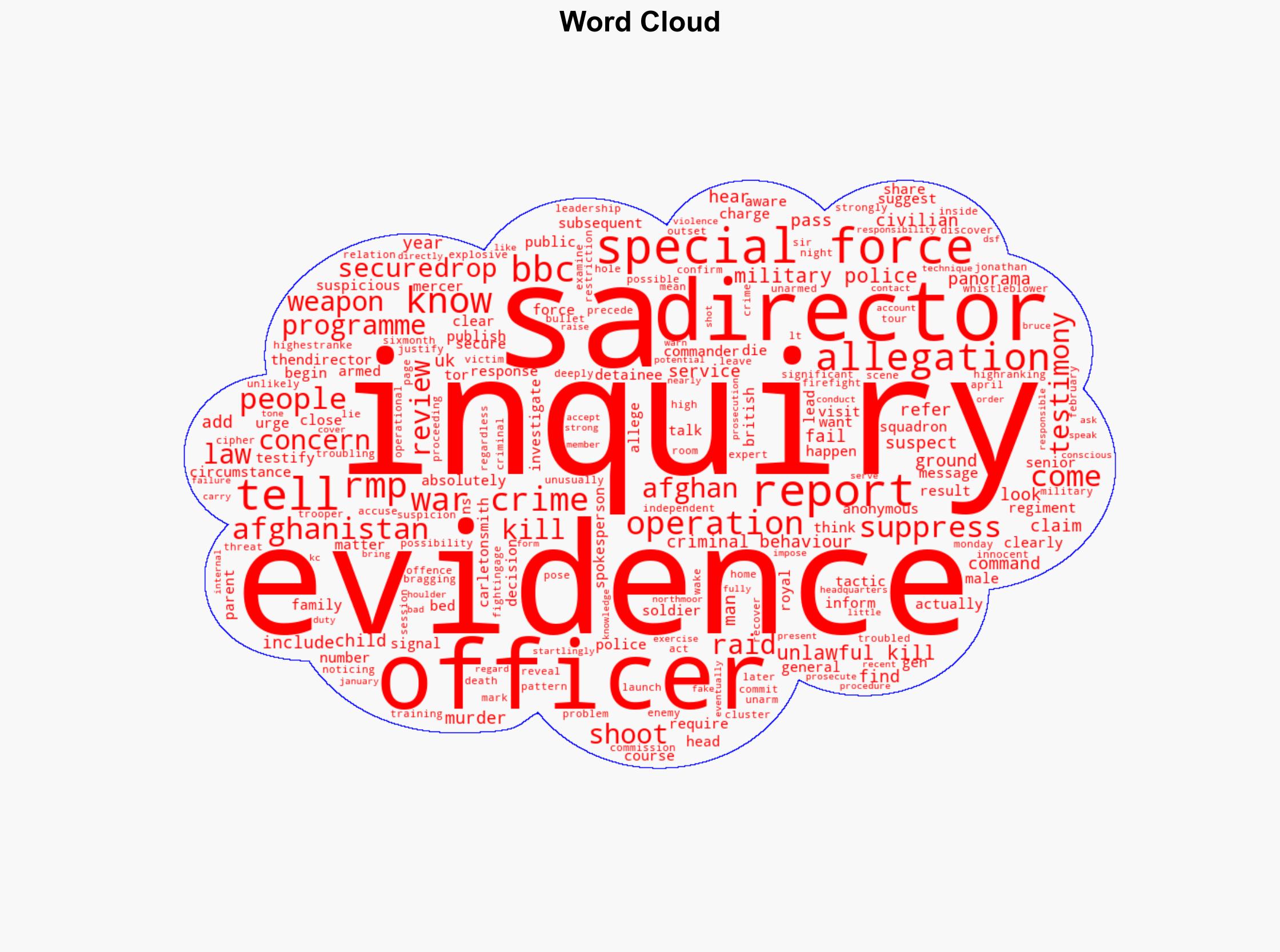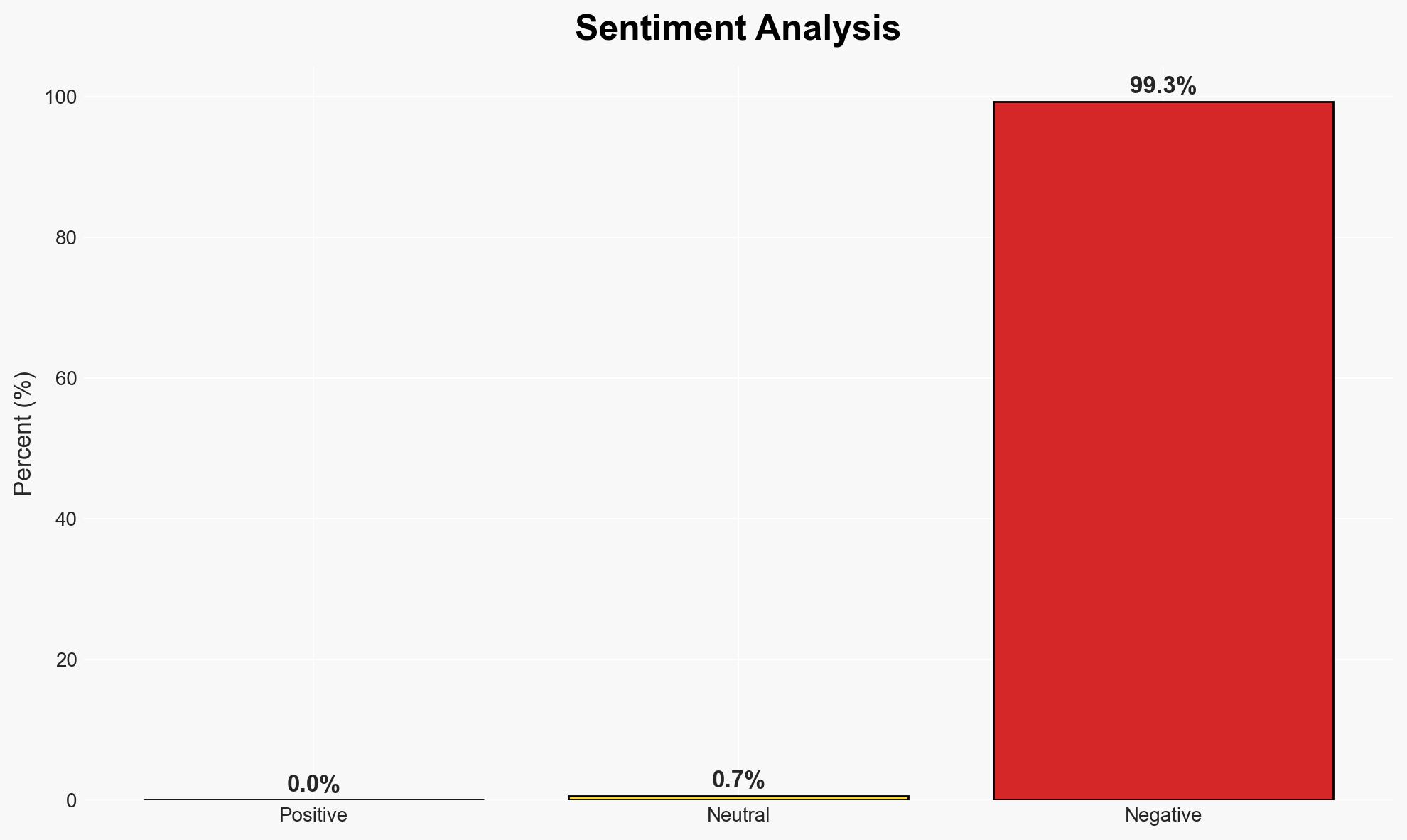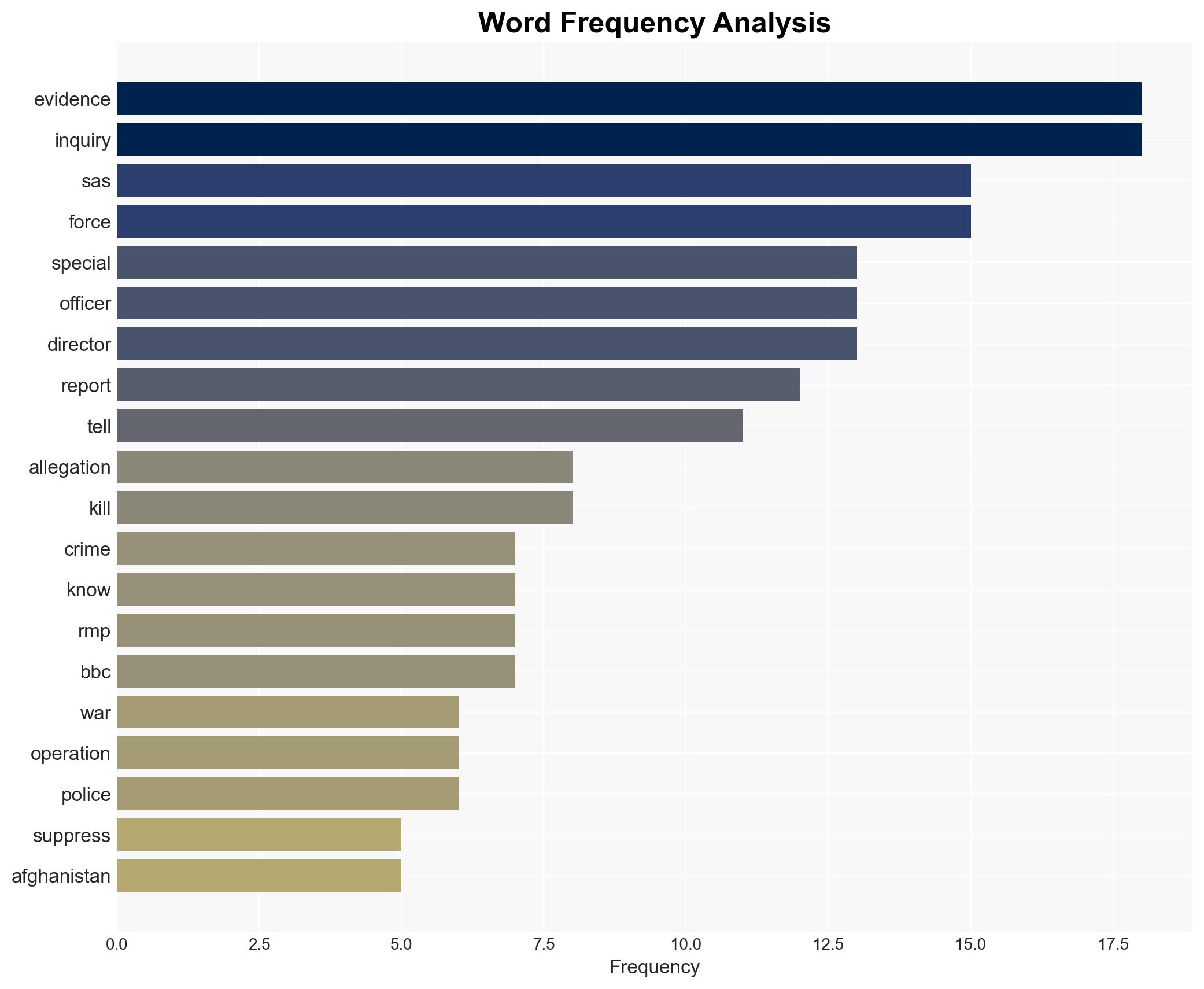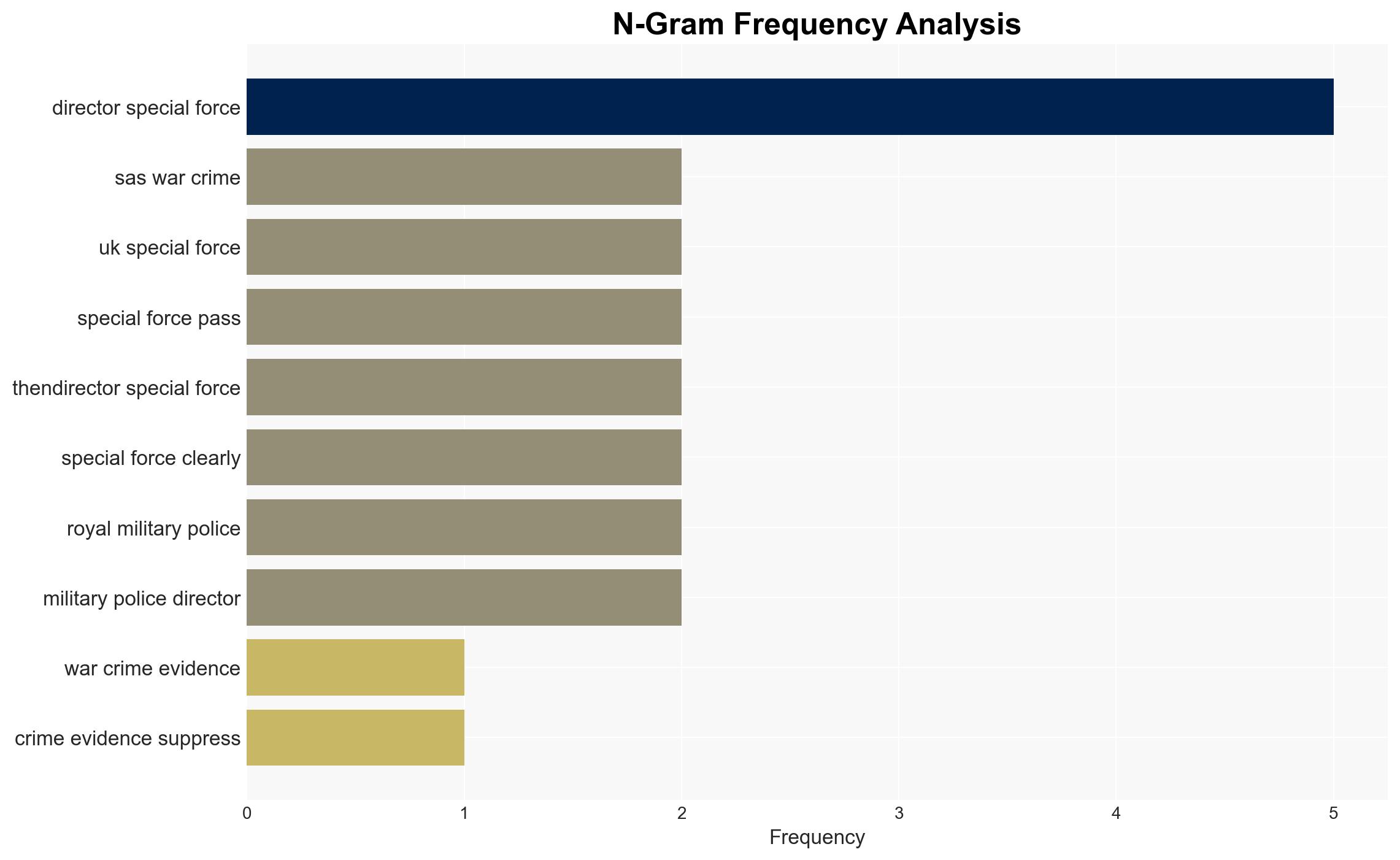
Inquiry reveals suppression of evidence regarding alleged SAS war crimes, raising serious accountability conc…
Published on: 2025-12-01
AI-powered OSINT brief from verified open sources. Automated NLP signal extraction with human verification. See our Methodology and Why WorldWideWatchers.
Intelligence Report: SAS war crime evidence suppressed inquiry hears
1. BLUF (Bottom Line Up Front)
The inquiry into alleged war crimes by the UK Special Air Service (SAS) suggests potential suppression of evidence by high-ranking officers. This could have significant implications for military accountability and international relations. The most likely hypothesis is that there was a deliberate effort to conceal these actions, affecting the credibility of UK military operations. Overall confidence in this assessment is moderate due to limited direct evidence and reliance on testimony.
2. Competing Hypotheses
- Hypothesis A: High-ranking officers in the SAS deliberately suppressed evidence of war crimes to protect the reputation of the unit and its personnel. This is supported by testimony from senior officers and the pattern of unreported incidents. However, the lack of direct evidence and reliance on whistleblower accounts introduce uncertainty.
- Hypothesis B: The suppression of evidence was unintentional, resulting from bureaucratic inefficiencies or miscommunication within the chain of command. This is less supported, as the inquiry highlights specific instances of alleged deliberate actions to withhold information.
- Assessment: Hypothesis A is currently better supported due to the consistency of testimonies and the nature of the allegations. Key indicators that could shift this judgment include the emergence of direct evidence or credible counter-testimonies.
3. Key Assumptions and Red Flags
- Assumptions: The testimonies provided are accurate and reflect the true nature of the events; the inquiry process is unbiased and thorough; the SAS leadership had full knowledge of the alleged incidents.
- Information Gaps: Direct evidence of suppression activities; comprehensive records of internal communications within the SAS; testimonies from lower-ranking personnel involved in the operations.
- Bias & Deception Risks: Potential bias from whistleblowers with personal grievances; manipulation of evidence by involved parties; institutional bias within the military to protect its image.
4. Implications and Strategic Risks
This development could lead to increased scrutiny of UK military operations and affect international partnerships. It may also impact the morale and operational effectiveness of the SAS.
- Political / Geopolitical: Strain on UK relations with Afghanistan and allied nations; potential diplomatic fallout if allegations are substantiated.
- Security / Counter-Terrorism: Possible operational constraints on SAS activities; increased oversight may affect rapid response capabilities.
- Cyber / Information Space: Potential for adversaries to exploit the situation in information operations against the UK.
- Economic / Social: Limited direct economic impact, but potential social unrest if public perception of military integrity is damaged.
5. Recommendations and Outlook
- Immediate Actions (0–30 days): Enhance monitoring of the inquiry process; engage with international partners to manage diplomatic fallout; initiate internal reviews of SAS operations.
- Medium-Term Posture (1–12 months): Develop resilience measures to address potential operational constraints; strengthen oversight mechanisms within military units.
- Scenario Outlook:
- Best: Allegations are disproven, and military credibility is restored.
- Worst: Substantiated allegations lead to international condemnation and operational restrictions.
- Most-Likely: Partial substantiation leads to reforms and increased oversight.
6. Key Individuals and Entities
- General Sir Mark Carleton-Smith
- Lieutenant General Jonathan Page
- Royal Military Police (RMP)
- Not clearly identifiable from open sources in this snippet.
7. Thematic Tags
National Security Threats, military accountability, war crimes, evidence suppression, SAS, UK-Afghanistan relations, military oversight, international diplomacy
Structured Analytic Techniques Applied
- Cognitive Bias Stress Test: Expose and correct potential biases in assessments through red-teaming and structured challenge.
- Bayesian Scenario Modeling: Use probabilistic forecasting for conflict trajectories or escalation likelihood.
- Network Influence Mapping: Map influence relationships to assess actor impact.
Explore more:
National Security Threats Briefs ·
Daily Summary ·
Support us