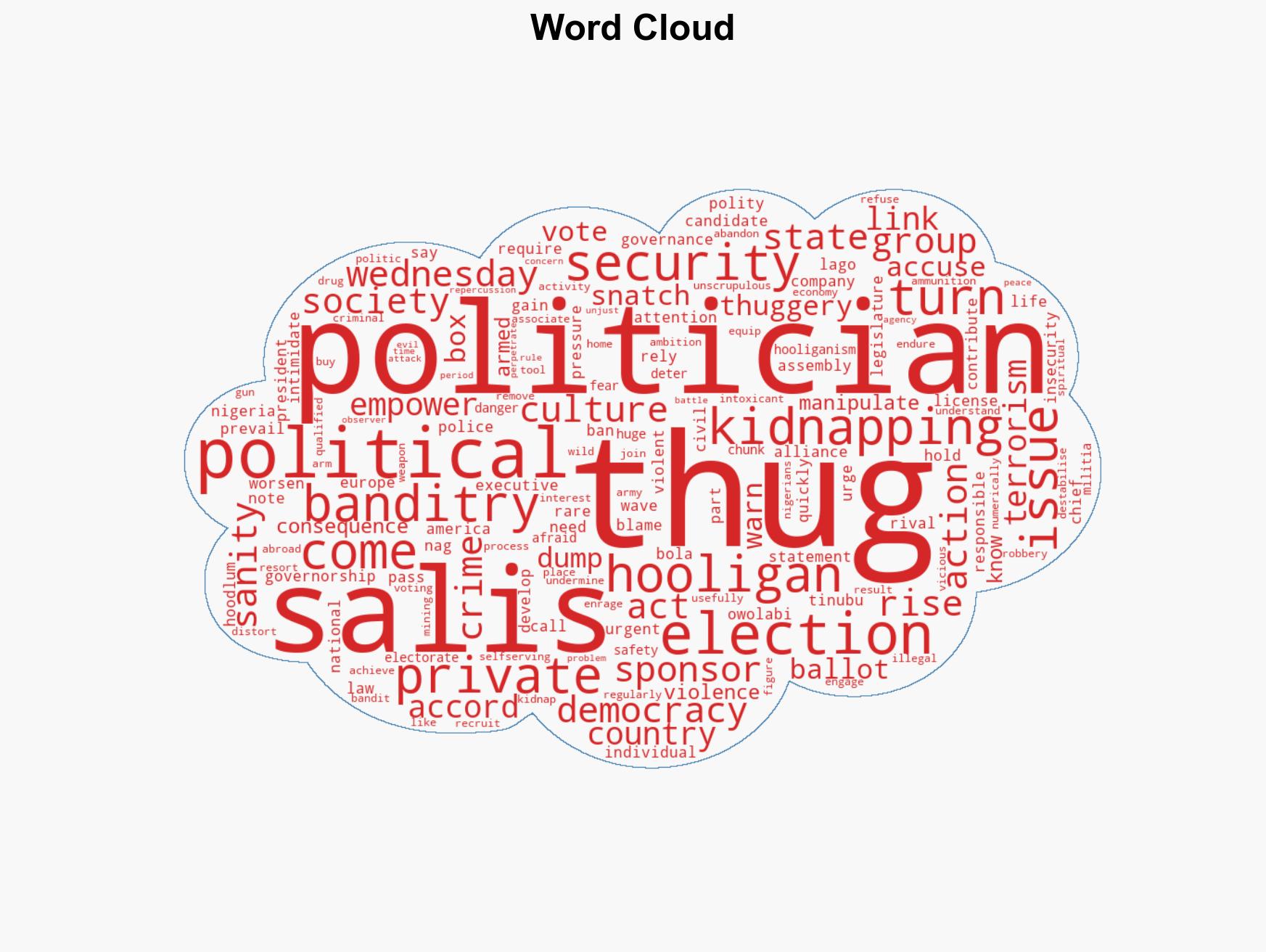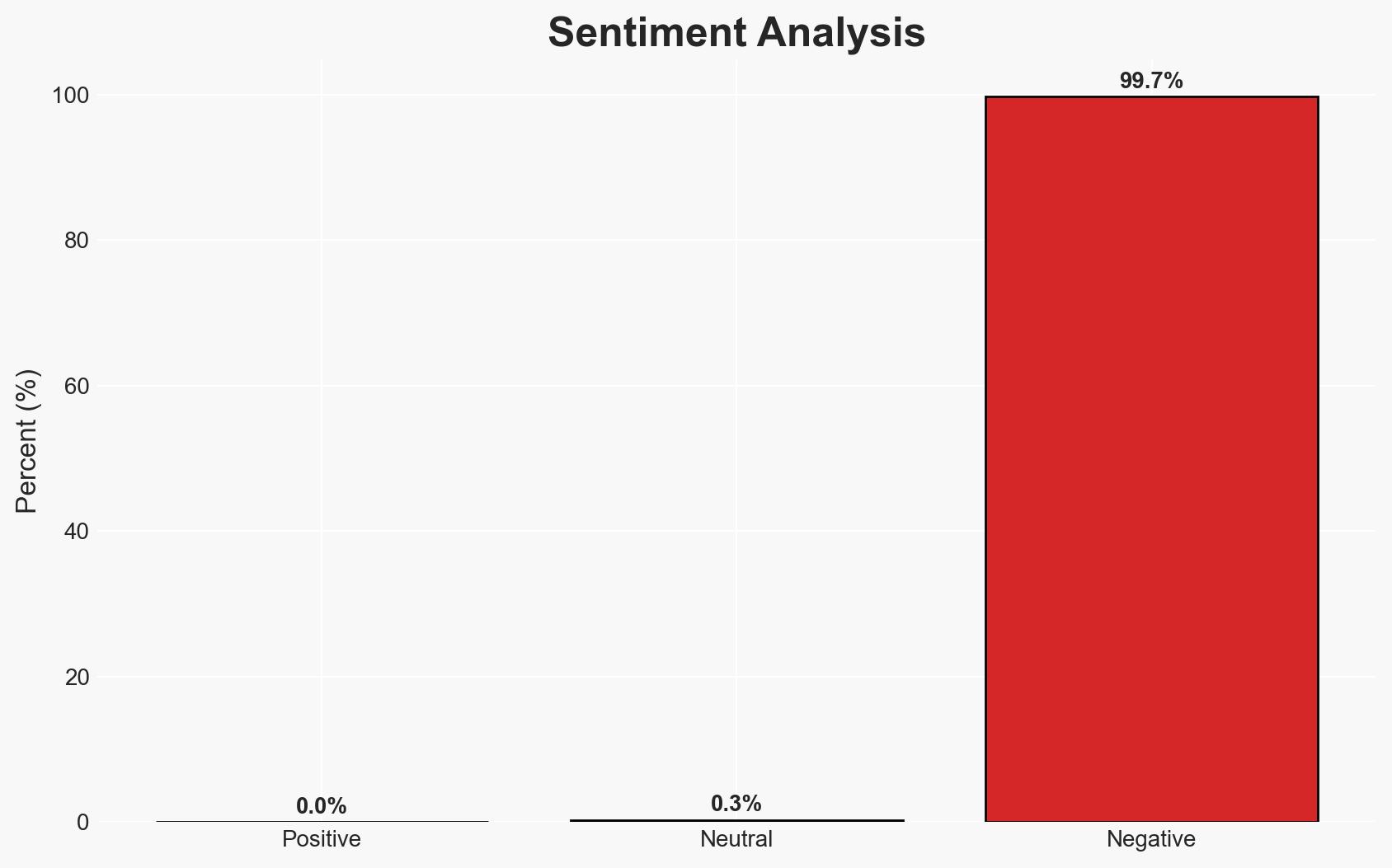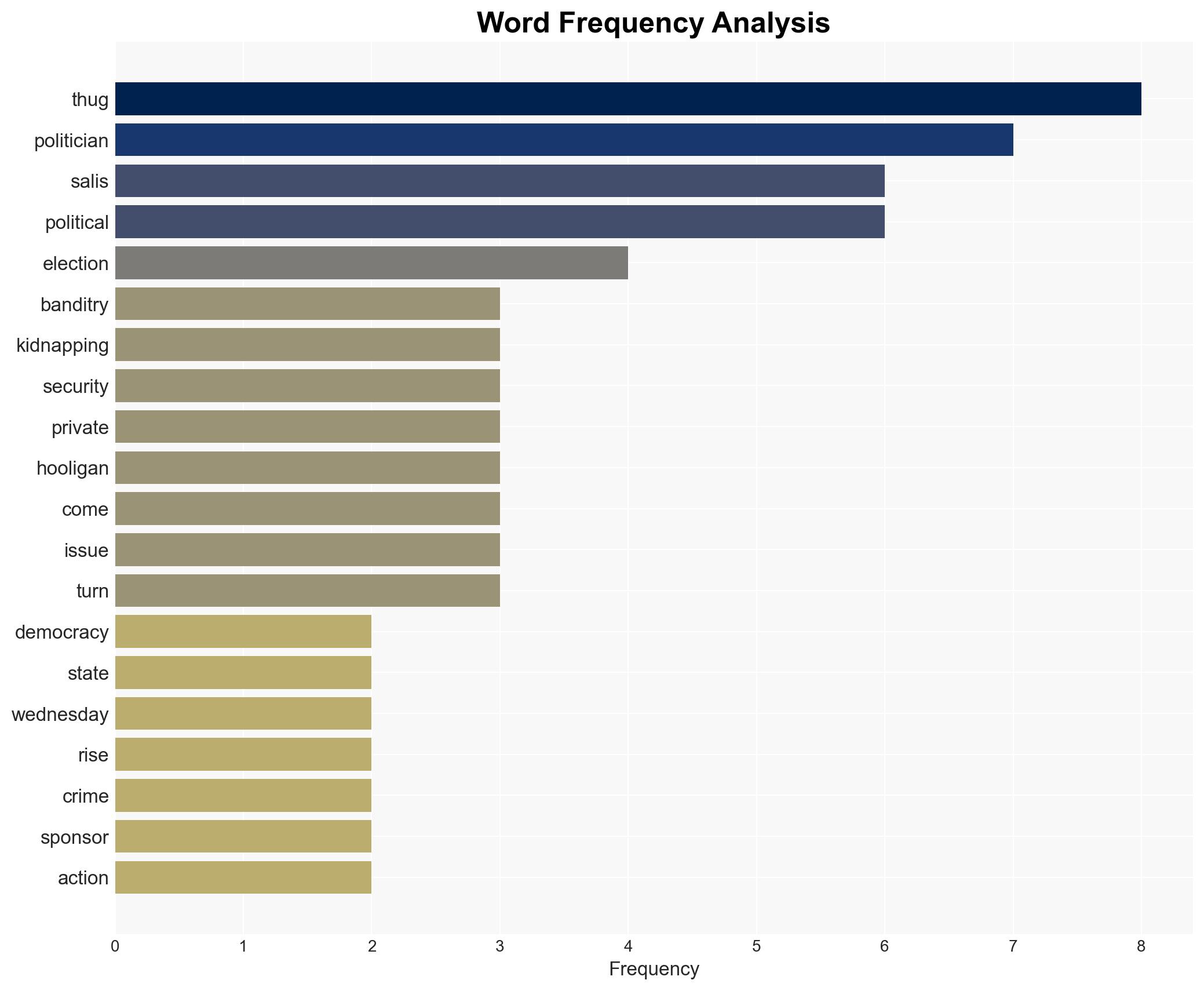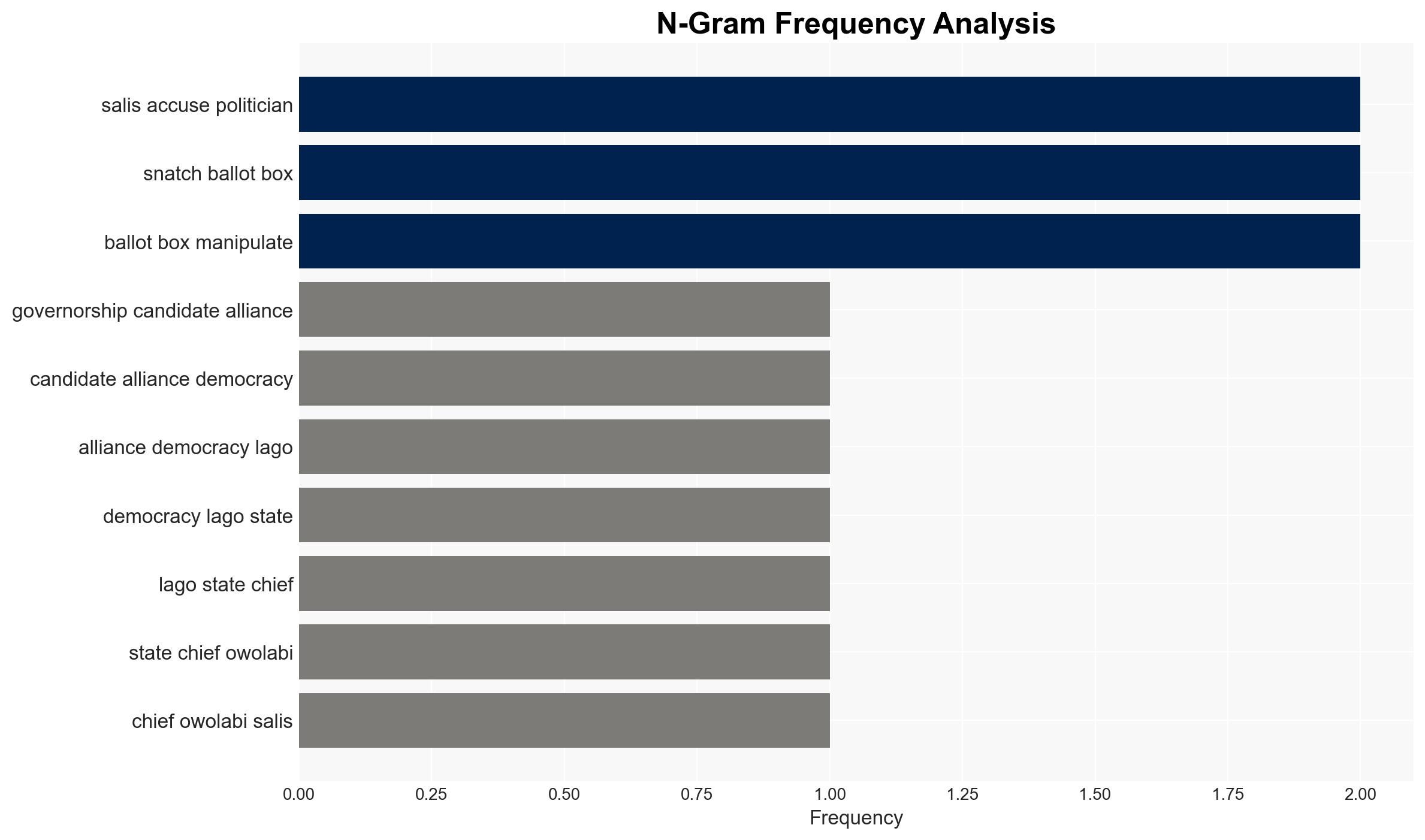

Owolabi Salis accuses politicians of inciting banditry and violence through thug sponsorship.
Published on: 2025-12-03
AI-powered OSINT brief from verified open sources. Automated NLP signal extraction with human verification. See our Methodology and Why WorldWideWatchers.
Intelligence Report: Owolabi Salis blames politicians for fuelling criminality banditry
1. BLUF (Bottom Line Up Front)
Chief Owolabi Salis attributes the rise in banditry and violent crimes in Nigeria to politicians who employ thugs for political gain. The most likely hypothesis is that political thuggery contributes significantly to national insecurity, affecting both political stability and public safety. This assessment is made with moderate confidence due to limited corroborative data and potential bias in the source.
2. Competing Hypotheses
- Hypothesis A: Political thuggery directly contributes to the rise in banditry and violent crimes in Nigeria. Supporting evidence includes Salis’s claims about politicians using thugs for electoral manipulation and subsequent abandonment, leading to criminal activities. Key uncertainties include the lack of independent verification and potential bias in Salis’s statements.
- Hypothesis B: The rise in banditry and violent crimes is primarily due to broader socio-economic factors rather than political thuggery. This explanation considers systemic issues such as poverty, unemployment, and weak law enforcement as primary drivers. Contradicting evidence includes Salis’s specific allegations against political actors, but these lack independent corroboration.
- Assessment: Hypothesis A is currently better supported due to specific allegations made by Salis about the role of political actors in fostering criminality. However, this judgment could shift with new data on socio-economic conditions or independent investigations into political activities.
3. Key Assumptions and Red Flags
- Assumptions: Political actors have significant influence over thuggery; thugs contribute to broader criminal activities; Salis’s statements reflect a widespread issue.
- Information Gaps: Lack of independent verification of Salis’s claims; absence of comprehensive data on the socio-economic drivers of crime in Nigeria.
- Bias & Deception Risks: Potential bias from Salis as a political figure; risk of exaggeration or manipulation to serve political agendas.
4. Implications and Strategic Risks
The continuation of political thuggery could exacerbate national insecurity and undermine democratic processes. This development may interact with broader socio-political dynamics, potentially destabilizing the region further.
- Political / Geopolitical: Potential erosion of democratic institutions and increased political violence.
- Security / Counter-Terrorism: Escalation in criminal activities, complicating counter-terrorism efforts.
- Cyber / Information Space: Possible misinformation campaigns or cyber operations to manipulate public perception.
- Economic / Social: Deterioration of economic stability and social cohesion due to increased crime and insecurity.
5. Recommendations and Outlook
- Immediate Actions (0–30 days): Initiate independent investigations into political thuggery; enhance monitoring of political activities during elections.
- Medium-Term Posture (1–12 months): Develop partnerships with civil society to promote electoral reforms; strengthen law enforcement capabilities.
- Scenario Outlook:
- Best: Successful reforms reduce political thuggery, leading to improved security.
- Worst: Continued political manipulation exacerbates insecurity and undermines governance.
- Most-Likely: Incremental improvements with ongoing challenges due to entrenched political interests.
6. Key Individuals and Entities
- Owolabi Salis – Former governorship candidate, Alliance for Democracy
- President Bola Tinubu – Current President of Nigeria
- National Assembly of Nigeria
7. Thematic Tags
National Security Threats, political violence, electoral integrity, national security, criminal networks, governance reform, socio-economic instability, Nigeria
Structured Analytic Techniques Applied
- Cognitive Bias Stress Test: Expose and correct potential biases in assessments through red-teaming and structured challenge.
- Bayesian Scenario Modeling: Use probabilistic forecasting for conflict trajectories or escalation likelihood.
- Network Influence Mapping: Map relationships between state and non-state actors for impact estimation.
Explore more:
National Security Threats Briefs ·
Daily Summary ·
Support us