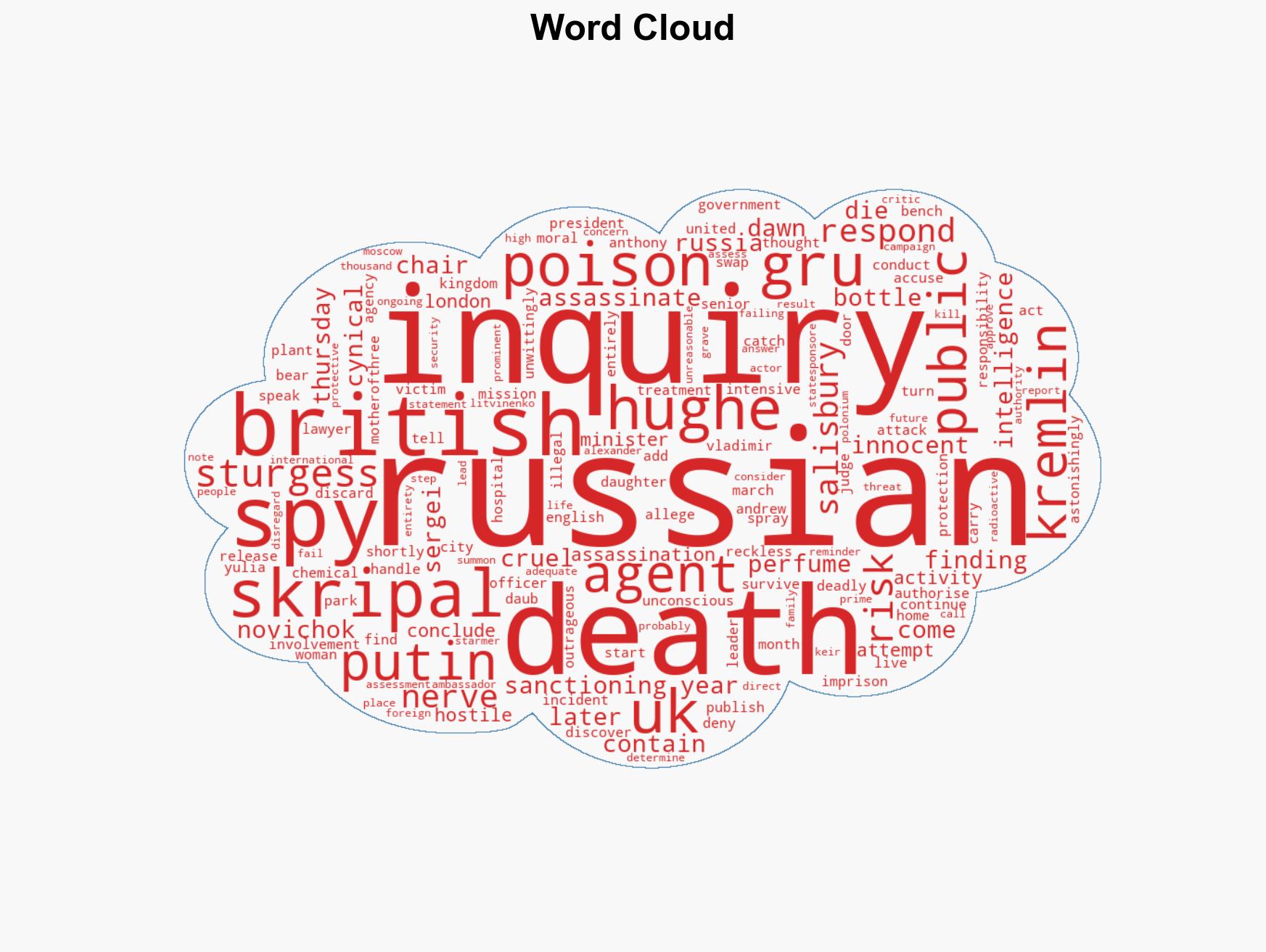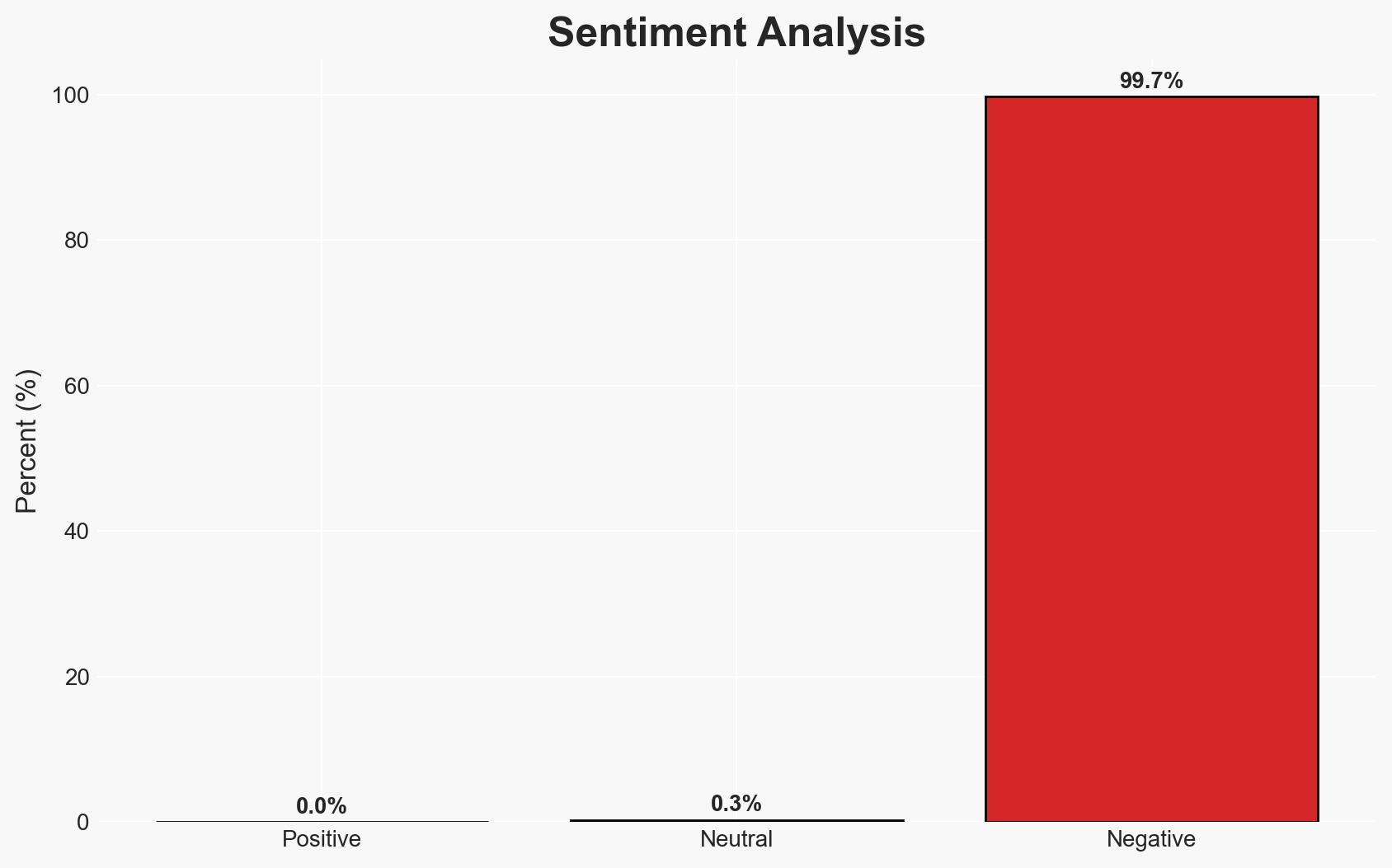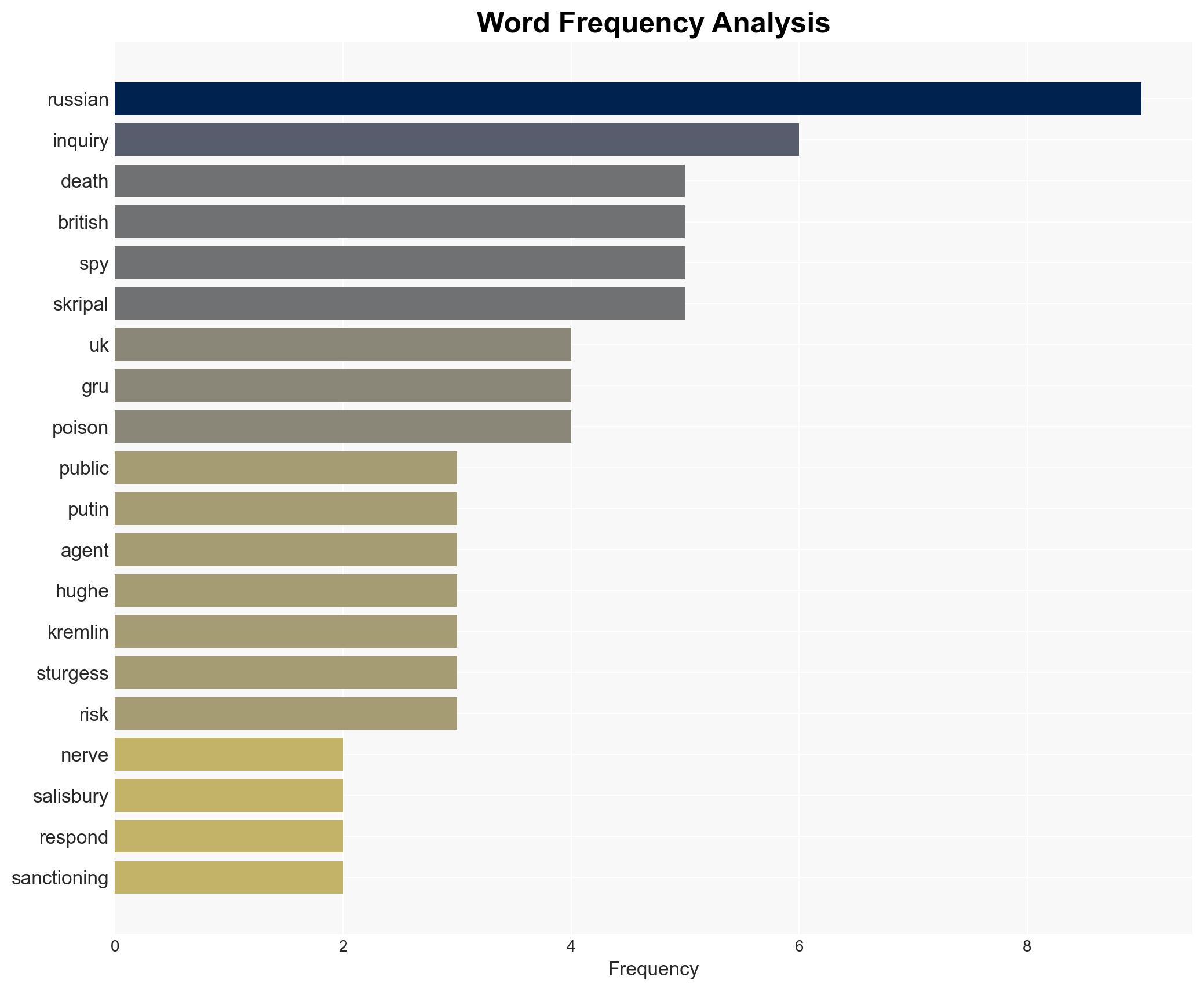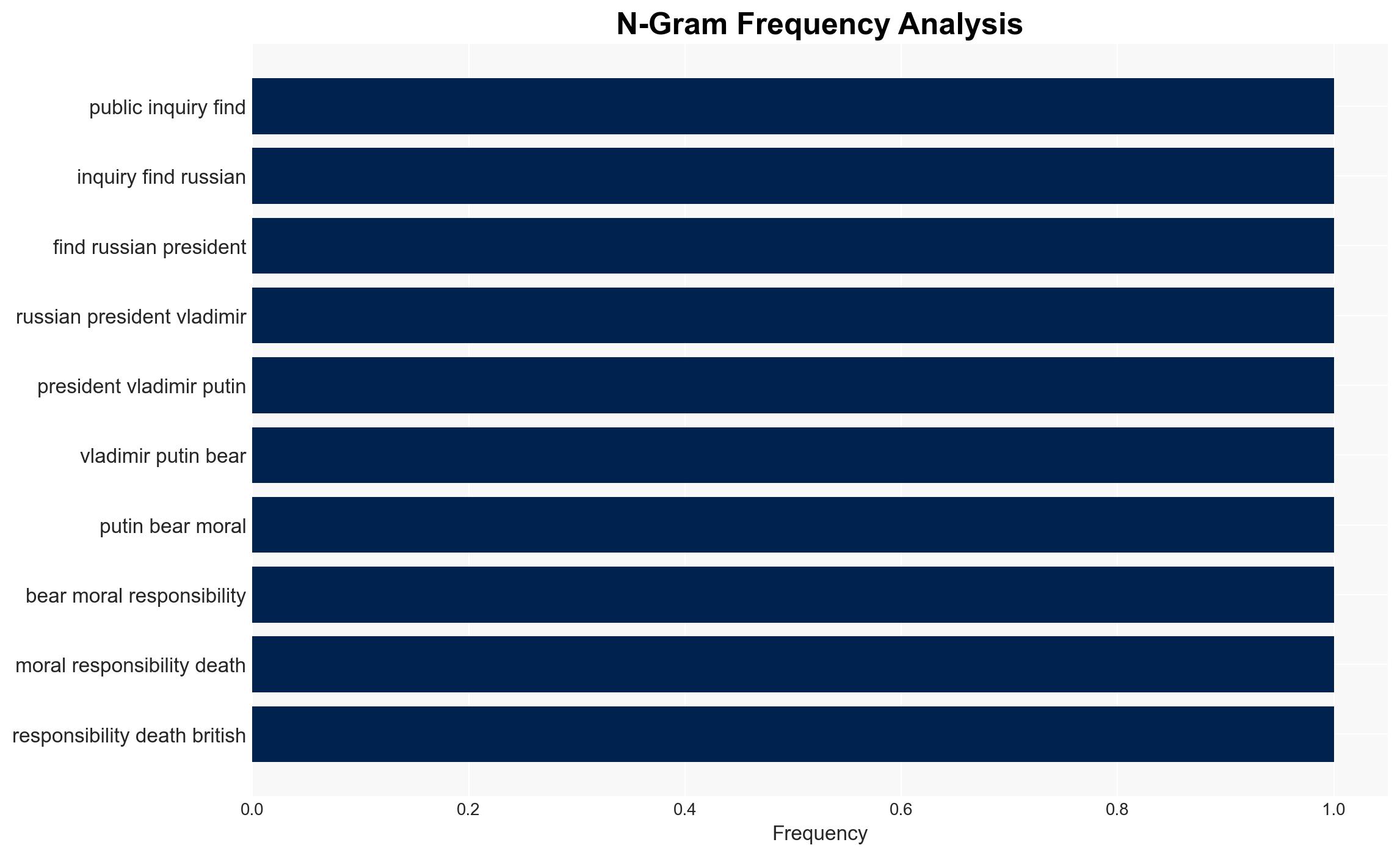

Putin deemed morally accountable for British woman’s death in Salisbury nerve agent attack
Published on: 2025-12-04
AI-powered OSINT brief from verified open sources. Automated NLP signal extraction with human verification. See our Methodology and Why WorldWideWatchers.
Intelligence Report: Russias Putin found morally responsible for nerve agent death in UK
1. BLUF (Bottom Line Up Front)
A UK public inquiry has attributed moral responsibility to Russian President Vladimir Putin for a nerve agent attack in Salisbury, resulting in the death of a British citizen. The UK government has responded with sanctions against the GRU. This situation heightens tensions between the UK and Russia, with moderate confidence in the assessment due to limited direct evidence linking Putin to operational decisions.
2. Competing Hypotheses
- Hypothesis A: The Russian government, under Putin’s directive, orchestrated the nerve agent attack as a targeted assassination of Sergei Skripal. This is supported by the inquiry’s findings and the use of Novichok, a Russian-developed nerve agent. However, direct evidence of Putin’s involvement is lacking, creating uncertainty.
- Hypothesis B: The attack was conducted by rogue elements within the GRU without explicit authorization from the highest levels of the Russian government. This hypothesis is contradicted by the inquiry’s assertion of Putin’s moral responsibility but remains plausible due to the lack of direct evidence of state-level authorization.
- Assessment: Hypothesis A is currently better supported due to the inquiry’s findings and the pattern of similar incidents attributed to Russian state actors. Indicators such as further intelligence disclosures or diplomatic communications could shift this judgment.
3. Key Assumptions and Red Flags
- Assumptions: The GRU operates under direct Kremlin oversight; Novichok is exclusively controlled by Russian state actors; the UK inquiry’s findings are based on reliable intelligence.
- Information Gaps: Direct evidence linking Putin to the operational planning of the attack; comprehensive intelligence on GRU internal operations.
- Bias & Deception Risks: Potential bias in UK inquiry findings due to geopolitical tensions; Russian denial may include elements of deception to obscure state involvement.
4. Implications and Strategic Risks
This development could exacerbate UK-Russia relations, influence NATO’s posture towards Russia, and impact international norms regarding state-sponsored assassinations.
- Political / Geopolitical: Potential for increased diplomatic isolation of Russia and strengthened alliances among Western nations.
- Security / Counter-Terrorism: Heightened threat perception of Russian intelligence operations in Europe; potential for retaliatory actions.
- Cyber / Information Space: Increased likelihood of cyber operations or disinformation campaigns by Russia in response to sanctions.
- Economic / Social: Potential economic impacts from sanctions on Russian entities; public concern over security and intelligence capabilities.
5. Recommendations and Outlook
- Immediate Actions (0–30 days): Enhance monitoring of Russian diplomatic and intelligence activities; increase security measures for individuals at risk.
- Medium-Term Posture (1–12 months): Strengthen international partnerships to counter state-sponsored threats; develop resilience against potential cyber and disinformation campaigns.
- Scenario Outlook:
- Best: Diplomatic resolution and de-escalation of tensions.
- Worst: Escalation leading to broader geopolitical conflict.
- Most-Likely: Continued diplomatic strain with periodic cyber and information operations.
6. Key Individuals and Entities
- Vladimir Putin – President of Russia
- Sergei Skripal – Former Russian spy
- Dawn Sturgess – Victim of the nerve agent attack
- GRU – Russian military intelligence agency
- Anthony Hughes – Chair of the public inquiry
7. Thematic Tags
National Security Threats, counter-terrorism, sanctions, state-sponsored assassination, UK-Russia relations, intelligence operations, international law, geopolitical tensions
Structured Analytic Techniques Applied
- Cognitive Bias Stress Test: Expose and correct potential biases in assessments through red-teaming and structured challenge.
- Bayesian Scenario Modeling: Use probabilistic forecasting for conflict trajectories or escalation likelihood.
- Network Influence Mapping: Map relationships between state and non-state actors for impact estimation.
Explore more:
National Security Threats Briefs ·
Daily Summary ·
Support us