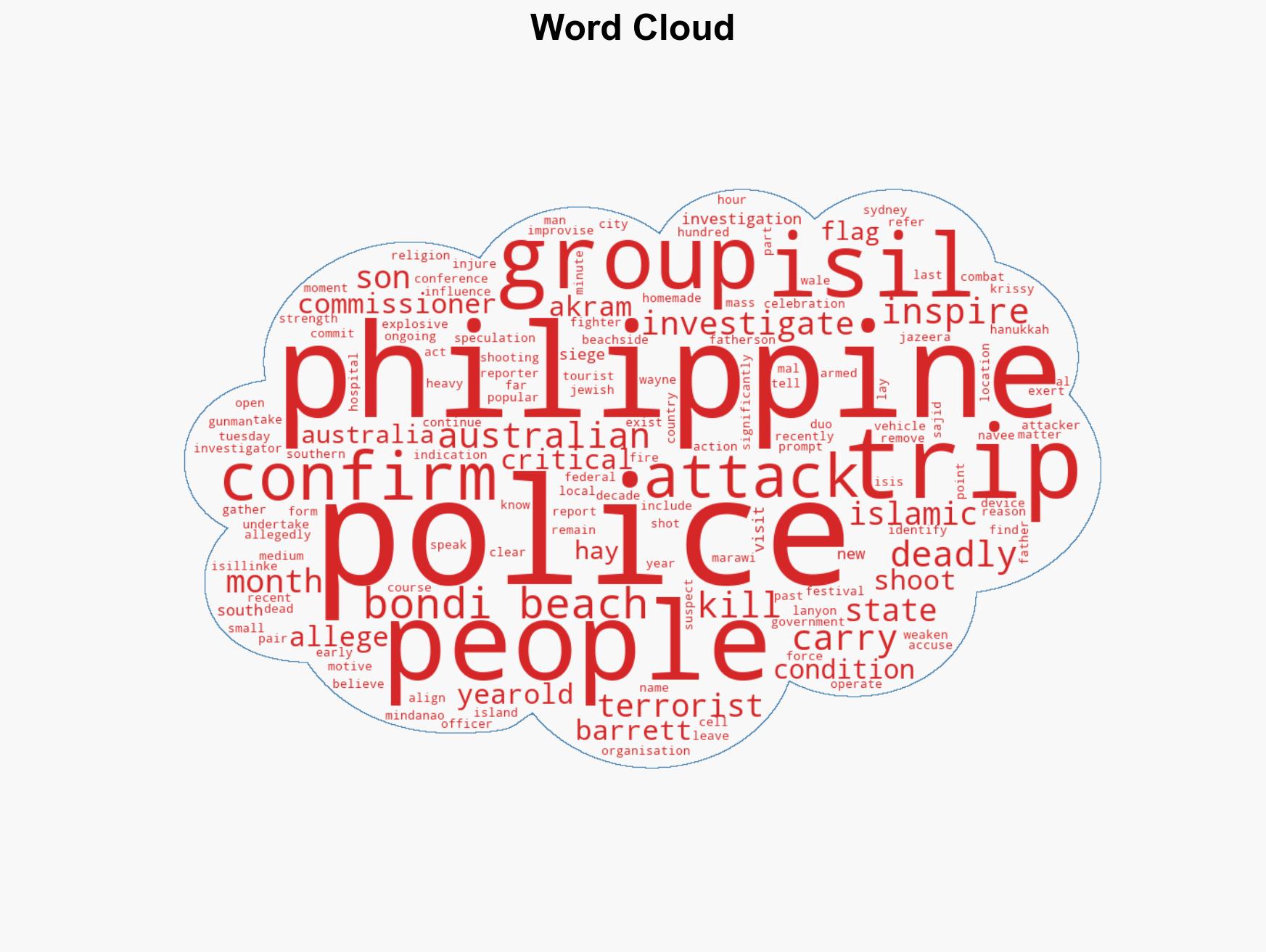
Bondi Beach shooting linked to ISIL inspiration, claims Australian police investigation into father-son attac…
Published on: 2025-12-16
AI-powered OSINT brief from verified open sources. Automated NLP signal extraction with human verification. See our Methodology and Why WorldWideWatchers.
Intelligence Report: Australian police say Bondi Beach attackers inspired by ISIL
1. BLUF (Bottom Line Up Front)
The Bondi Beach shooting, attributed to ISIL inspiration, highlights a significant terrorist threat within Australia, with potential international linkages. The investigation into the suspects’ recent trip to the Philippines could reveal broader connections to ISIL-affiliated groups. This assessment is made with moderate confidence due to ongoing investigations and incomplete information.
2. Competing Hypotheses
- Hypothesis A: The attack was a locally planned and executed operation inspired by ISIL ideology, with no direct operational support from ISIL. This is supported by the homemade ISIL flags and lack of immediate evidence of external coordination. Key uncertainties include the purpose of the suspects’ trip to the Philippines.
- Hypothesis B: The attack was part of a broader ISIL-coordinated effort, potentially involving training or support from ISIL-linked groups in the Philippines. This is suggested by the suspects’ travel to a region with known ISIL activity. Contradicting evidence includes the current lack of concrete links between the suspects and organized ISIL cells.
- Assessment: Hypothesis A is currently better supported due to the absence of direct evidence linking the suspects to ISIL operational cells. Indicators that could shift this judgment include new intelligence on the Philippines trip or communications with known ISIL operatives.
3. Key Assumptions and Red Flags
- Assumptions: The suspects acted primarily based on ideological inspiration; ISIL’s operational capacity in the Philippines remains limited; local law enforcement has accurately identified the suspects’ motivations.
- Information Gaps: Details of the suspects’ activities and contacts during their Philippines trip; any communications between the suspects and ISIL operatives.
- Bias & Deception Risks: Potential confirmation bias in attributing the attack to ISIL without conclusive evidence; media or political narratives influencing public perception before full investigation results.
4. Implications and Strategic Risks
This development could influence Australia’s counter-terrorism policies and international cooperation, particularly with Southeast Asian nations. It may also impact public perception of security and immigration policies.
- Political / Geopolitical: Potential strain on Australia-Philippines relations if links to ISIL are confirmed; increased regional counter-terrorism collaboration.
- Security / Counter-Terrorism: Heightened alert levels and security measures at public events; potential for copycat attacks inspired by ISIL.
- Cyber / Information Space: Increased ISIL propaganda efforts targeting vulnerable individuals in Australia; potential for misinformation campaigns.
- Economic / Social: Impact on tourism, particularly in Sydney; potential rise in anti-immigrant sentiment and social division.
5. Recommendations and Outlook
- Immediate Actions (0–30 days): Enhance security measures at public gatherings; expedite intelligence sharing with the Philippines; monitor online extremist activities.
- Medium-Term Posture (1–12 months): Strengthen counter-terrorism partnerships in Southeast Asia; invest in community outreach programs to counter radicalization.
- Scenario Outlook: Best: No further attacks and successful disruption of ISIL networks. Worst: Additional attacks inspired by ISIL. Most-Likely: Continued isolated incidents with ideological links to ISIL.
6. Key Individuals and Entities
- Sajid Akram (deceased suspect)
- Naveed Akram (suspect in critical condition)
- Australian Federal Police Commissioner Krissy Barrett
- New South Wales Police Commissioner Mal Lanyon
- ISIL (ISIS)
7. Thematic Tags
Counter-Terrorism, ISIL, Australia, Philippines, radicalization, security, international cooperation
Structured Analytic Techniques Applied
- ACH 2.0: Reconstruct likely threat actor intentions via hypothesis testing and structured refutation.
- Indicators Development: Track radicalization signals and propaganda patterns to anticipate operational planning.
- Narrative Pattern Analysis: Deconstruct and track propaganda or influence narratives.
Explore more:
Counter-Terrorism Briefs ·
Daily Summary ·
Support us