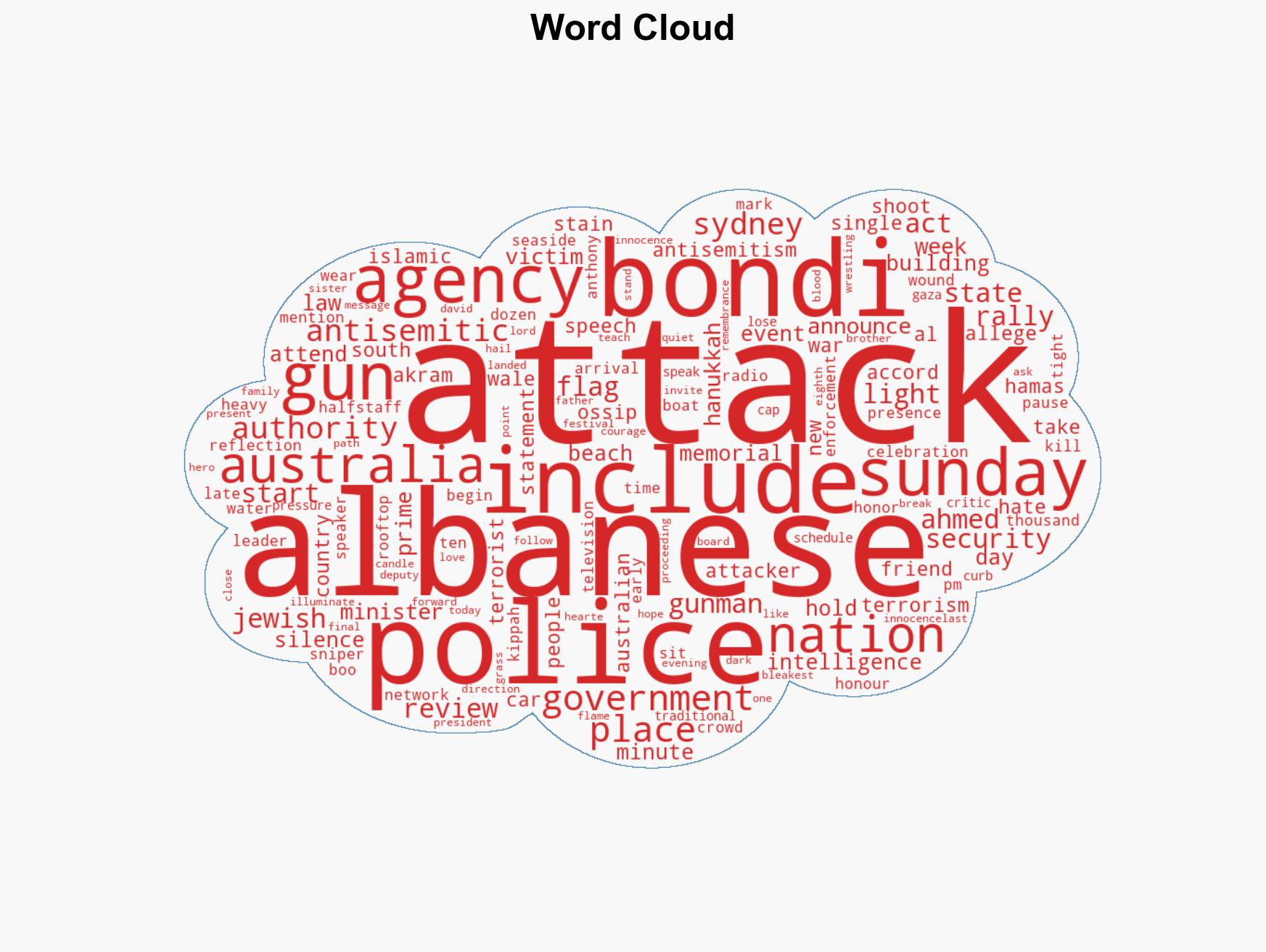
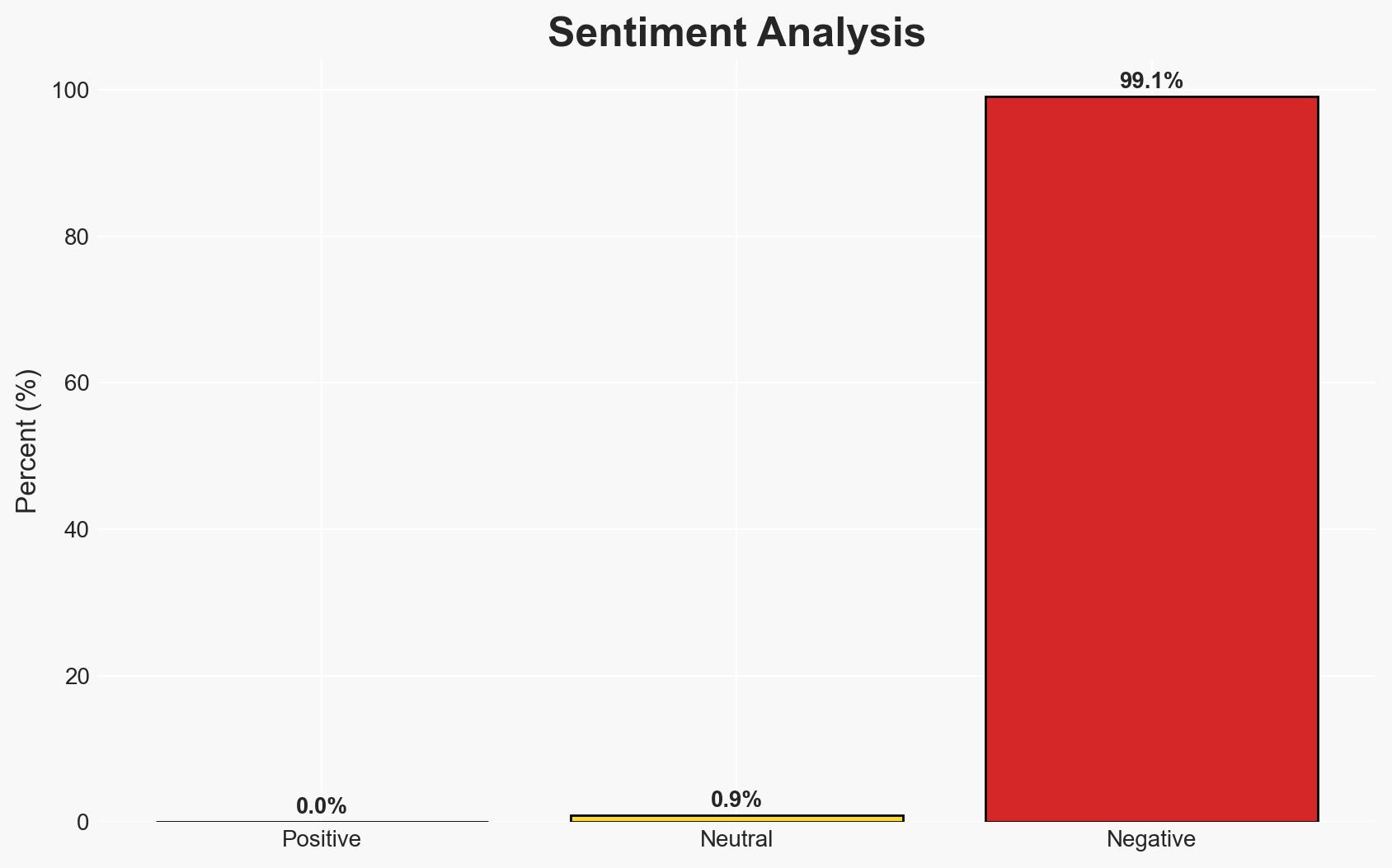
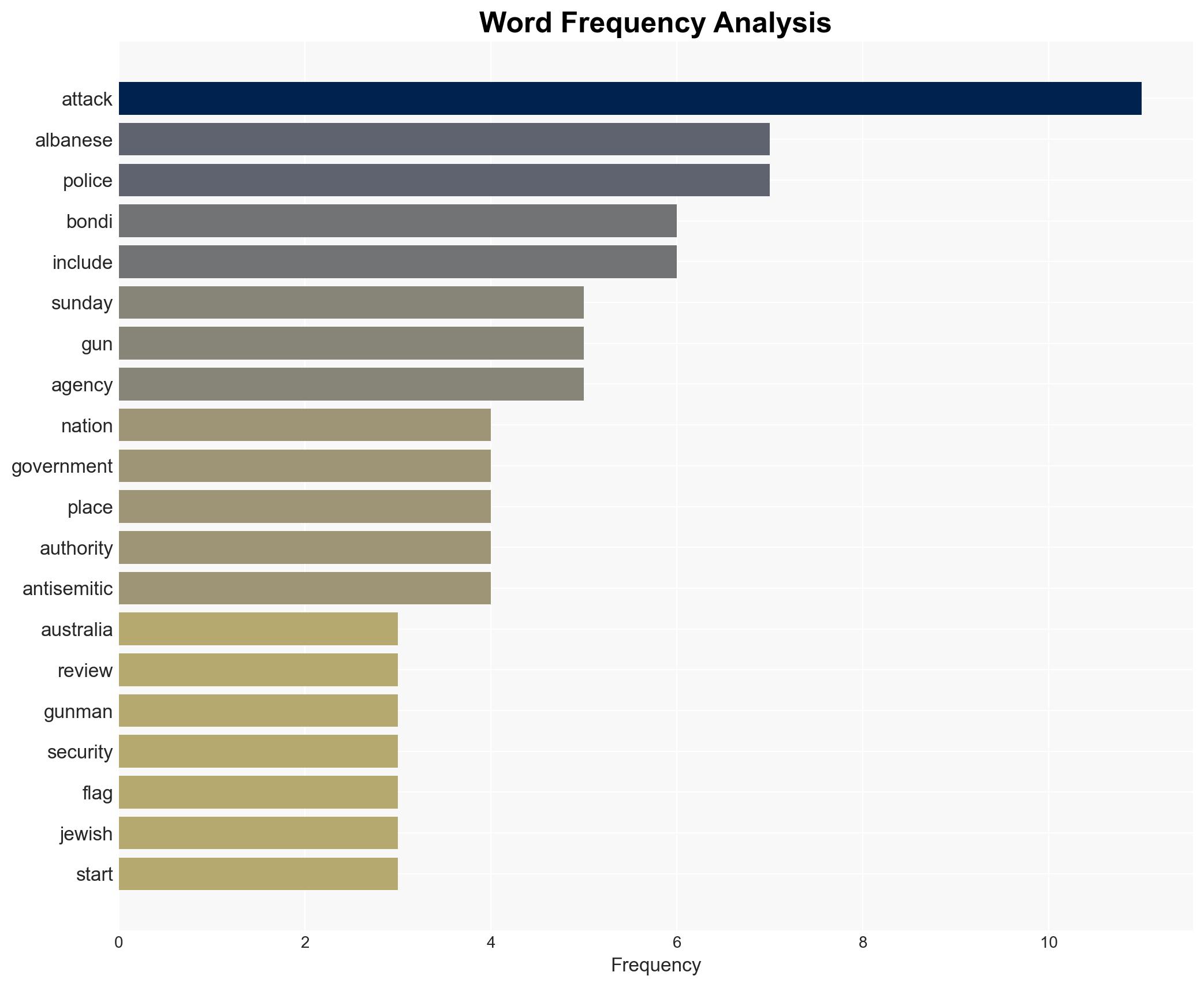
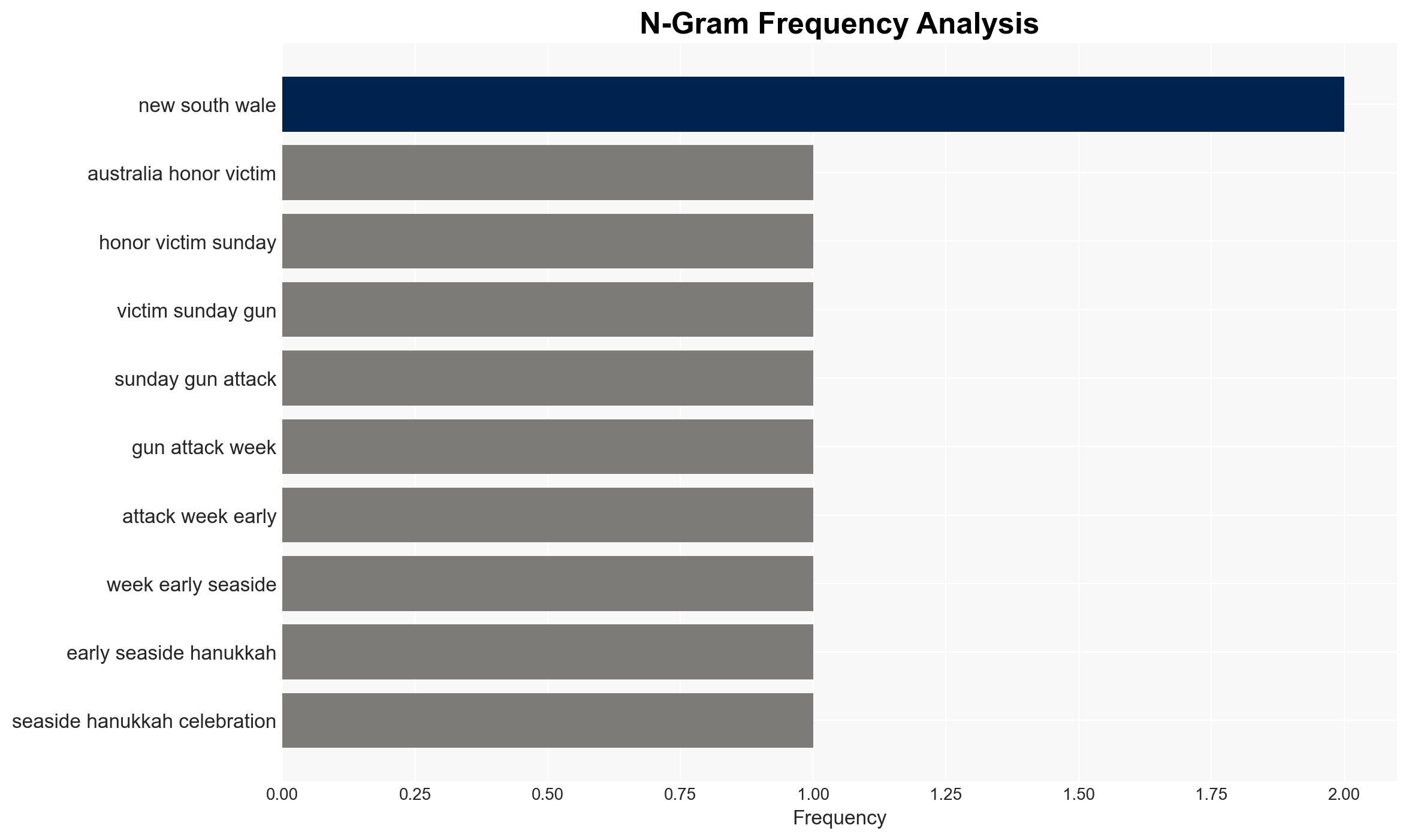
Australia commemorates Bondi beach attack victims as PM initiates safety assessment of law enforcement agenci…
Published on: 2025-12-21
AI-powered OSINT brief from verified open sources. Automated NLP signal extraction with human verification. See our Methodology and Why WorldWideWatchers.
Intelligence Report: Australia honors Bondi beach attack victims as PM orders safety review
1. BLUF (Bottom Line Up Front)
The Australian government is conducting a review of its law enforcement and intelligence agencies following a deadly attack on a Hanukkah celebration at Bondi beach. The review aims to address potential gaps in gun-license assessments and information-sharing. This incident has heightened national security concerns and increased scrutiny on antisemitism. Overall confidence in these assessments is moderate due to limited details on the attackers’ motivations and the effectiveness of current measures.
2. Competing Hypotheses
- Hypothesis A: The attack was primarily motivated by antisemitic sentiments, potentially exacerbated by geopolitical tensions such as the war in Gaza. This is supported by the timing and target of the attack, but lacks direct evidence linking the attackers to organized antisemitic groups.
- Hypothesis B: The attack was an isolated incident carried out by individuals with personal grievances or mental health issues, rather than a coordinated effort by a larger group. This is supported by the lack of immediate claims of responsibility by known terrorist organizations.
- Assessment: Hypothesis A is currently better supported due to the context of rising antisemitism and the symbolic nature of the attack during a Jewish festival. Indicators such as further antisemitic incidents or communications from extremist groups could shift this judgment.
3. Key Assumptions and Red Flags
- Assumptions: The attackers acted with antisemitic intent; existing intelligence and law enforcement frameworks have gaps; public sentiment is influenced by geopolitical events.
- Information Gaps: Detailed profiles of the attackers, their affiliations, and motivations; effectiveness of current counter-terrorism measures; public sentiment data post-attack.
- Bias & Deception Risks: Potential confirmation bias in attributing the attack to antisemitism without clear evidence; media portrayal may skew public perception and policy response.
4. Implications and Strategic Risks
This development could lead to increased domestic security measures and influence Australia’s foreign policy stance, particularly regarding Middle Eastern conflicts. It may also impact social cohesion and public trust in government institutions.
- Political / Geopolitical: Potential diplomatic tensions with countries perceived as supporting antisemitic actions; internal political pressure on the government to act decisively.
- Security / Counter-Terrorism: Heightened security measures and resource allocation towards preventing similar attacks; potential for copycat incidents.
- Cyber / Information Space: Increased online discourse and propaganda related to antisemitism and terrorism; potential cyber threats targeting Jewish communities and institutions.
- Economic / Social: Economic impact due to increased security spending; potential social unrest or division exacerbated by perceived government inaction or overreaction.
5. Recommendations and Outlook
- Immediate Actions (0–30 days): Enhance intelligence sharing between agencies; conduct a comprehensive threat assessment; engage with community leaders to address public concerns.
- Medium-Term Posture (1–12 months): Develop resilience measures against antisemitic threats; strengthen partnerships with international intelligence agencies; review and update gun control policies.
- Scenario Outlook:
- Best: Successful mitigation of antisemitic threats and improved public confidence in security measures.
- Worst: Escalation of antisemitic incidents and significant public unrest.
- Most-Likely: Incremental improvements in security measures with ongoing public scrutiny and political pressure.
6. Key Individuals and Entities
- Prime Minister Anthony Albanese
- David Ossip, President of the New South Wales Jewish Board of Deputies
- Ahmed al Ahmed, “Bondi Hero”
- Not clearly identifiable from open sources in this snippet for attackers
7. Thematic Tags
Counter-Terrorism, antisemitism, national security, intelligence review, gun control, public safety, geopolitical tensions
Structured Analytic Techniques Applied
- ACH 2.0: Reconstruct likely threat actor intentions via hypothesis testing and structured refutation.
- Indicators Development: Track radicalization signals and propaganda patterns to anticipate operational planning.
- Narrative Pattern Analysis: Analyze spread/adaptation of ideological narratives for recruitment/incitement signals.
- Network Influence Mapping: Map influence relationships to assess actor impact.
Explore more:
Counter-Terrorism Briefs ·
Daily Summary ·
Support us