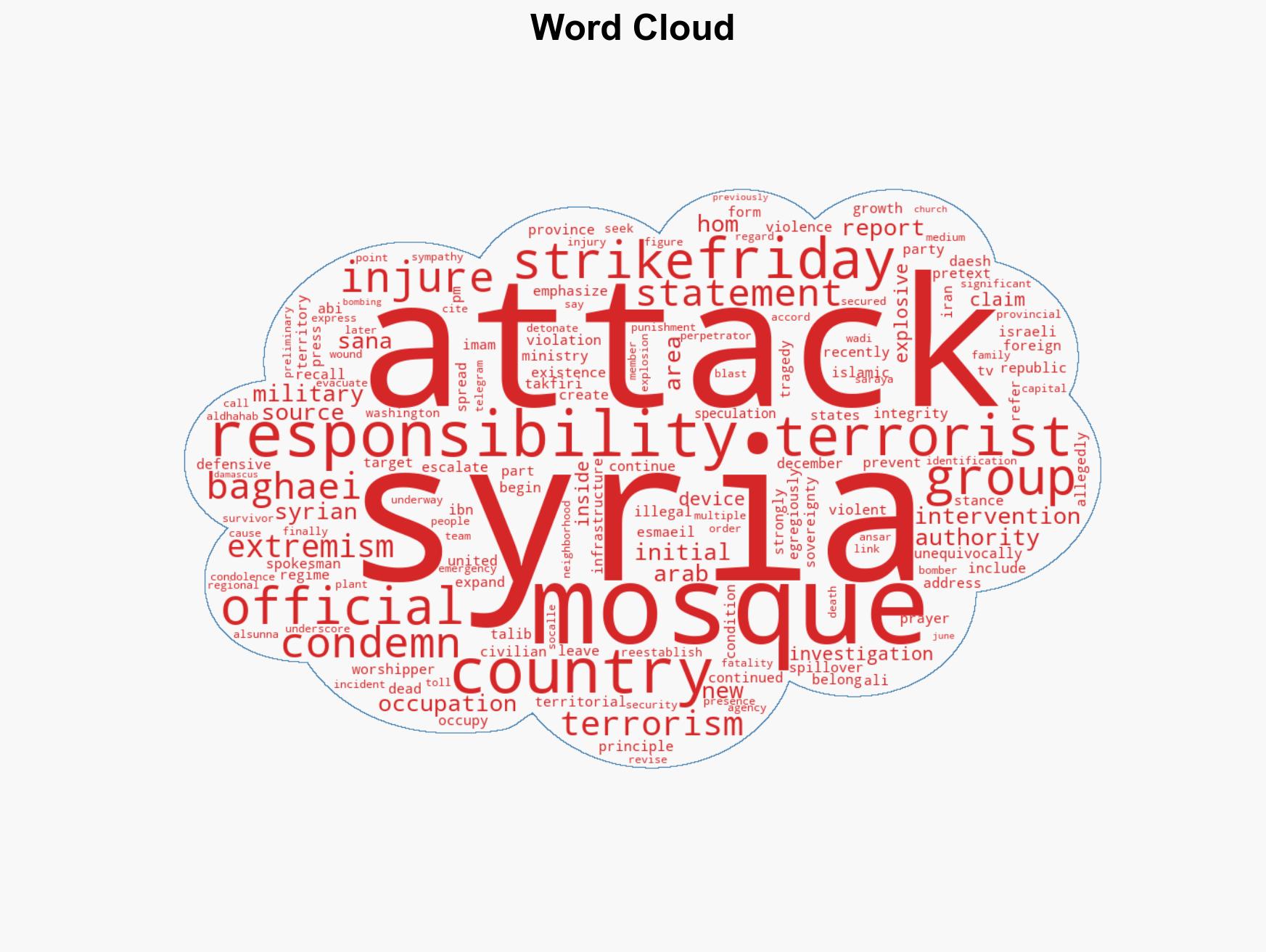
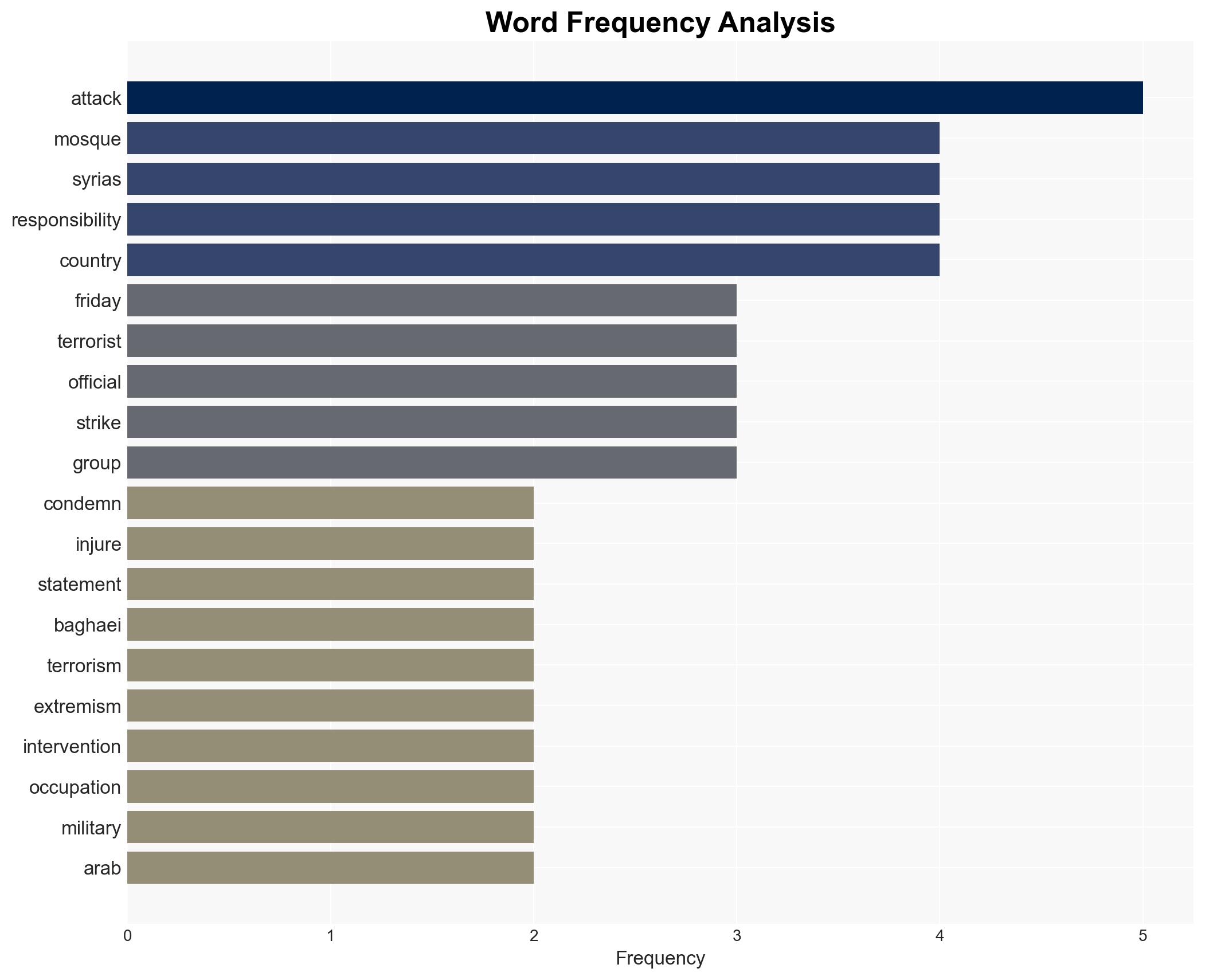
Iran denounces terrorist attack on worshippers in Homs, blames foreign interventions for escalating violence
Published on: 2025-12-27
AI-powered OSINT brief from verified open sources. Automated NLP signal extraction with human verification. See our Methodology and Why WorldWideWatchers.
Intelligence Report: Iran strongly condemns deadly terrorist attack targeting worshippers in Syria’s Homs
1. BLUF (Bottom Line Up Front)
The terrorist attack in Homs, Syria, claimed by Saraya Ansar al-Sunna, highlights ongoing instability and the potential for increased sectarian violence. Iran’s condemnation underscores regional tensions involving Iran, Syria, the US, and Israel. The most likely hypothesis is that this attack is part of a broader strategy by extremist groups to destabilize the region. Overall confidence in this assessment is moderate.
2. Competing Hypotheses
- Hypothesis A: The attack was orchestrated by Saraya Ansar al-Sunna to incite sectarian violence and destabilize the region. This is supported by the group’s claim of responsibility and their history of similar attacks. However, the group’s actual capabilities and external support are uncertain.
- Hypothesis B: The attack could be a false flag operation intended to justify increased military intervention by external actors like the US or Israel. There is limited evidence for this, and it contradicts the group’s claim of responsibility.
- Assessment: Hypothesis A is currently better supported due to the direct claim of responsibility by Saraya Ansar al-Sunna. Key indicators that could shift this judgment include evidence of external orchestration or changes in regional military postures.
3. Key Assumptions and Red Flags
- Assumptions: The claim by Saraya Ansar al-Sunna is genuine; the attack aims to destabilize the region; Iran’s condemnation reflects its geopolitical stance.
- Information Gaps: Details on the group’s operational capabilities, potential external support, and the specifics of the explosive devices used.
- Bias & Deception Risks: Potential bias in Iranian and Syrian state media reporting; possible deception in the claim of responsibility by Saraya Ansar al-Sunna.
4. Implications and Strategic Risks
This development could exacerbate regional tensions and lead to increased military actions by involved states. It may also embolden extremist groups to conduct further attacks.
- Political / Geopolitical: Increased tensions between Iran, Syria, the US, and Israel, potentially leading to diplomatic or military escalations.
- Security / Counter-Terrorism: Heightened threat environment in Syria, necessitating increased counter-terrorism efforts.
- Cyber / Information Space: Potential for increased propaganda and misinformation campaigns by involved parties.
- Economic / Social: Possible negative impacts on local economies and social cohesion due to fear and instability.
5. Recommendations and Outlook
- Immediate Actions (0–30 days): Enhance intelligence-sharing among regional allies, increase monitoring of extremist group communications, and bolster security at religious sites.
- Medium-Term Posture (1–12 months): Develop regional counter-terrorism partnerships, strengthen diplomatic channels to de-escalate tensions, and invest in community resilience programs.
- Scenario Outlook:
- Best Case: Successful de-escalation and containment of extremist threats with improved regional cooperation.
- Worst Case: Escalation into broader conflict involving state actors, leading to significant regional instability.
- Most Likely: Continued low-level violence with periodic escalations, requiring sustained counter-terrorism efforts.
6. Key Individuals and Entities
- Esmaeil Baghaei, Iranian Foreign Ministry Spokesman
- Saraya Ansar al-Sunna, Extremist Group
- Syrian Government Authorities
- Not clearly identifiable from open sources in this snippet.
7. Thematic Tags
national security threats, counter-terrorism, regional stability, sectarian violence, geopolitical tensions, extremist groups, military intervention, information warfare
Structured Analytic Techniques Applied
- Cognitive Bias Stress Test: Expose and correct potential biases in assessments through red-teaming and structured challenge.
- Bayesian Scenario Modeling: Use probabilistic forecasting for conflict trajectories or escalation likelihood.
- Network Influence Mapping: Map relationships between state and non-state actors for impact estimation.
Explore more:
National Security Threats Briefs ·
Daily Summary ·
Support us