How Iran Transformed Its Concept of Victory from Khorramshahr to Modern Conflicts
Published on: 2025-12-30
AI-powered OSINT brief from verified open sources. Automated NLP signal extraction with human verification. See our Methodology and Why WorldWideWatchers.
Intelligence Report: From Khorramshahr to Hezbollah How Iran Learned to Win by Not Winning
1. BLUF (Bottom Line Up Front)
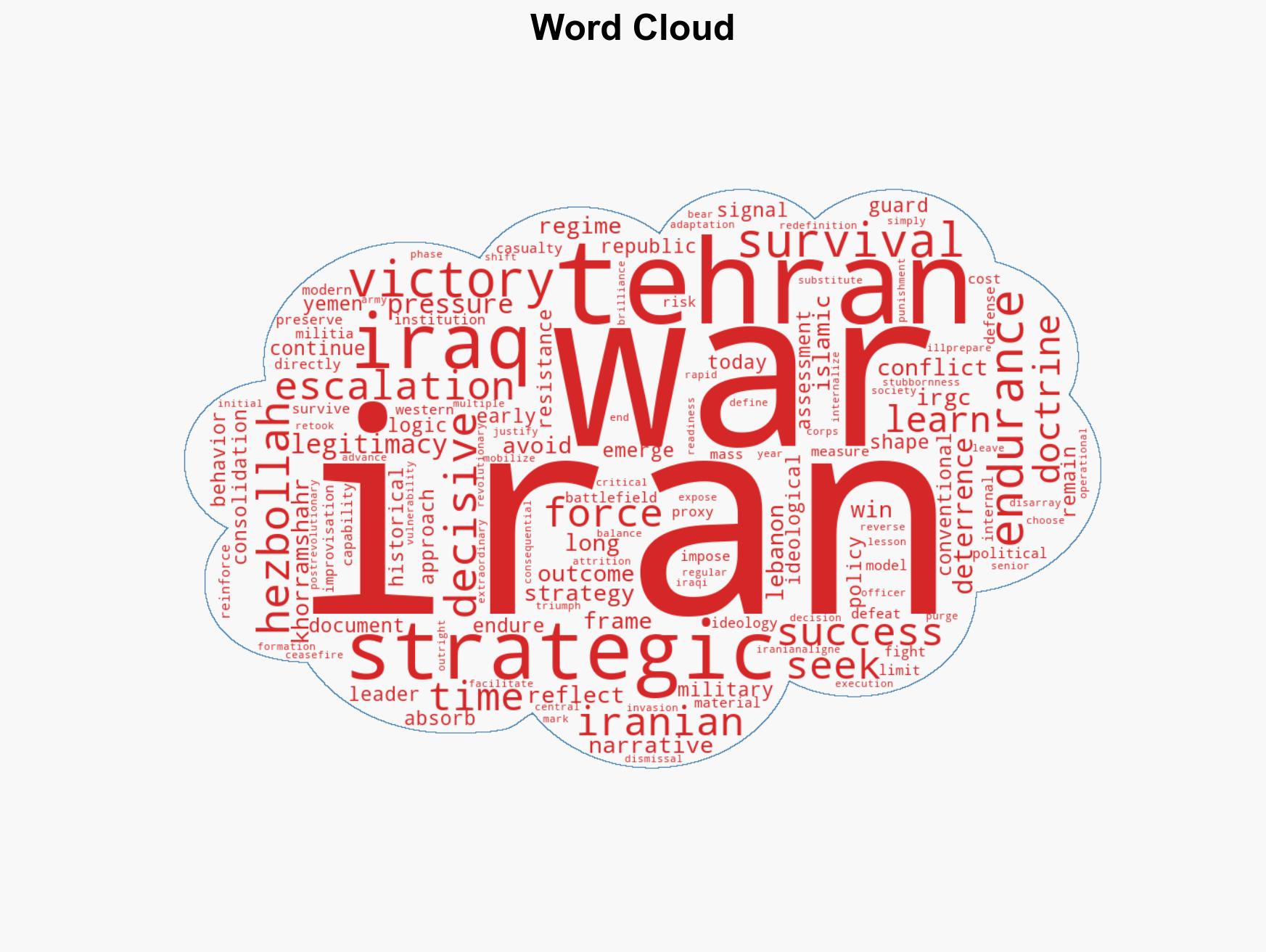
Iran’s strategic doctrine, developed during the Iran-Iraq War, prioritizes endurance and ideological consolidation over decisive military victories. This approach influences its current use of proxy forces across the Middle East. The most likely hypothesis is that Iran will continue to leverage this strategy to expand its influence while avoiding direct confrontation. Overall confidence in this assessment is moderate.
2. Competing Hypotheses
- Hypothesis A: Iran’s continuation of the Iran-Iraq War was driven by ideological goals and a desire to redefine victory as survival and endurance. Supporting evidence includes Iran’s focus on ideological mobilization and the development of the IRGC as a force capable of sustaining long-term conflicts. Key uncertainties include the extent to which internal political dynamics influenced this decision.
- Hypothesis B: Iran continued the war due to miscalculations about potential military gains and external pressures. Contradicting evidence includes the lack of significant territorial gains post-Khorramshahr and the strategic shift towards proxy warfare. This hypothesis is less supported due to the consistent pattern of Iran’s strategic behavior aligning with ideological endurance.
- Assessment: Hypothesis A is currently better supported due to Iran’s historical and ongoing emphasis on ideological endurance and proxy warfare. Indicators that could shift this judgment include new evidence of external pressures or internal dissent influencing Iran’s strategic decisions.
3. Key Assumptions and Red Flags
- Assumptions: Iran prioritizes ideological goals over territorial gains; the IRGC’s development was primarily influenced by the Iran-Iraq War; Tehran’s current proxy strategy is a direct evolution of wartime lessons.
- Information Gaps: Detailed insights into Iran’s internal decision-making processes during the war; the role of external actors in influencing Iran’s strategic decisions.
- Bias & Deception Risks: Potential bias in historical accounts favoring Iranian narratives; risk of underestimating Iran’s strategic adaptability and external influences.
4. Implications and Strategic Risks
The evolution of Iran’s strategic doctrine could lead to increased regional instability as Tehran continues to support proxy groups. This approach may embolden other state and non-state actors to adopt similar strategies, complicating conflict resolution efforts.
- Political / Geopolitical: Potential for increased tensions with regional rivals and Western powers; possible escalation in proxy conflicts.
- Security / Counter-Terrorism: Enhanced capabilities and reach of Iranian-backed militias could pose greater threats to regional security.
- Cyber / Information Space: Iran may leverage cyber capabilities to support its proxy strategies and influence operations.
- Economic / Social: Prolonged conflicts may strain regional economies and exacerbate social tensions.
5. Recommendations and Outlook
- Immediate Actions (0–30 days): Increase intelligence monitoring of Iranian proxy activities; engage regional allies to counterbalance Iranian influence.
- Medium-Term Posture (1–12 months): Develop resilience measures and partnerships to mitigate proxy threats; enhance capabilities for countering asymmetric warfare.
- Scenario Outlook:
- Best: Iran reduces proxy activities due to international pressure and economic constraints.
- Worst: Intensification of proxy conflicts leads to broader regional war.
- Most-Likely: Continued low-intensity conflicts with periodic escalations, driven by Iranian strategic doctrine.
6. Key Individuals and Entities
- Islamic Revolutionary Guard Corps (IRGC)
- Hezbollah
- Iranian-aligned militias in Iraq and Yemen
- Not clearly identifiable from open sources in this snippet.
7. Thematic Tags
Counter-Terrorism, proxy warfare, ideological strategy, Iran-Iraq War, IRGC, regional influence, asymmetric conflict, Middle East security
Structured Analytic Techniques Applied
- ACH 2.0: Reconstruct likely threat actor intentions via hypothesis testing and structured refutation.
- Indicators Development: Track radicalization signals and propaganda patterns to anticipate operational planning.
- Narrative Pattern Analysis: Deconstruct and track propaganda or influence narratives.
- Causal Layered Analysis (CLA): Empirical → systemic → worldview → myth layers.
Explore more:
Counter-Terrorism Briefs ·
Daily Summary ·
Support us