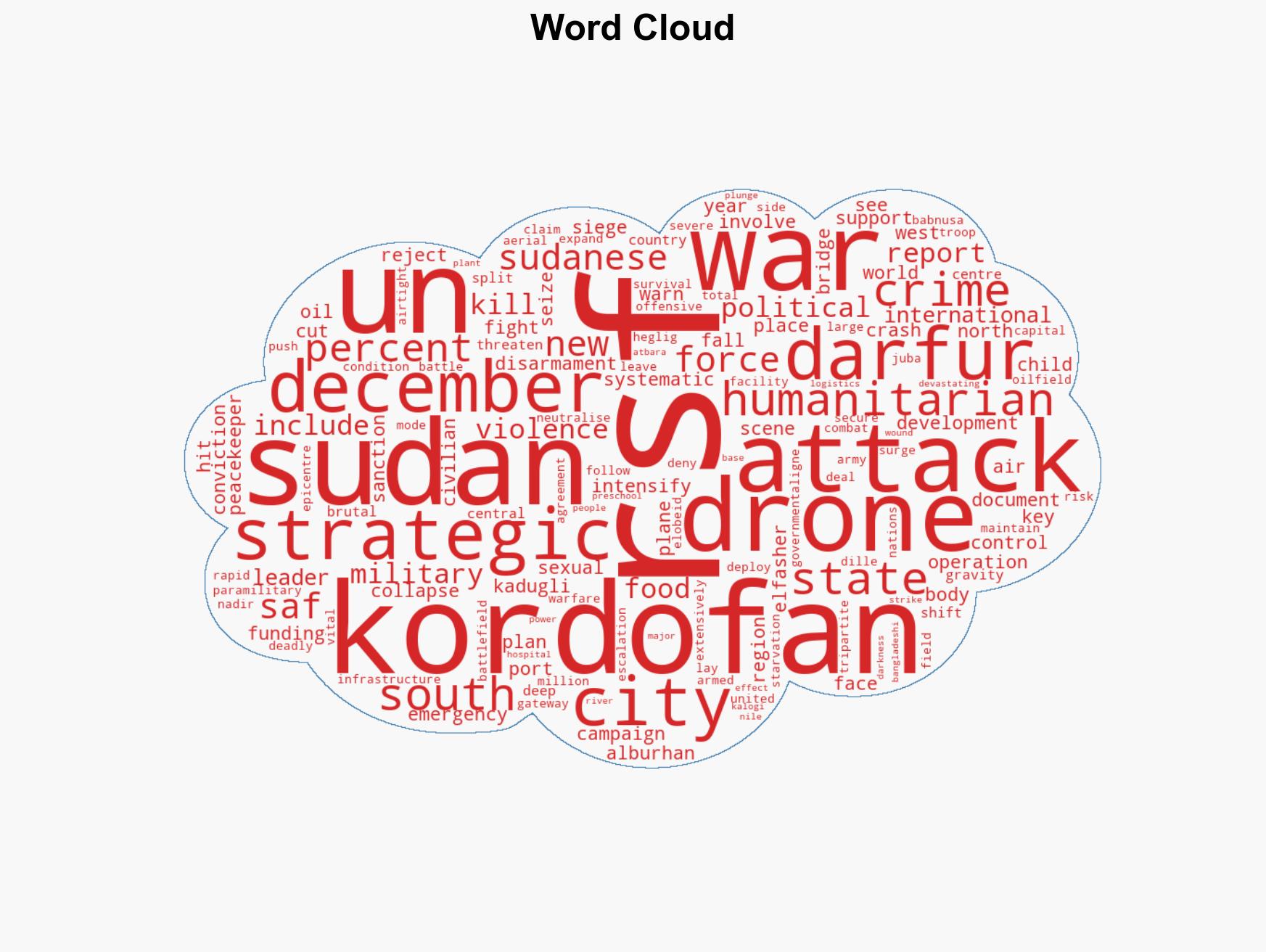
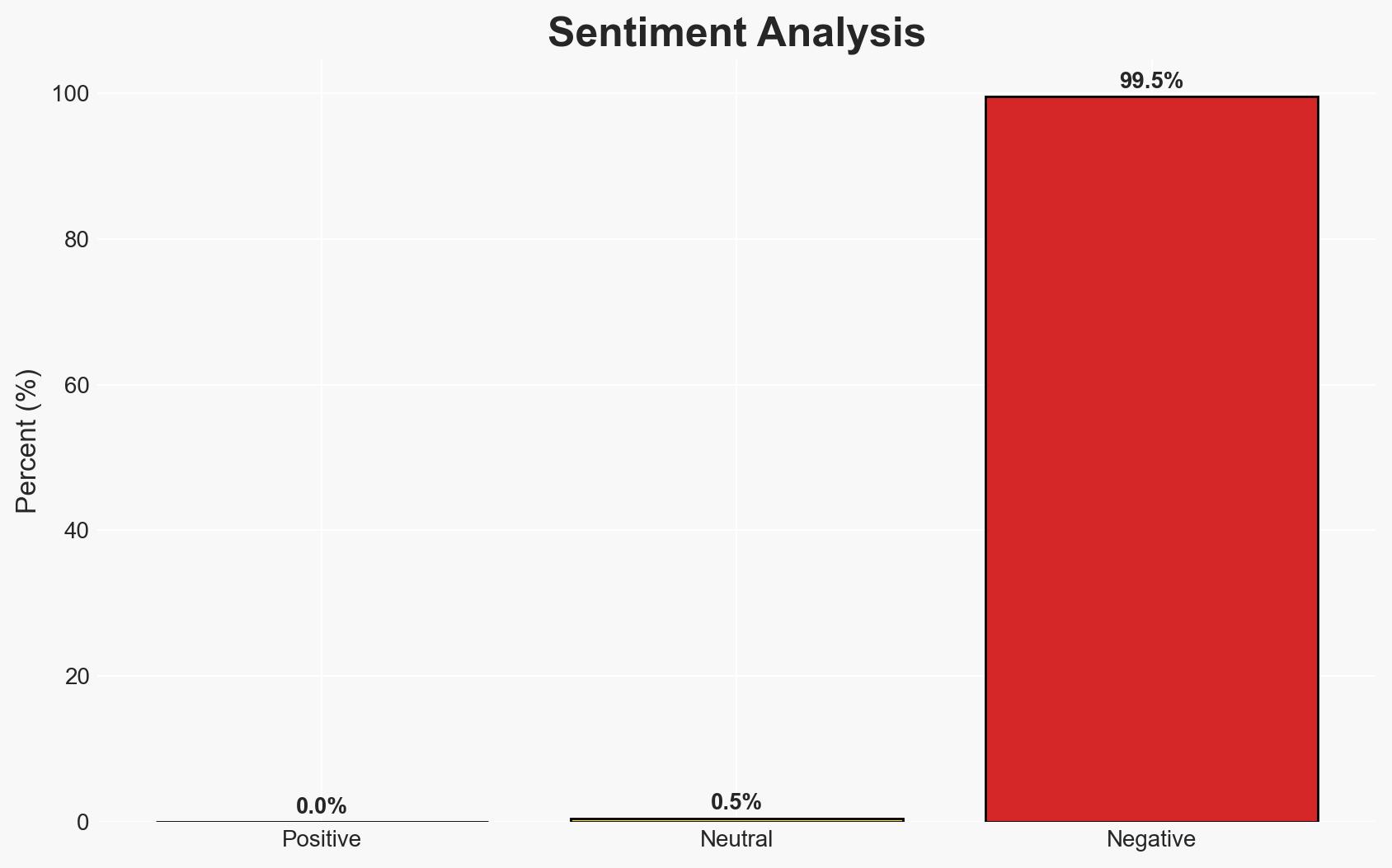
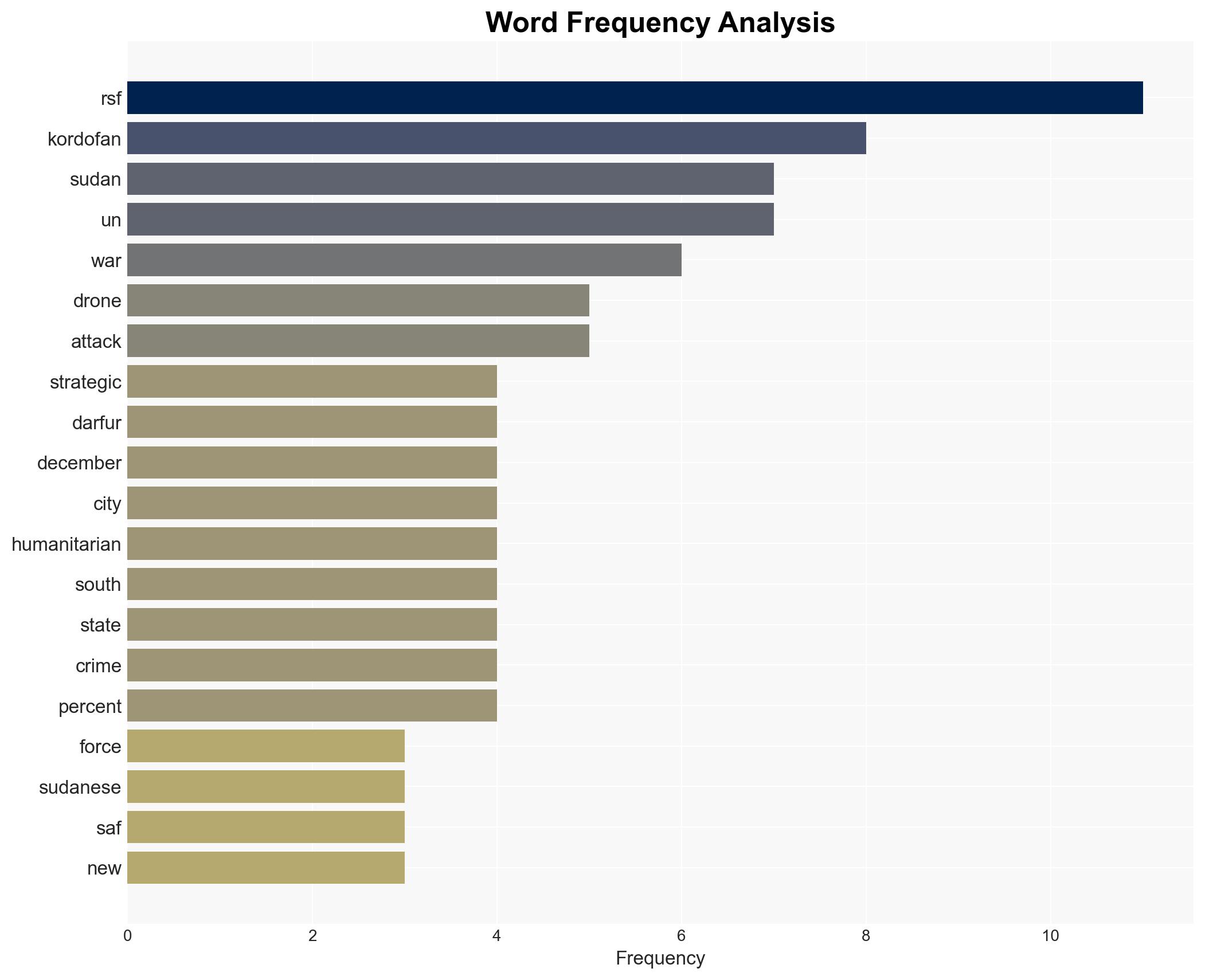
Escalating Conflict in Sudan: Kordofan Becomes the New Battleground Amid Humanitarian Crisis in December 2025
Published on: 2025-12-31
AI-powered OSINT brief from verified open sources. Automated NLP signal extraction with human verification. See our Methodology and Why WorldWideWatchers.
Intelligence Report: War in Sudan Humanitarian collapse fighting deadlock December 2025
1. BLUF (Bottom Line Up Front)
The ongoing conflict in Sudan, now centered in Kordofan, threatens to further destabilize the region and exacerbate humanitarian crises. The RSF’s strategic gains, including the seizure of the Heglig oilfield, have intensified the conflict with the SAF. The humanitarian situation is dire, with severe funding cuts impacting aid delivery. Moderate confidence in the assessment that the conflict will continue to escalate, affecting regional stability and humanitarian conditions.
2. Competing Hypotheses
- Hypothesis A: The RSF’s offensive will lead to a decisive military advantage, potentially splitting Sudan into separate regions. This is supported by their control of key infrastructure and cities, but contradicted by the SAF’s continued resistance and aerial campaigns.
- Hypothesis B: The conflict will remain a protracted stalemate, with neither side able to secure a decisive victory. This is supported by the ongoing military engagements and external interventions, such as the deployment of South Sudanese troops to neutralize the Heglig oilfield.
- Assessment: Hypothesis B is currently better supported due to the balanced military capabilities and external interventions preventing a clear victory. Key indicators that could shift this judgment include significant territorial gains by either side or changes in international support.
3. Key Assumptions and Red Flags
- Assumptions: The RSF and SAF will continue to receive external support; humanitarian aid will remain underfunded; regional actors will avoid direct military intervention.
- Information Gaps: Detailed intelligence on the internal cohesion of RSF and SAF; the extent of international support for each faction; the full impact of drone warfare capabilities.
- Bias & Deception Risks: Potential bias in reports from conflict parties; risk of manipulated information regarding battlefield successes and humanitarian conditions.
4. Implications and Strategic Risks
The conflict’s continuation could further destabilize Sudan and the broader region, increasing the risk of spillover into neighboring countries and exacerbating humanitarian needs.
- Political / Geopolitical: Potential for increased regional involvement or intervention; risk of Sudan’s fragmentation.
- Security / Counter-Terrorism: Heightened risk of terrorist exploitation of the security vacuum; increased arms proliferation.
- Cyber / Information Space: Potential for increased cyber operations targeting critical infrastructure and information warfare to sway international opinion.
- Economic / Social: Further economic decline due to disrupted oil production; worsening humanitarian crisis leading to mass displacement and social unrest.
5. Recommendations and Outlook
- Immediate Actions (0–30 days): Increase intelligence collection on RSF and SAF capabilities; enhance monitoring of humanitarian aid distribution; engage regional partners to mediate conflict.
- Medium-Term Posture (1–12 months): Develop resilience measures for humanitarian aid delivery; strengthen partnerships with regional actors; invest in conflict resolution mechanisms.
- Scenario Outlook: Best: Negotiated ceasefire and peace talks; Worst: Full-scale regional conflict; Most-Likely: Continued stalemate with sporadic escalations. Triggers include changes in international support or significant territorial shifts.
6. Key Individuals and Entities
- Not clearly identifiable from open sources in this snippet.
7. Thematic Tags
national security threats, conflict, humanitarian crisis, regional stability, drone warfare, oil infrastructure, international intervention, peacekeeping
Structured Analytic Techniques Applied
- Cognitive Bias Stress Test: Expose and correct potential biases in assessments through red-teaming and structured challenge.
- Bayesian Scenario Modeling: Use probabilistic forecasting for conflict trajectories or escalation likelihood.
- Network Influence Mapping: Map relationships between state and non-state actors for impact estimation.
Explore more:
National Security Threats Briefs ·
Daily Summary ·
Support us