Federal Prosecutors Pursue Death Penalty for Suspect in Murders of Israeli Embassy Staff in Washington, DC
Published on: 2026-01-18
AI-powered OSINT brief from verified open sources. Automated NLP signal extraction with human verification. See our Methodology and Why WorldWideWatchers.
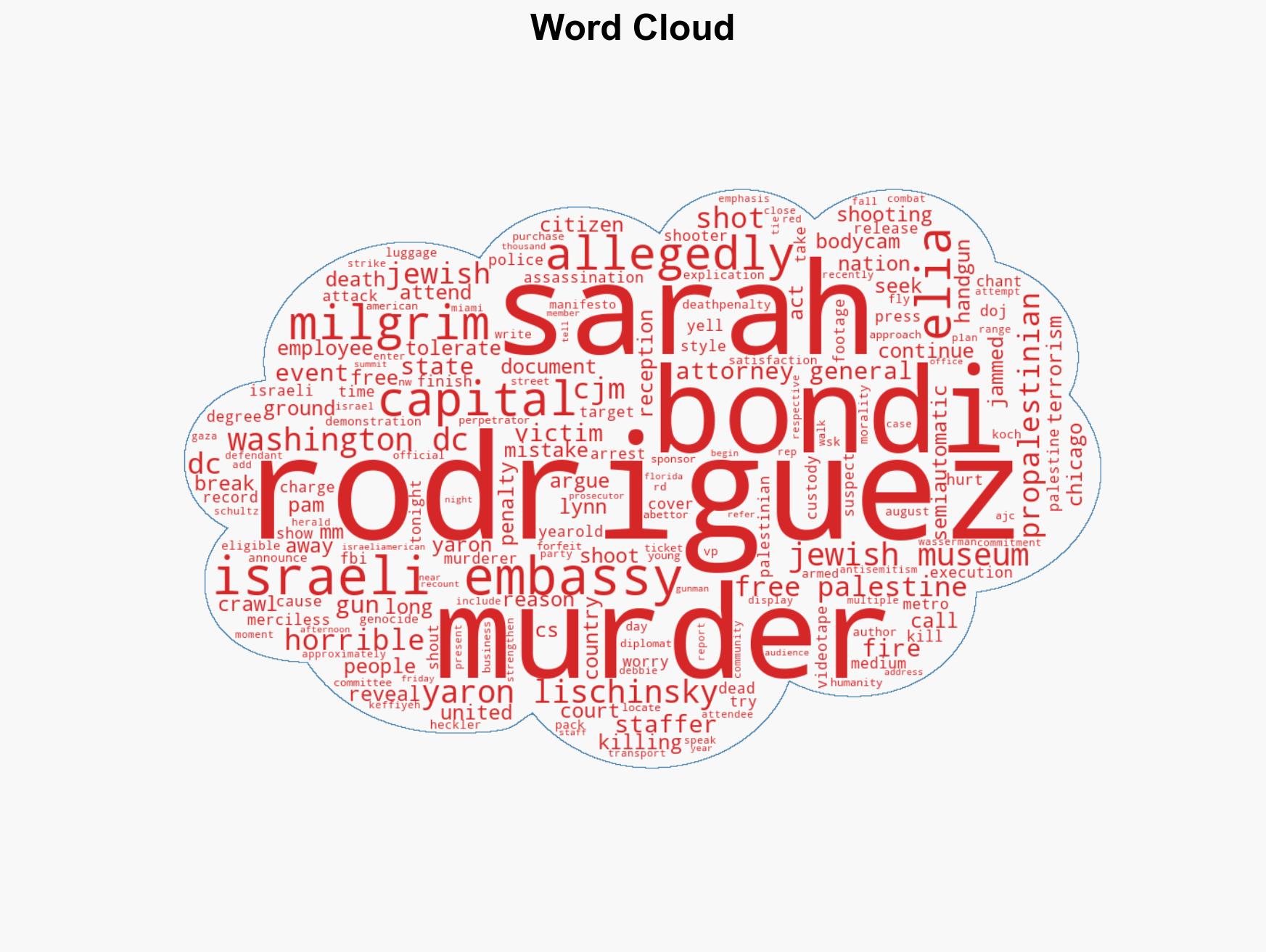
Intelligence Report: Feds To Seek Death Penalty In DC Murders of Two Israeli Embassy Staffers By Pro-Palestinian
1. BLUF (Bottom Line Up Front)
The murder of two Israeli Embassy staffers in Washington, D.C., by Elias Rodriguez, is assessed as a targeted act of pro-Palestinian terrorism, with moderate confidence. The attack has significant implications for U.S.-Middle East relations and domestic security policies. The most likely hypothesis is that Rodriguez acted independently, motivated by extremist ideology. This incident affects diplomatic relations, security protocols, and community tensions.
2. Competing Hypotheses
- Hypothesis A: Elias Rodriguez acted independently, driven by personal extremist beliefs and a desire to make a political statement. Supporting evidence includes his manifesto and the fact that his weapon jammed, preventing further casualties. Key uncertainties involve potential undisclosed affiliations or support networks.
- Hypothesis B: Rodriguez was part of a larger coordinated effort by a pro-Palestinian extremist group. This hypothesis is less supported due to a lack of evidence indicating organizational backing or communication with known groups.
- Assessment: Hypothesis A is currently better supported due to the personal nature of the manifesto and lack of evidence of external coordination. Indicators such as communications with known extremist groups or financial support could shift this judgment.
3. Key Assumptions and Red Flags
- Assumptions: Rodriguez acted alone; his manifesto accurately reflects his motivations; no significant external support was involved.
- Information Gaps: Details on Rodriguez’s communications and potential affiliations; insights into his radicalization process.
- Bias & Deception Risks: Confirmation bias in interpreting evidence as solely indicative of lone-wolf action; potential for Rodriguez to exaggerate personal motivations to obscure group affiliations.
4. Implications and Strategic Risks
This development could exacerbate tensions between pro-Palestinian and pro-Israeli groups in the U.S., influencing domestic and foreign policy. It may also prompt increased security measures at diplomatic sites.
- Political / Geopolitical: Potential strain on U.S.-Middle East diplomatic relations; increased lobbying by interest groups.
- Security / Counter-Terrorism: Heightened security protocols at embassies and Jewish cultural sites; potential for copycat attacks.
- Cyber / Information Space: Possible increase in online propaganda and recruitment efforts by extremist groups.
- Economic / Social: Potential for increased community tensions and social unrest; impact on tourism and event attendance at cultural sites.
5. Recommendations and Outlook
- Immediate Actions (0–30 days): Enhance security at diplomatic and cultural sites; monitor extremist communications for signs of coordination.
- Medium-Term Posture (1–12 months): Strengthen community engagement and counter-radicalization programs; enhance intelligence-sharing with international partners.
- Scenario Outlook: Best: No further incidents, improved community relations. Worst: Escalation of violence and diplomatic fallout. Most-Likely: Increased security measures and isolated incidents of unrest.
6. Key Individuals and Entities
- Elias Rodriguez – Suspect
- Sarah Lynn Milgrim – Victim
- Yaron Lischinsky – Victim
- Israeli Embassy in Washington, D.C.
- American Jewish Committee (AJC)
7. Thematic Tags
national security threats, counter-terrorism, diplomatic security, pro-Palestinian extremism, U.S.-Middle East relations, lone-wolf terrorism, community tensions, embassy security
Structured Analytic Techniques Applied
- Cognitive Bias Stress Test: Expose and correct potential biases in assessments through red-teaming and structured challenge.
- Bayesian Scenario Modeling: Use probabilistic forecasting for conflict trajectories or escalation likelihood.
- Network Influence Mapping: Map relationships between state and non-state actors for impact estimation.
Explore more:
National Security Threats Briefs ·
Daily Summary ·
Support us