Blinken and UK Foreign Secretary affirm transatlantic solidarity during Ukraine visit amid Iranian missile co…
Published on: 2026-01-21
AI-powered OSINT brief from verified open sources. Automated NLP signal extraction with human verification. See our Methodology and Why WorldWideWatchers.
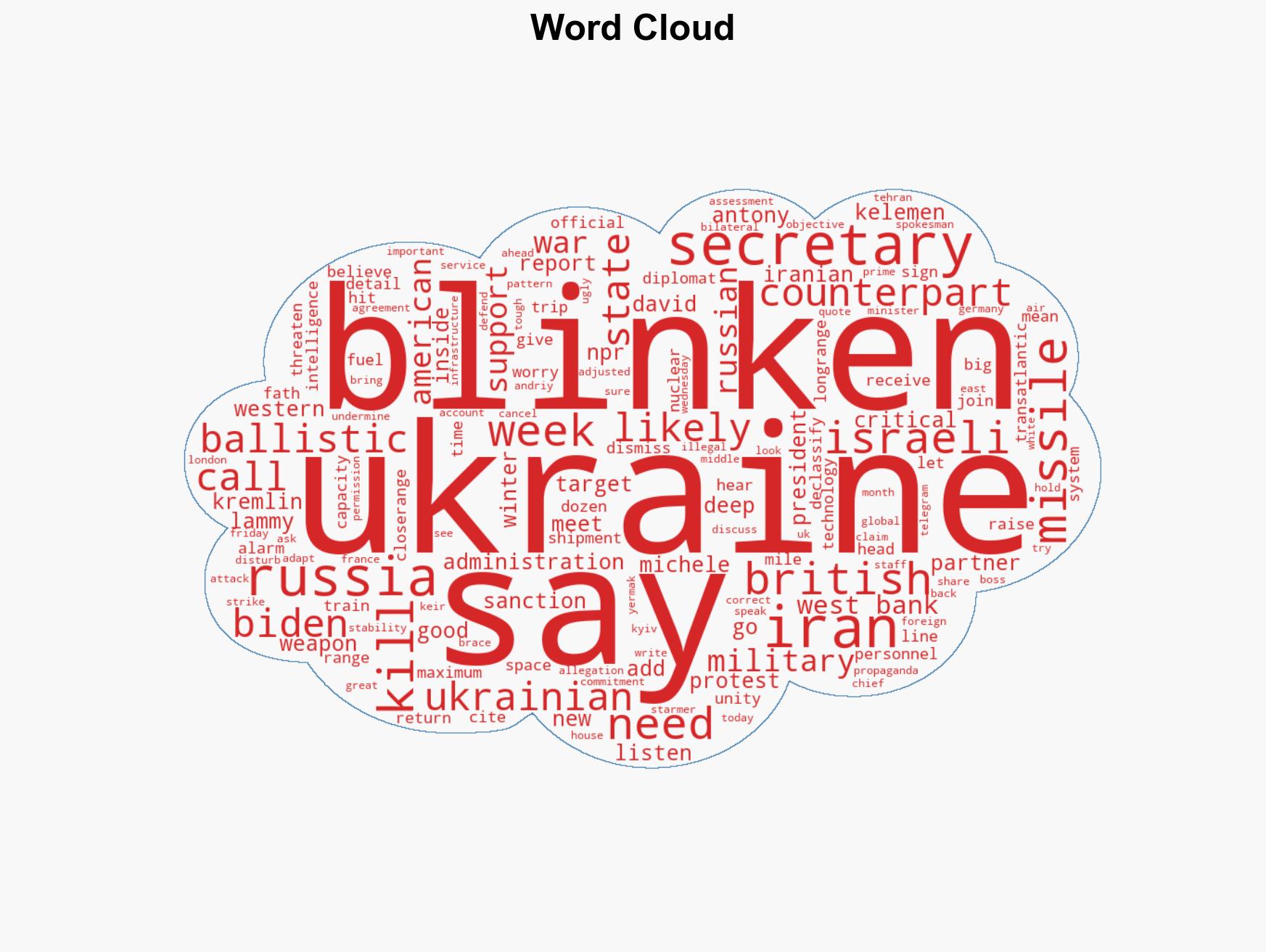
Intelligence Report: Blinken and British counterpart signal trans-Atlantic unity with visit to Ukraine
1. BLUF (Bottom Line Up Front)
The visit by Secretary of State Antony Blinken and British Foreign Secretary David Lammy to Ukraine underscores trans-Atlantic unity against Iranian support for Russia’s military efforts. The deployment of Iranian ballistic missiles to Russia represents a significant escalation, potentially altering the conflict dynamics in Ukraine. This development may lead to increased Western military support for Ukraine. Overall confidence in this assessment is moderate due to limited declassified intelligence details.
2. Competing Hypotheses
- Hypothesis A: Iran is actively supporting Russia’s military operations in Ukraine by providing ballistic missiles, enhancing Russia’s ability to strike Ukrainian targets. This is supported by U.S. intelligence reports and corroborated by British officials. However, Iran’s denial and lack of detailed evidence present uncertainties.
- Hypothesis B: The reports of Iranian missile support to Russia are exaggerated or part of a misinformation campaign to justify increased Western military aid to Ukraine. The lack of concrete evidence and Iran’s dismissal as “ugly propaganda” support this hypothesis.
- Assessment: Hypothesis A is currently better supported due to the alignment of U.S. and U.K. intelligence assessments and the strategic pattern of Iran-Russia cooperation. Indicators such as confirmed missile use in Ukraine or further intelligence disclosures could shift this judgment.
3. Key Assumptions and Red Flags
- Assumptions: The U.S. and U.K. intelligence assessments are accurate; Iran’s missile shipments are intended for use in Ukraine; Western responses will be limited to sanctions and military aid.
- Information Gaps: Specific details of the Iran-Russia exchange agreements; independent verification of missile deployment and usage in Ukraine.
- Bias & Deception Risks: Potential confirmation bias in interpreting intelligence; source bias from U.S. and U.K. intelligence; possible Iranian and Russian misinformation campaigns.
4. Implications and Strategic Risks
The deployment of Iranian missiles to Russia could escalate the conflict in Ukraine, prompting increased Western military aid and potentially broader geopolitical tensions.
- Political / Geopolitical: Strengthened Iran-Russia ties may lead to further isolation of Iran and increased Western sanctions.
- Security / Counter-Terrorism: Enhanced Russian missile capabilities could lead to more significant threats to Ukrainian infrastructure and civilian areas.
- Cyber / Information Space: Potential increase in cyber operations targeting Western allies as part of broader conflict dynamics.
- Economic / Social: Prolonged conflict could exacerbate economic instability in Ukraine and strain European economies due to increased defense spending.
5. Recommendations and Outlook
- Immediate Actions (0–30 days): Increase intelligence sharing among Western allies; enhance monitoring of Iranian military shipments; prepare contingency plans for increased military aid to Ukraine.
- Medium-Term Posture (1–12 months): Strengthen diplomatic efforts to isolate Iran; develop resilience measures for Ukrainian infrastructure; explore further sanctions and economic measures against Iran and Russia.
- Scenario Outlook:
- Best: Diplomatic efforts lead to de-escalation and cessation of Iranian support.
- Worst: Escalation leads to broader regional conflict involving NATO.
- Most-Likely: Continued proxy conflict with incremental Western military support to Ukraine.
6. Key Individuals and Entities
- Antony Blinken – U.S. Secretary of State
- David Lammy – British Foreign Secretary
- Andriy Yermak – Chief of Staff to the President of Ukraine
- Kremlin – Russian Government
- Iranian Government
7. Thematic Tags
regional conflicts, trans-Atlantic unity, Iranian missiles, Russia-Ukraine conflict, military aid, sanctions, intelligence sharing, geopolitical tensions
Structured Analytic Techniques Applied
- Causal Layered Analysis (CLA): Analyze events across surface happenings, systems, worldviews, and myths.
- Cross-Impact Simulation: Model ripple effects across neighboring states, conflicts, or economic dependencies.
- Scenario Generation: Explore divergent futures under varying assumptions to identify plausible paths.
Explore more:
Regional Conflicts Briefs ·
Daily Summary ·
Support us