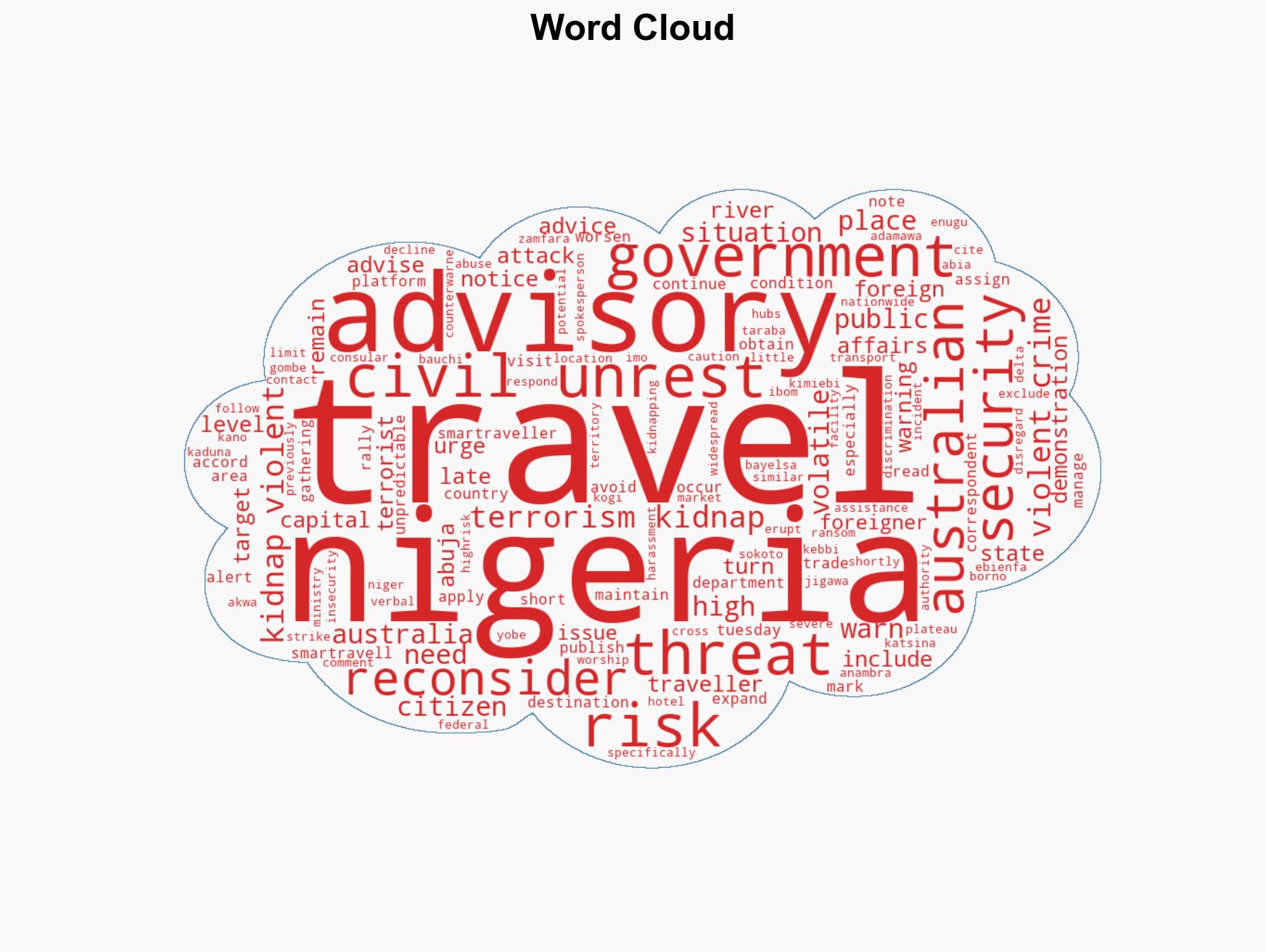
Australia issues travel advisory for 26 Nigerian states amid escalating security threats and civil unrest.
Published on: 2026-02-05
AI-powered OSINT brief from verified open sources. Automated NLP signal extraction with human verification. See our Methodology and Why WorldWideWatchers.
Intelligence Report: Australia warns against travel to 26 states in Nigeria
1. BLUF (Bottom Line Up Front)
The Australian government has issued a travel advisory against visiting 26 states in Nigeria due to escalating security threats, including terrorism, kidnapping, and civil unrest. This advisory affects Australian citizens and potentially impacts bilateral relations. The most likely hypothesis is that the security situation in Nigeria is deteriorating, warranting such advisories. Overall confidence in this assessment is moderate.
2. Competing Hypotheses
- Hypothesis A: The security situation in Nigeria has deteriorated significantly, justifying Australia’s travel advisory. Supporting evidence includes reports of terrorism, kidnapping, and civil unrest. Contradicting evidence is limited due to lack of detailed incident data.
- Hypothesis B: The advisory is a precautionary measure based on historical security concerns rather than recent developments. Supporting evidence includes the lack of new, specific incidents reported in the advisory. Contradicting evidence includes the explicit warning of high risks in public places.
- Assessment: Hypothesis A is currently better supported due to the explicit mention of high risks and the advisory’s focus on specific states. Key indicators that could shift this judgment include new intelligence on specific threats or a change in the security environment.
3. Key Assumptions and Red Flags
- Assumptions: The security threats are based on credible intelligence; the advisory reflects current conditions; Nigeria’s security forces are unable to mitigate these threats effectively.
- Information Gaps: Detailed incident reports and intelligence on specific threats in the affected states; Nigerian government response strategies.
- Bias & Deception Risks: Potential bias in reporting due to diplomatic tensions; risk of overestimating threats without corroborating evidence.
4. Implications and Strategic Risks
This development could lead to increased diplomatic tensions between Australia and Nigeria, affect regional stability, and influence foreign investment decisions.
- Political / Geopolitical: Potential strain on Australia-Nigeria relations; influence on other countries’ travel advisories.
- Security / Counter-Terrorism: Heightened alertness among international security agencies; potential for increased counter-terrorism operations in Nigeria.
- Cyber / Information Space: Possible exploitation of the situation by malicious actors to spread misinformation or conduct cyber operations.
- Economic / Social: Negative impact on Nigeria’s tourism and foreign investment; potential for increased social unrest due to economic pressures.
5. Recommendations and Outlook
- Immediate Actions (0–30 days): Enhance monitoring of security developments in Nigeria; engage in diplomatic dialogue to assess the situation; issue updated advisories as necessary.
- Medium-Term Posture (1–12 months): Develop resilience measures for citizens in Nigeria; strengthen intelligence-sharing with Nigerian authorities; explore partnerships for regional stability.
- Scenario Outlook:
- Best: Security situation stabilizes, leading to advisory downgrades.
- Worst: Escalation of violence and increased targeting of foreigners.
- Most-Likely: Continued volatility with sporadic incidents affecting travel advisories.
6. Key Individuals and Entities
- Not clearly identifiable from open sources in this snippet.
7. Thematic Tags
national security threats, counter-terrorism, travel advisory, diplomatic relations, civil unrest, kidnapping, security threats
Structured Analytic Techniques Applied
- Cognitive Bias Stress Test: Expose and correct potential biases in assessments through red-teaming and structured challenge.
- Bayesian Scenario Modeling: Use probabilistic forecasting for conflict trajectories or escalation likelihood.
- Network Influence Mapping: Map relationships between state and non-state actors for impact estimation.
Explore more:
National Security Threats Briefs ·
Daily Summary ·
Support us