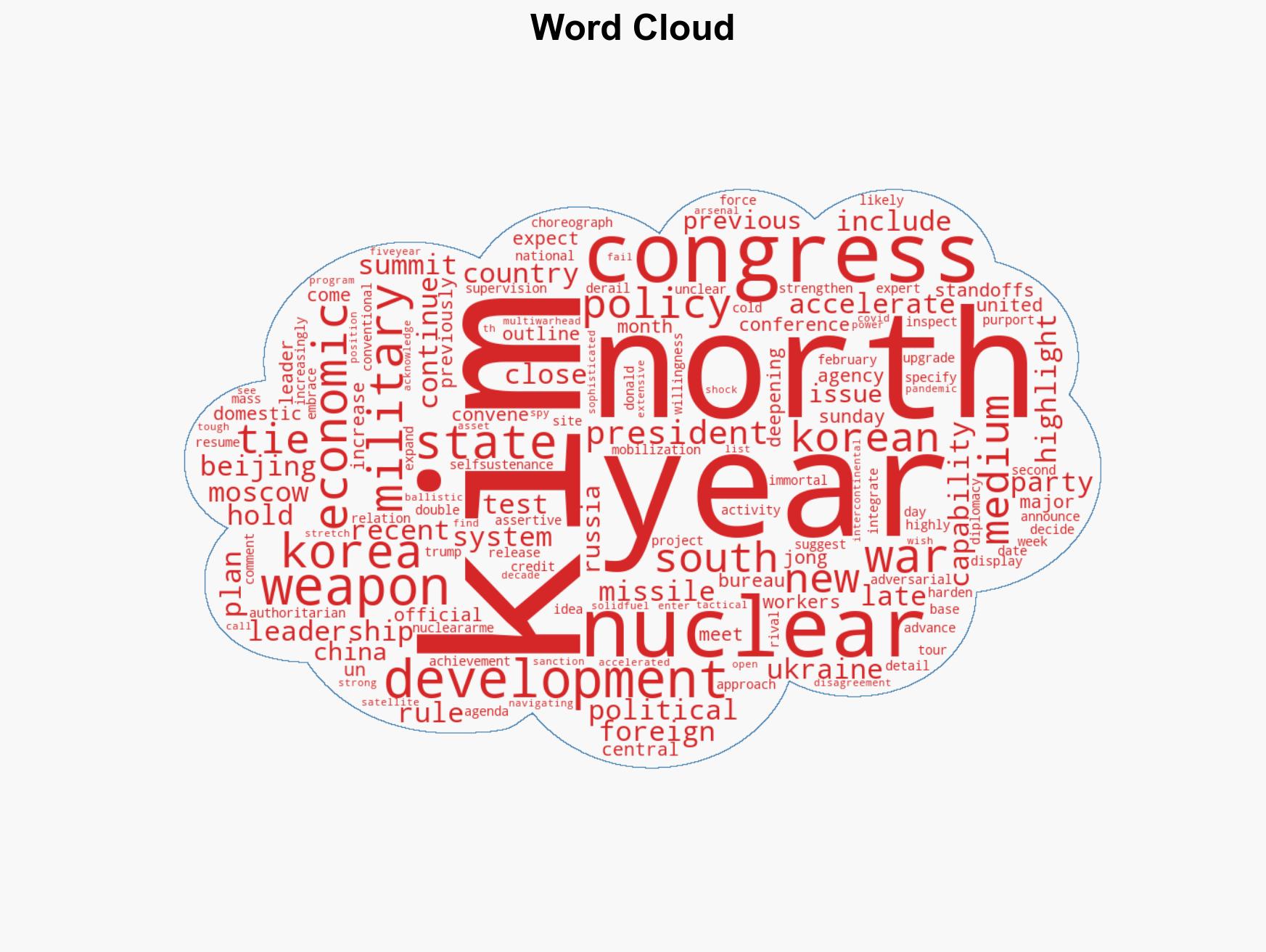
Kim Jong Un to unveil key policy initiatives at North Korea’s Workers’ Party congress later this month
Published on: 2026-02-08
AI-powered OSINT brief from verified open sources. Automated NLP signal extraction with human verification. See our Methodology and Why WorldWideWatchers.
Intelligence Report: Kim expected to issue major policy goals at North Korea party congress in late February
1. BLUF (Bottom Line Up Front)
North Korea’s upcoming party congress is expected to reinforce Kim Jong Un’s focus on military expansion and economic self-reliance, with potential implications for regional stability and international relations. The congress may solidify North Korea’s alignment with Russia and China, while maintaining an adversarial stance towards South Korea and the United States. Overall confidence in this assessment is moderate, given the lack of specific agenda details and potential for strategic deception by North Korean state media.
2. Competing Hypotheses
- Hypothesis A: Kim Jong Un will use the congress to announce a significant expansion of North Korea’s military capabilities and deepen ties with Russia and China. This is supported by recent military inspections and state media narratives. However, the lack of detailed agenda and potential for strategic posturing introduce uncertainty.
- Hypothesis B: The congress will focus primarily on domestic economic policies with limited foreign policy shifts. This could be inferred from Kim’s previous acknowledgment of economic challenges. Contradicting this is the emphasis on military achievements and foreign alliances in state media.
- Assessment: Hypothesis A is currently better supported due to the recent emphasis on military activities and foreign policy alignments in state media. Indicators that could shift this judgment include new economic policy announcements or diplomatic overtures towards the U.S.
3. Key Assumptions and Red Flags
- Assumptions: Kim Jong Un remains committed to military expansion; North Korea’s alignment with Russia and China will continue; domestic economic challenges persist.
- Information Gaps: Specific details of the congress agenda; internal political dynamics within North Korea’s leadership; real economic conditions in North Korea.
- Bias & Deception Risks: North Korean state media’s portrayal of events may be exaggerated or misleading; potential confirmation bias in interpreting military activities as aggressive posturing.
4. Implications and Strategic Risks
The developments at the congress could reinforce North Korea’s military posture and geopolitical alignments, impacting regional security dynamics and international diplomatic efforts.
- Political / Geopolitical: Strengthened ties with Russia and China may embolden North Korea’s adversarial stance towards the U.S. and South Korea, potentially escalating tensions.
- Security / Counter-Terrorism: Enhanced military capabilities could alter the regional threat landscape, necessitating adjustments in defense postures by neighboring countries.
- Cyber / Information Space: Potential increase in cyber operations as part of broader military strategy; propaganda efforts to shape international perceptions.
- Economic / Social: Continued focus on self-sustenance may exacerbate economic hardships, impacting social stability and humanitarian conditions.
5. Recommendations and Outlook
- Immediate Actions (0–30 days): Enhance intelligence collection on congress proceedings; engage regional allies to assess collective security measures.
- Medium-Term Posture (1–12 months): Strengthen diplomatic channels with China and Russia to mediate North Korean actions; bolster regional defense capabilities.
- Scenario Outlook:
- Best: Diplomatic engagement leads to de-escalation; triggers include conciliatory statements from North Korea.
- Worst: Military provocations escalate; triggers include new missile tests or aggressive rhetoric.
- Most-Likely: Continued military focus with limited diplomatic progress; triggers include reaffirmation of military goals at the congress.
6. Key Individuals and Entities
- Kim Jong Un, North Korean leader
- Workers’ Party of Korea
- Korean Central News Agency
- Russian President Vladimir Putin
- Chinese government (not specifically named)
7. Thematic Tags
regional conflicts, military expansion, North Korea, geopolitical alignment, economic self-reliance, regional security, diplomacy, nuclear capabilities
Structured Analytic Techniques Applied
- Causal Layered Analysis (CLA): Analyze events across surface happenings, systems, worldviews, and myths.
- Cross-Impact Simulation: Model ripple effects across neighboring states, conflicts, or economic dependencies.
- Scenario Generation: Explore divergent futures under varying assumptions to identify plausible paths.
- Adversarial Threat Simulation: Model hostile behavior to identify vulnerabilities.
Explore more:
Regional Conflicts Briefs ·
Daily Summary ·
Support us