Canadians show interest in Chinese vehicles despite expert warnings on data privacy concerns
Published on: 2026-02-16
AI-powered OSINT brief from verified open sources. Automated NLP signal extraction with human verification. See our Methodology and Why WorldWideWatchers.
Intelligence Report: Canadians are ready for Chinese-made autos but experts note there are security risks
1. BLUF (Bottom Line Up Front)
There is moderate confidence that while Canadian consumers are open to purchasing Chinese-made electric vehicles (EVs), there are significant security and privacy concerns associated with these vehicles. The primary affected parties include Canadian consumers, the automotive industry, and national security stakeholders. The most likely hypothesis is that consumer interest will continue to grow despite these concerns, driven by market demand and perceptions of privacy as a secondary issue.
2. Competing Hypotheses
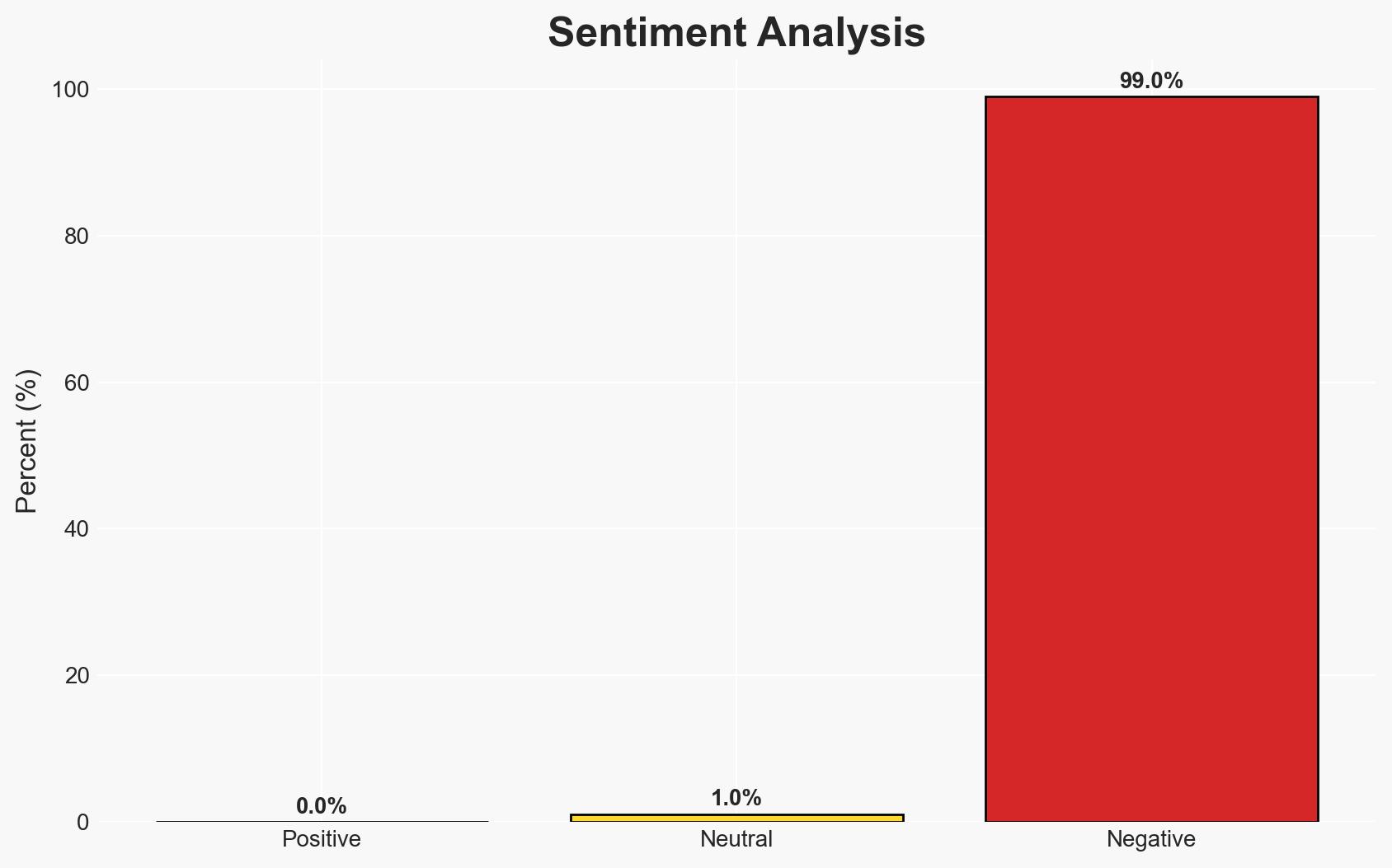
- Hypothesis A: Canadian consumers will prioritize cost and availability of Chinese-made EVs over privacy concerns. This is supported by survey data indicating 61% favorability towards Chinese EVs and consumer statements minimizing privacy risks. However, uncertainties include the potential for increased public awareness of privacy issues to shift consumer attitudes.
- Hypothesis B: Privacy and security concerns will deter significant adoption of Chinese-made EVs in Canada. This is contradicted by current consumer sentiment and survey data, but could gain traction if there are high-profile data breaches or geopolitical tensions that highlight these risks.
- Assessment: Hypothesis A is currently better supported due to prevailing consumer attitudes and the lack of immediate, tangible privacy incidents. Key indicators that could shift this judgment include changes in privacy legislation, publicized data breaches, or geopolitical developments affecting China-Canada relations.
3. Key Assumptions and Red Flags
- Assumptions: Canadian consumers are informed about privacy risks; Chinese EVs are competitively priced; privacy concerns are secondary to other purchasing factors; Canadian privacy laws remain unchanged.
- Information Gaps: Detailed data on the specific privacy risks associated with Chinese-made EVs; consumer behavior trends over time; potential legislative changes in privacy laws.
- Bias & Deception Risks: Consumer surveys may reflect bias towards economic factors over security; potential underreporting of privacy incidents by manufacturers; geopolitical narratives influencing public perception.
4. Implications and Strategic Risks
The introduction of Chinese-made EVs into the Canadian market could have several implications across various domains, potentially affecting national security, economic stability, and consumer privacy.
- Political / Geopolitical: Potential strain on Canada-China relations if privacy concerns escalate; impact on trade negotiations and diplomatic engagements.
- Security / Counter-Terrorism: Increased risk of data exploitation by foreign entities; potential for vehicles to be used as surveillance tools.
- Cyber / Information Space: Enhanced vulnerability to cyber-attacks targeting vehicle data; potential for misinformation campaigns exploiting privacy fears.
- Economic / Social: Disruption to the domestic automotive industry; potential consumer backlash if privacy issues become prominent.
5. Recommendations and Outlook
- Immediate Actions (0–30 days): Monitor consumer sentiment and sales data; engage with cybersecurity experts to assess vehicle vulnerabilities; initiate public awareness campaigns on privacy risks.
- Medium-Term Posture (1–12 months): Develop partnerships with cybersecurity firms; advocate for stronger privacy legislation; enhance regulatory frameworks for imported vehicles.
- Scenario Outlook:
- Best: Privacy concerns are mitigated through robust legislation, fostering a competitive and secure market.
- Worst: Major data breach leads to public outcry and regulatory crackdowns, damaging trade relations.
- Most-Likely: Gradual increase in Chinese EV adoption with ongoing privacy debates and incremental regulatory adjustments.
6. Key Individuals and Entities
- David Masson, Vice-President and Field Chief Information Security Officer at Darktrace
- Pierre Poilievre, Conservative Leader
- Doug Ford, Ontario Premier
- Not clearly identifiable from open sources in this snippet.
7. Thematic Tags
cybersecurity, national security, data privacy, automotive industry, Canada-China relations, consumer behavior, electric vehicles
Structured Analytic Techniques Applied
- Adversarial Threat Simulation: Model and simulate actions of cyber adversaries to anticipate vulnerabilities and improve resilience.
- Indicators Development: Detect and monitor behavioral or technical anomalies across systems for early threat detection.
- Bayesian Scenario Modeling: Quantify uncertainty and predict cyberattack pathways using probabilistic inference.
- Network Influence Mapping: Map influence relationships to assess actor impact.
Explore more:
Cybersecurity Briefs ·
Daily Summary ·
Support us