Federal Task Force Launches Investigation into Nonprofits Allegedly Funding Domestic Extremism
Published on: 2026-03-19
AI-powered OSINT brief from verified open sources. Automated NLP signal extraction with human verification. See our Methodology and Why WorldWideWatchers.
Intelligence Report: New federal task force formed to investigate nonprofits funding domestic terror groups
1. BLUF (Bottom Line Up Front)
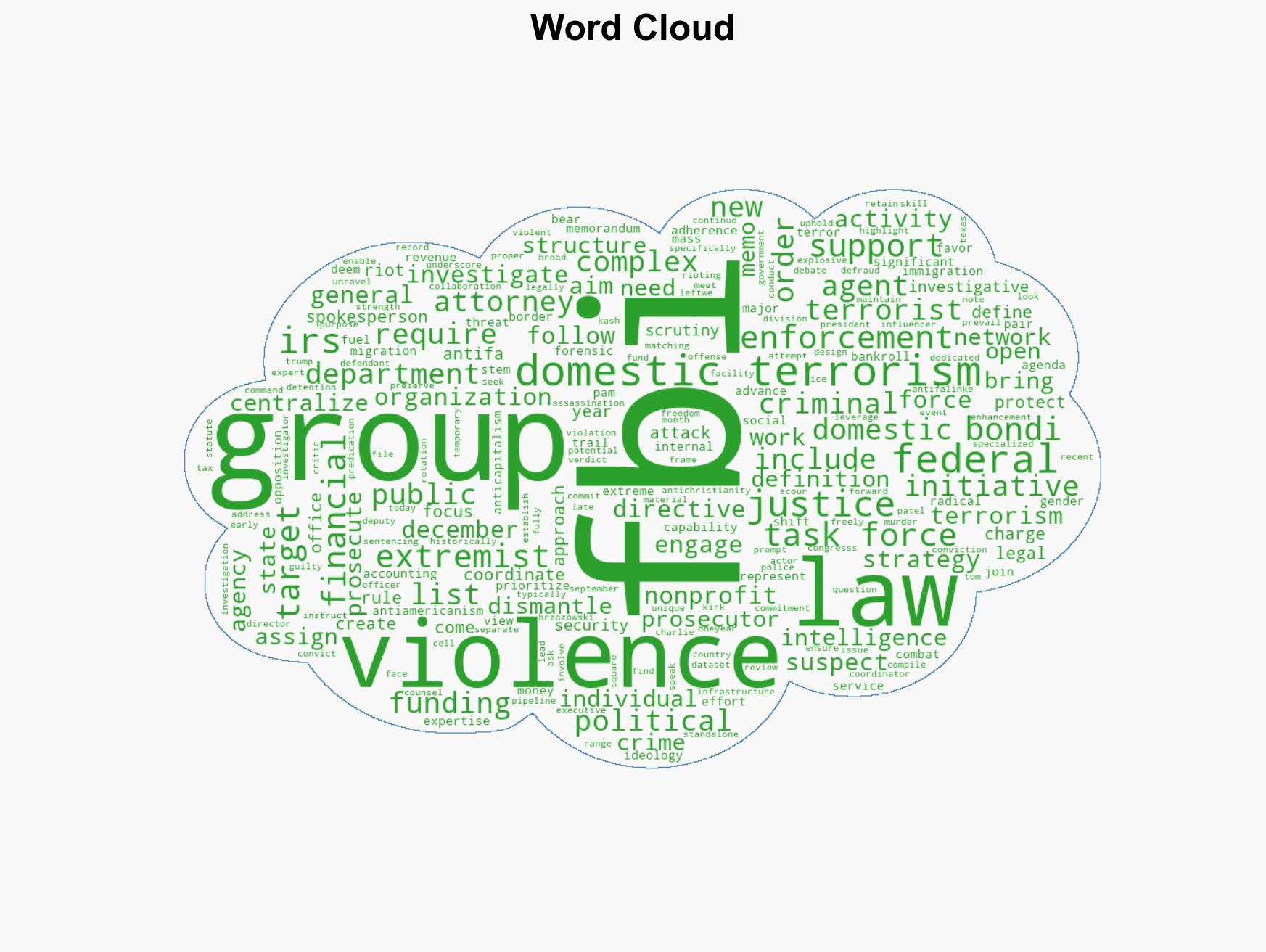
The formation of a federal task force combining the FBI and IRS to investigate nonprofits funding domestic terrorism represents a strategic shift in counter-terrorism efforts, focusing on financial networks. This initiative targets groups with extremist political agendas, potentially altering the domestic security landscape. The overall confidence level in this assessment is moderate, given the lack of public information on targeted groups and outcomes.
2. Competing Hypotheses
- Hypothesis A: The task force will effectively dismantle financial networks supporting domestic terrorism, reducing extremist activities. This is supported by the specialized capabilities of the FBI and IRS in intelligence and forensic accounting, respectively. However, the lack of transparency on targeted groups and potential legal challenges could hinder effectiveness.
- Hypothesis B: The task force may face significant challenges in achieving its objectives due to legal complexities and potential political bias, leading to limited impact on domestic terrorism. The focus on specific ideologies, such as left-wing extremism, may skew operations and outcomes.
- Assessment: Hypothesis A is currently better supported due to the strategic alignment of FBI and IRS capabilities, but ongoing monitoring of legal and political developments is crucial. Indicators such as successful prosecutions or public backlash could shift this judgment.
3. Key Assumptions and Red Flags
- Assumptions: The task force will have access to sufficient intelligence and financial data; legal frameworks will support prosecution efforts; political directives will not unduly influence operations.
- Information Gaps: Specific criteria for targeting groups; details on the legal framework for prosecuting financial crimes linked to terrorism; public reaction to the task force’s activities.
- Bias & Deception Risks: Potential political bias in targeting specific ideologies; risk of manipulation of financial data by targeted groups to evade detection.
4. Implications and Strategic Risks
This development could lead to increased scrutiny of nonprofit organizations and alter the landscape of domestic terrorism financing. It may also provoke political and legal debates over civil liberties and the definition of extremism.
- Political / Geopolitical: Potential for increased political polarization and debates over civil liberties and government overreach.
- Security / Counter-Terrorism: Enhanced capability to disrupt financial support for extremist groups, potentially reducing domestic terror incidents.
- Cyber / Information Space: Potential for increased cyber operations by targeted groups to protect financial data or retaliate against government actions.
- Economic / Social: Nonprofits may face increased compliance costs and scrutiny, affecting their operations and public perception.
5. Recommendations and Outlook
- Immediate Actions (0–30 days): Establish clear communication channels between the FBI and IRS; develop criteria for targeting groups; initiate public outreach to clarify objectives and legal frameworks.
- Medium-Term Posture (1–12 months): Monitor legal challenges and public perception; enhance inter-agency collaboration; develop resilience measures for potential cyber threats.
- Scenario Outlook:
- Best: Successful dismantling of financial networks, reduced extremist activities.
- Worst: Legal challenges and political backlash undermine task force effectiveness.
- Most-Likely: Moderate success with ongoing legal and political challenges.
6. Key Individuals and Entities
- Attorney General Pam Bondi
- FBI
- IRS Criminal Investigation Division
- Justice Department
- U.S. Attorney Offices
7. Thematic Tags
national security threats, counter-terrorism, domestic terrorism, financial networks, nonprofit organizations, legal challenges, political bias, inter-agency collaboration
Structured Analytic Techniques Applied
- Cognitive Bias Stress Test: Expose and correct potential biases in assessments through red-teaming and structured challenge.
- Bayesian Scenario Modeling: Use probabilistic forecasting for conflict trajectories or escalation likelihood.
- Network Influence Mapping: Map influence relationships to assess actor impact.
- Narrative Pattern Analysis: Deconstruct and track propaganda or influence narratives.
Explore more:
National Security Threats Briefs ·
Daily Summary ·
Support us