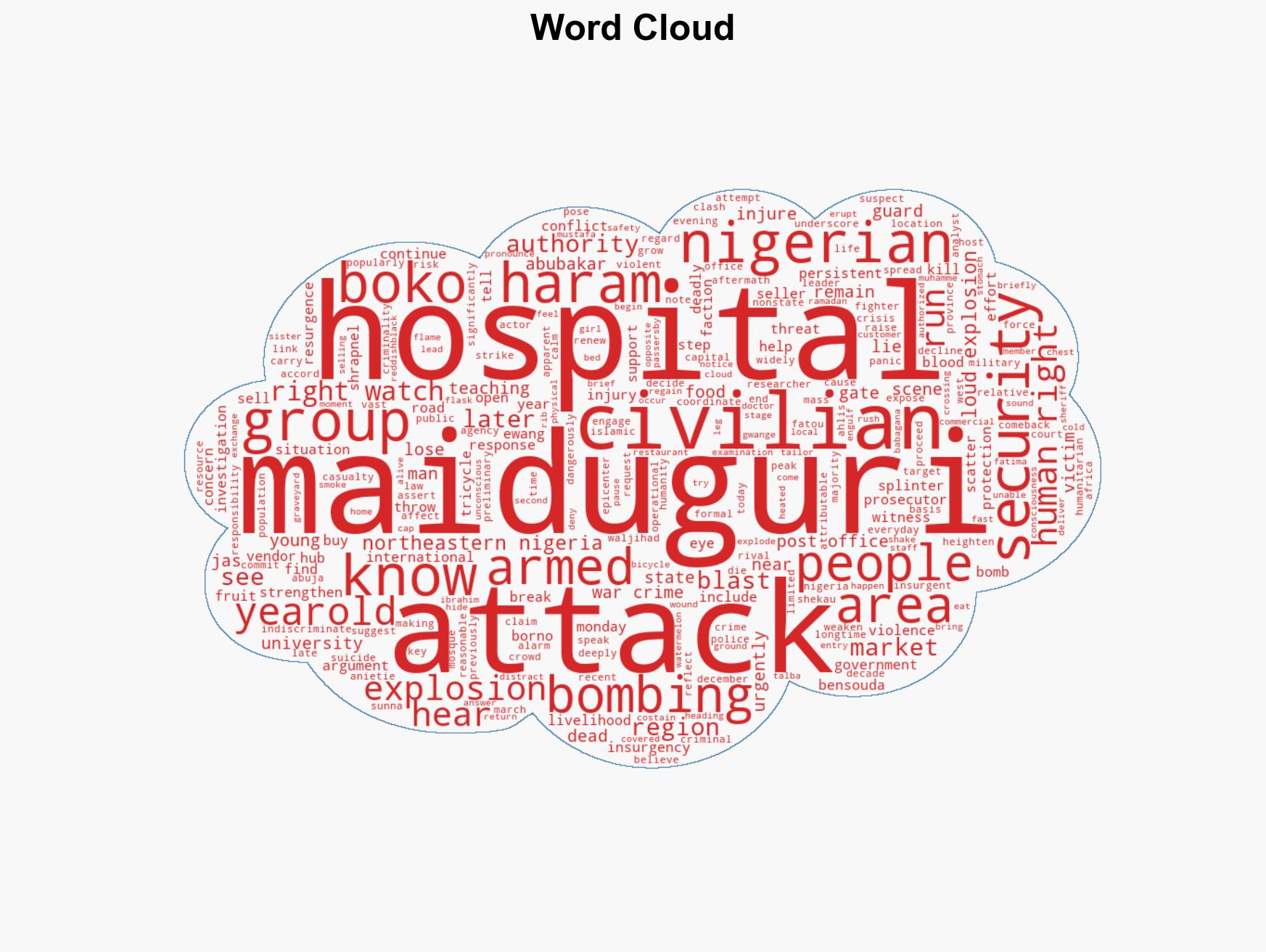
Maiduguri Bombings Highlight Escalating Civilian Risks Amid Boko Haram Resurgence
Published on: 2026-03-26
AI-powered OSINT brief from verified open sources. Automated NLP signal extraction with human verification. See our Methodology and Why WorldWideWatchers.
Intelligence Report: Nigeria Maiduguri Bombings Show New Threat to Civilians
1. BLUF (Bottom Line Up Front)
The recent bombings in Maiduguri indicate a potential resurgence of Boko Haram activities, posing a renewed threat to civilian safety in northeastern Nigeria. The attacks highlight the ongoing vulnerability of the region despite prolonged security efforts. The most likely hypothesis is that Boko Haram or its splinter factions are responsible, reflecting their continued operational capability. Overall confidence in this assessment is moderate due to the lack of a direct claim of responsibility.
2. Competing Hypotheses
- Hypothesis A: Boko Haram or its splinter groups are responsible for the Maiduguri bombings. This is supported by the modus operandi and historical patterns of attacks by these groups, as well as the Nigerian military’s assessment. However, the absence of a claim of responsibility introduces uncertainty.
- Hypothesis B: Another unidentified group or faction could be responsible, possibly aiming to leverage the chaos for strategic gains. The lack of a claim of responsibility and the potential for new actors in the region support this hypothesis but lack concrete evidence.
- Assessment: Hypothesis A is currently better supported due to the alignment with known Boko Haram tactics and the Nigerian military’s suspicion. Indicators such as a claim of responsibility or intelligence on new group activities could shift this judgment.
3. Key Assumptions and Red Flags
- Assumptions: Boko Haram retains operational capability; Nigerian security forces have limited capacity to fully secure the region; the attacks were intended to cause mass casualties and panic.
- Information Gaps: Lack of direct claim of responsibility; specific intelligence on the current strength and leadership of Boko Haram factions.
- Bias & Deception Risks: Potential over-reliance on historical patterns of Boko Haram behavior; possible manipulation of narratives by local actors to influence public perception.
4. Implications and Strategic Risks
The resurgence of attacks in Maiduguri could destabilize the region further, affecting humanitarian efforts and regional security dynamics.
- Political / Geopolitical: Increased pressure on the Nigerian government to enhance security measures; potential for international scrutiny and calls for intervention.
- Security / Counter-Terrorism: Heightened threat environment requiring intensified counter-terrorism operations; risk of further attacks on civilian targets.
- Cyber / Information Space: Potential for misinformation campaigns to exploit the situation, affecting public trust in government responses.
- Economic / Social: Disruption of local economies and increased displacement; potential strain on social cohesion and humanitarian resources.
5. Recommendations and Outlook
- Immediate Actions (0–30 days): Increase intelligence gathering and surveillance in Maiduguri; enhance security presence at key civilian locations.
- Medium-Term Posture (1–12 months): Strengthen regional security partnerships; invest in community resilience and counter-radicalization programs.
- Scenario Outlook: Best: Successful containment of Boko Haram activities with improved security. Worst: Escalation of attacks leading to regional instability. Most-Likely: Continued sporadic attacks with gradual security improvements.
6. Key Individuals and Entities
- Not clearly identifiable from open sources in this snippet.
7. Thematic Tags
Counter-Terrorism, Boko Haram, civilian protection, Nigerian security, insurgency, humanitarian impact, regional stability
Structured Analytic Techniques Applied
- ACH 2.0: Reconstruct likely threat actor intentions via hypothesis testing and structured refutation.
- Indicators Development: Track radicalization signals and propaganda patterns to anticipate operational planning.
- Narrative Pattern Analysis: Analyze spread/adaptation of ideological narratives for recruitment/incitement signals.
Explore more:
Counter-Terrorism Briefs ·
Daily Summary ·
Support us