US Defense Department Accelerates Production of Key Weapons in Anticipation of Major Conflicts
Published on: 2026-03-26
AI-powered OSINT brief from verified open sources. Automated NLP signal extraction with human verification. See our Methodology and Why WorldWideWatchers.
Intelligence Report: The US military is pushing up production for the weapons that could matter most in a major war
1. BLUF (Bottom Line Up Front)
The US Department of Defense is significantly increasing the production of critical missile systems in response to depleted stockpiles and anticipated future conflicts, particularly with China. This move is likely to impact defense contractors, military readiness, and geopolitical stability. Overall confidence in this assessment is moderate, given the available data and potential for strategic misdirection.
2. Competing Hypotheses
- Hypothesis A: The US is ramping up production primarily to address immediate stockpile shortages and prepare for potential conflicts with China. Supporting evidence includes recent agreements with major defense contractors and the high expenditure rate of these weapons. However, uncertainties remain regarding the exact timeline and scale of potential conflicts.
- Hypothesis B: The production increase is a strategic move to deter adversaries by showcasing enhanced military capabilities. This hypothesis is supported by the public nature of the announcements and the focus on advanced systems like THAAD and Tomahawks. Contradicting evidence includes the urgency implied by current stockpile depletion.
- Assessment: Hypothesis A is currently better supported due to the immediate need to replenish stockpiles and the specific focus on systems used in recent conflicts. Indicators such as further production agreements or changes in geopolitical tensions could shift this judgment.
3. Key Assumptions and Red Flags
- Assumptions: The US anticipates a high likelihood of conflict with China; current stockpile levels are insufficient for sustained operations; defense contractors can meet increased production demands.
- Information Gaps: Precise stockpile levels, detailed timelines for production increases, and specific intelligence on adversary capabilities and intentions.
- Bias & Deception Risks: Potential overestimation of threat levels due to cognitive bias; source bias from defense contractors with vested interests; possible strategic deception by adversaries to mislead US defense planning.
4. Implications and Strategic Risks
This development could lead to an arms race, increased regional tensions, and shifts in global power dynamics. The focus on missile production may also influence allied and adversary defense strategies.
- Political / Geopolitical: Potential escalation in US-China tensions; pressure on allies to increase their own defense capabilities.
- Security / Counter-Terrorism: Enhanced US readiness may deter adversaries but could also provoke asymmetric responses.
- Cyber / Information Space: Increased risk of cyber-espionage targeting defense contractors and potential misinformation campaigns.
- Economic / Social: Boost to the defense sector economy but potential public concern over military spending priorities.
5. Recommendations and Outlook
- Immediate Actions (0–30 days): Monitor production progress and stockpile levels; engage with allies to align defense strategies; enhance cybersecurity measures for defense contractors.
- Medium-Term Posture (1–12 months): Develop resilience through diversified supply chains; strengthen diplomatic channels to manage tensions; invest in next-generation defense technologies.
- Scenario Outlook:
- Best Case: Increased production deters adversaries, leading to strategic stability.
- Worst Case: Production surge triggers an arms race, escalating regional conflicts.
- Most Likely: Enhanced readiness improves deterrence but maintains current tension levels, with potential for isolated conflicts.
6. Key Individuals and Entities
- Department of Defense
- Lockheed Martin
- BAE Systems
- Raytheon (RTX Corporation)
- US Navy
- Not clearly identifiable from open sources in this snippet.
7. Thematic Tags
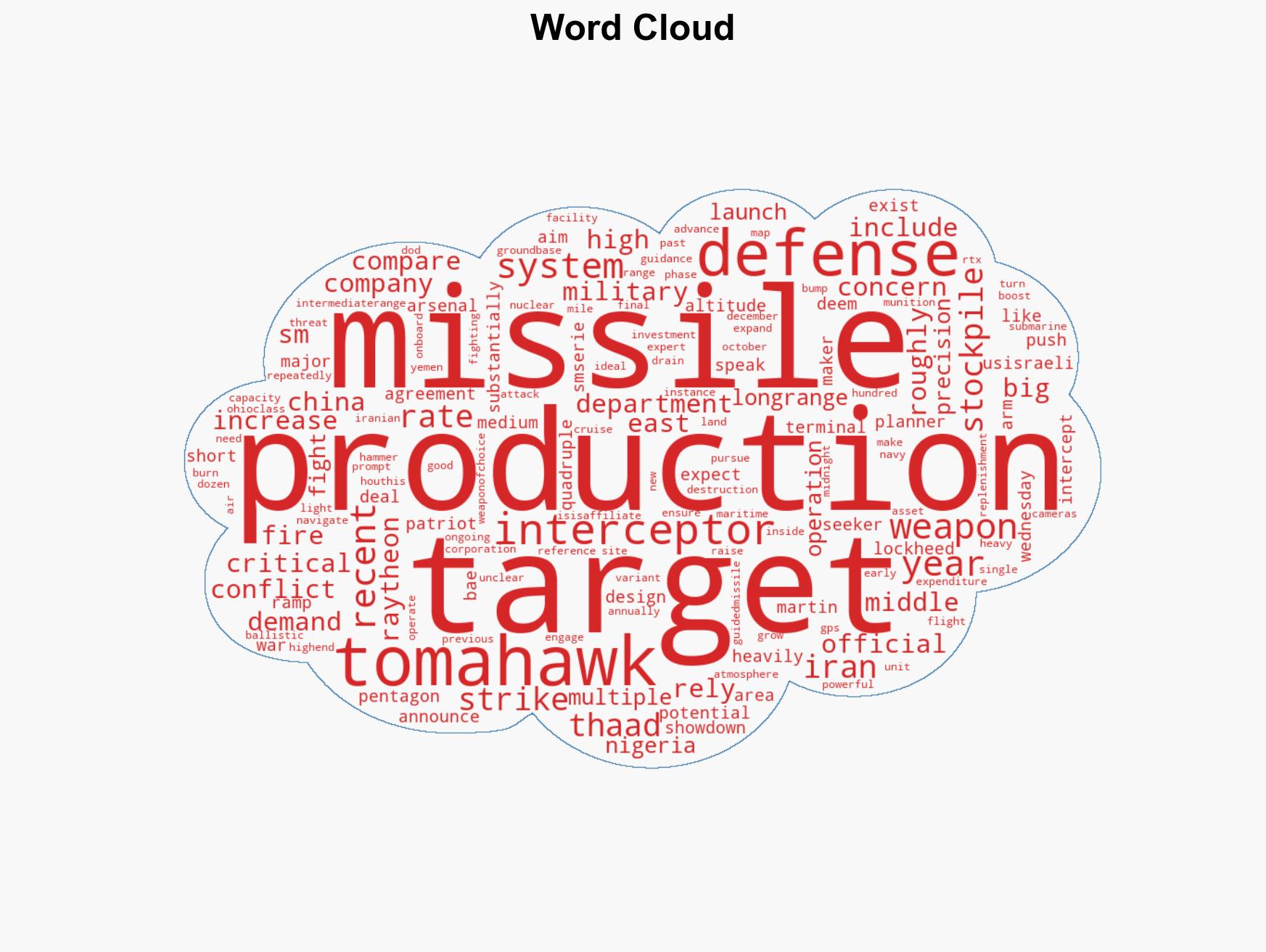
regional conflicts, military readiness, defense production, US-China relations, missile systems, stockpile management, geopolitical tensions, defense contractors
Structured Analytic Techniques Applied
- Causal Layered Analysis (CLA): Analyze events across surface happenings, systems, worldviews, and myths.
- Cross-Impact Simulation: Model ripple effects across neighboring states, conflicts, or economic dependencies.
- Scenario Generation: Explore divergent futures under varying assumptions to identify plausible paths.
Explore more:
Regional Conflicts Briefs ·
Daily Summary ·
Support us