Opposition Leader Criticizes Government for Uncoordinated Multi-Front Military Engagements
Published on: 2026-03-27
AI-powered OSINT brief from verified open sources. Automated NLP signal extraction with human verification. See our Methodology and Why WorldWideWatchers.
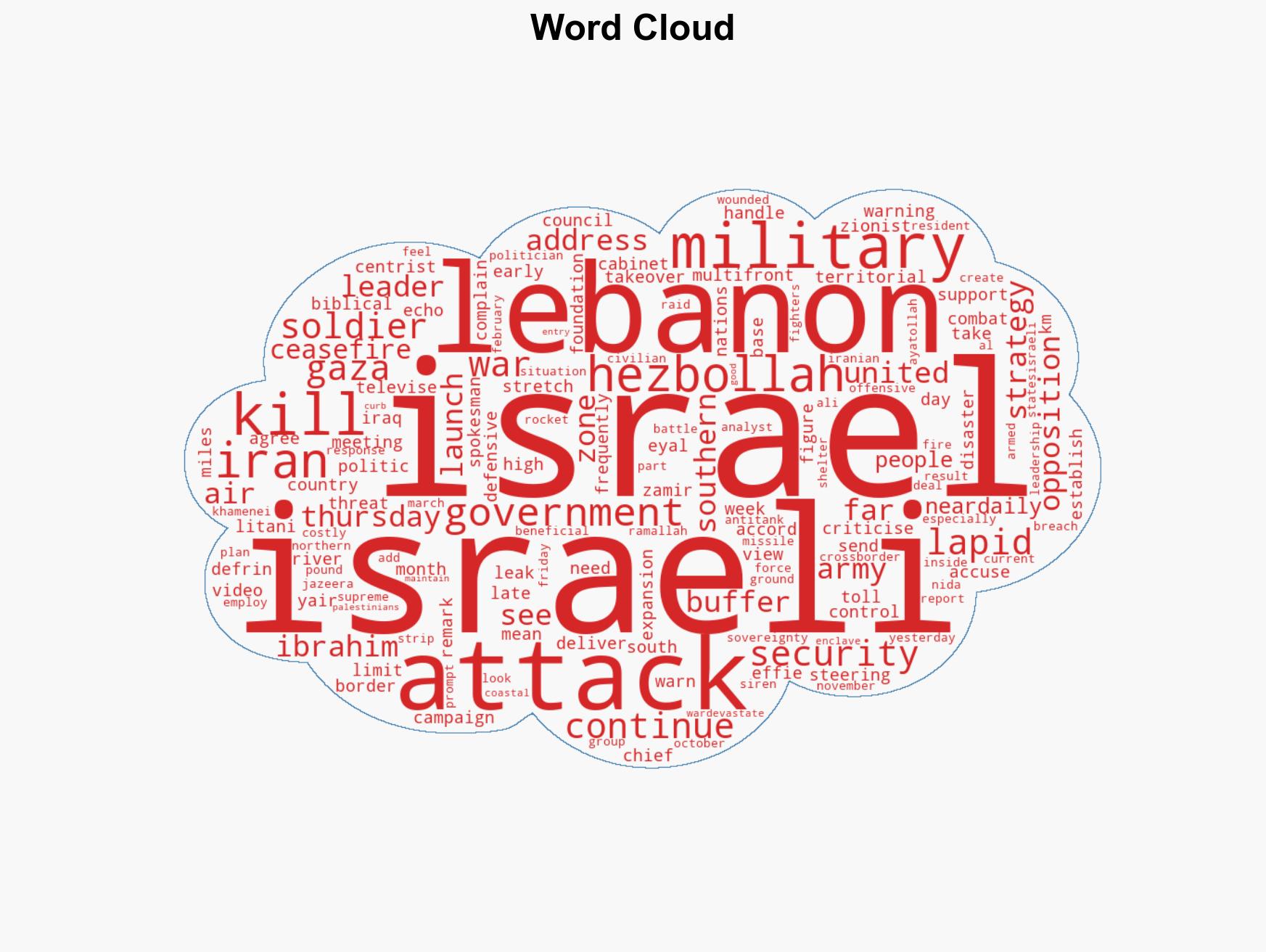
Intelligence Report: Israeli opposition leader rails against multi-front war without strategy
1. BLUF (Bottom Line Up Front)
The Israeli opposition leader Yair Lapid criticizes the government’s strategy in engaging in a multi-front war, highlighting potential security and military overstretch. The situation poses significant risks to Israel’s national security and regional stability. The most likely hypothesis is that the current strategy will lead to increased military and civilian casualties, with moderate confidence.
2. Competing Hypotheses
- Hypothesis A: The Israeli government lacks a coherent strategy for the multi-front war, leading to military overstretch and increased casualties. This is supported by Lapid’s criticism and the military’s call for more soldiers. However, the exact strategic objectives of the government remain unclear, representing a key uncertainty.
- Hypothesis B: The Israeli government has a strategic plan that is not publicly disclosed, aiming to achieve long-term security objectives despite short-term costs. This is contradicted by public criticism from military and political figures, suggesting a lack of consensus or communication.
- Assessment: Hypothesis A is currently better supported due to public statements from opposition and military leaders indicating strategic deficiencies. Key indicators that could shift this judgment include official government disclosures of strategic objectives or a significant change in military tactics.
3. Key Assumptions and Red Flags
- Assumptions: The Israeli military is operating at or beyond capacity; the government lacks a coherent multi-front strategy; opposition criticism reflects genuine strategic concerns; Hezbollah and Iran will continue aggressive actions.
- Information Gaps: Detailed Israeli government strategic objectives; Hezbollah and Iran’s long-term military plans; internal Israeli military assessments.
- Bias & Deception Risks: Potential bias in opposition statements aiming to undermine government credibility; risk of misinformation from involved parties to manipulate public perception.
4. Implications and Strategic Risks
The ongoing conflict could escalate, affecting regional stability and increasing international involvement. The lack of a clear strategy may lead to prolonged military engagement and higher casualties.
- Political / Geopolitical: Potential for increased tensions with Lebanon and Iran, impacting regional alliances and international diplomatic efforts.
- Security / Counter-Terrorism: Increased threat of retaliatory attacks within Israel and against Israeli interests abroad.
- Cyber / Information Space: Potential for cyber operations targeting Israeli infrastructure and information campaigns to sway public opinion.
- Economic / Social: Economic strain from prolonged military engagement and social unrest due to rising casualties and perceived government failures.
5. Recommendations and Outlook
- Immediate Actions (0–30 days): Increase intelligence collection on government strategy; enhance diplomatic engagement with regional allies; prepare contingency plans for civilian protection.
- Medium-Term Posture (1–12 months): Strengthen military resilience and logistics; develop partnerships for regional stability; invest in public communication strategies to manage domestic perceptions.
- Scenario Outlook: Best: De-escalation through diplomatic channels; Worst: Full-scale regional conflict; Most-Likely: Continued skirmishes with periodic escalations, contingent on government strategy clarity and international mediation efforts.
6. Key Individuals and Entities
- Yair Lapid – Israeli opposition leader
- Eyal Zamir – Israeli military chief
- Effie Defrin – Israeli military spokesman
- Hezbollah – Lebanese militant group
- Iran – Regional adversary
- Israeli Government – Current ruling entity
7. Thematic Tags
regional conflicts, multi-front conflict, Israeli military strategy, regional stability, Hezbollah, Iran-Israel tensions, military overstretch, opposition criticism
Structured Analytic Techniques Applied
- Causal Layered Analysis (CLA): Analyze events across surface happenings, systems, worldviews, and myths.
- Cross-Impact Simulation: Model ripple effects across neighboring states, conflicts, or economic dependencies.
- Scenario Generation: Explore divergent futures under varying assumptions to identify plausible paths.
Explore more:
Regional Conflicts Briefs ·
Daily Summary ·
Support us