Addressing Antisemitism: A Crucial Step for the Future of Christianity Amid Rising Violence
Published on: 2026-03-29
AI-powered OSINT brief from verified open sources. Automated NLP signal extraction with human verification. See our Methodology and Why WorldWideWatchers.
Intelligence Report: Fighting antisemitism would save Christianity
1. BLUF (Bottom Line Up Front)
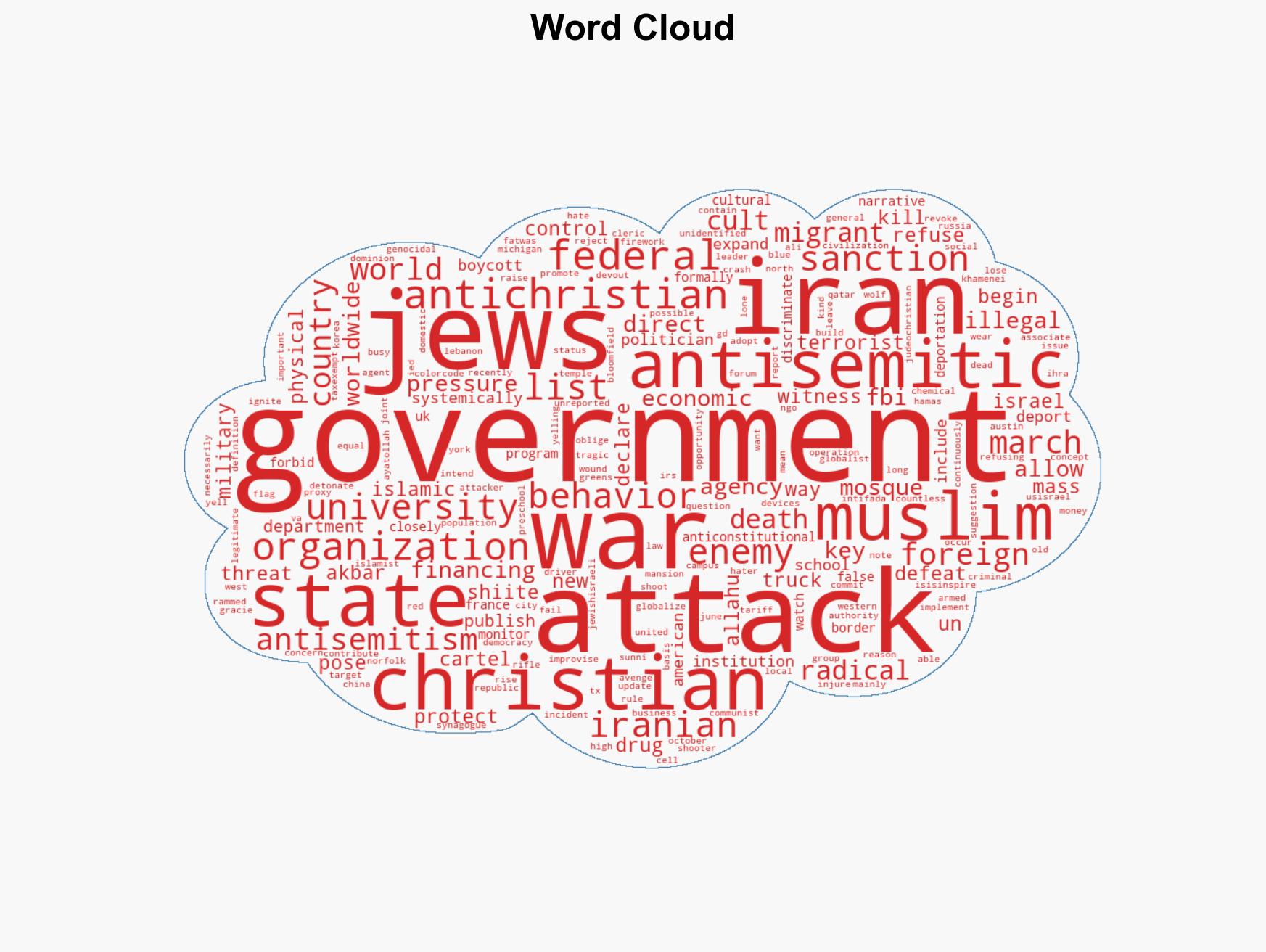
The rise in antisemitic and anti-Christian attacks in the United States, linked to geopolitical tensions and religious extremism, poses a significant threat to national security and social cohesion. The most likely hypothesis is that these attacks are part of a broader strategy by hostile state and non-state actors to destabilize Western societies. Confidence in this assessment is moderate, given the complexity of the actors involved and the potential for misinformation.
2. Competing Hypotheses
- Hypothesis A: The increase in antisemitic and anti-Christian attacks is primarily driven by state-sponsored actors, such as Iran, leveraging religious extremism to destabilize Western societies. Supporting evidence includes the coordinated nature of attacks and the geopolitical context of the U.S.-Iran conflict. Key uncertainties involve the extent of state control over individual attackers.
- Hypothesis B: The attacks are primarily the result of decentralized radicalization among individuals and small groups, with minimal direct state involvement. This is supported by the “lone wolf” nature of some incidents. However, the simultaneous rise in attacks suggests some level of coordination or inspiration from larger networks.
- Assessment: Hypothesis A is currently better supported due to the geopolitical context and the issuance of fatwas calling for revenge, indicating a level of state or organized non-state actor involvement. Indicators that could shift this judgment include evidence of independent radicalization or a lack of direct links to state actors.
3. Key Assumptions and Red Flags
- Assumptions: The attacks are linked to geopolitical tensions; religious extremism is a significant motivator; state and non-state actors are coordinating efforts.
- Information Gaps: The specific role of state actors in coordinating or inspiring attacks; the extent of radicalization within U.S. borders.
- Bias & Deception Risks: Potential confirmation bias in attributing attacks to state actors; risk of misinformation from biased sources or propaganda.
4. Implications and Strategic Risks
The continuation of antisemitic and anti-Christian attacks could exacerbate social divisions and strain law enforcement resources, potentially leading to increased domestic instability.
- Political / Geopolitical: Escalation of tensions between the U.S. and Iran, potential for broader international conflict.
- Security / Counter-Terrorism: Increased threat level, necessitating enhanced security measures and intelligence operations.
- Cyber / Information Space: Potential for cyber operations targeting critical infrastructure or spreading disinformation.
- Economic / Social: Potential economic impacts from increased security costs and social unrest, affecting business operations and community cohesion.
5. Recommendations and Outlook
- Immediate Actions (0–30 days): Enhance intelligence sharing with allies, increase monitoring of extremist networks, and strengthen community outreach programs to counter radicalization.
- Medium-Term Posture (1–12 months): Develop resilience measures, including public awareness campaigns and interfaith dialogue initiatives, and strengthen partnerships with international counter-terrorism organizations.
- Scenario Outlook:
- Best Case: Successful disruption of extremist networks, leading to a decrease in attacks.
- Worst Case: Escalation of attacks leading to significant loss of life and societal disruption.
- Most Likely: Continued sporadic attacks with gradual improvements in counter-terrorism effectiveness.
6. Key Individuals and Entities
- Ayatollah Ali Khamenei (deceased)
- Iranian proxy groups
- U.S. law enforcement and intelligence agencies
- Not clearly identifiable from open sources in this snippet.
7. Thematic Tags
national security threats, counter-terrorism, antisemitism, religious extremism, geopolitical tensions, U.S.-Iran relations, radicalization, national security
Structured Analytic Techniques Applied
- Cognitive Bias Stress Test: Expose and correct potential biases in assessments through red-teaming and structured challenge.
- Bayesian Scenario Modeling: Use probabilistic forecasting for conflict trajectories or escalation likelihood.
- Network Influence Mapping: Map relationships between state and non-state actors for impact estimation.
Explore more:
National Security Threats Briefs ·
Daily Summary ·
Support us