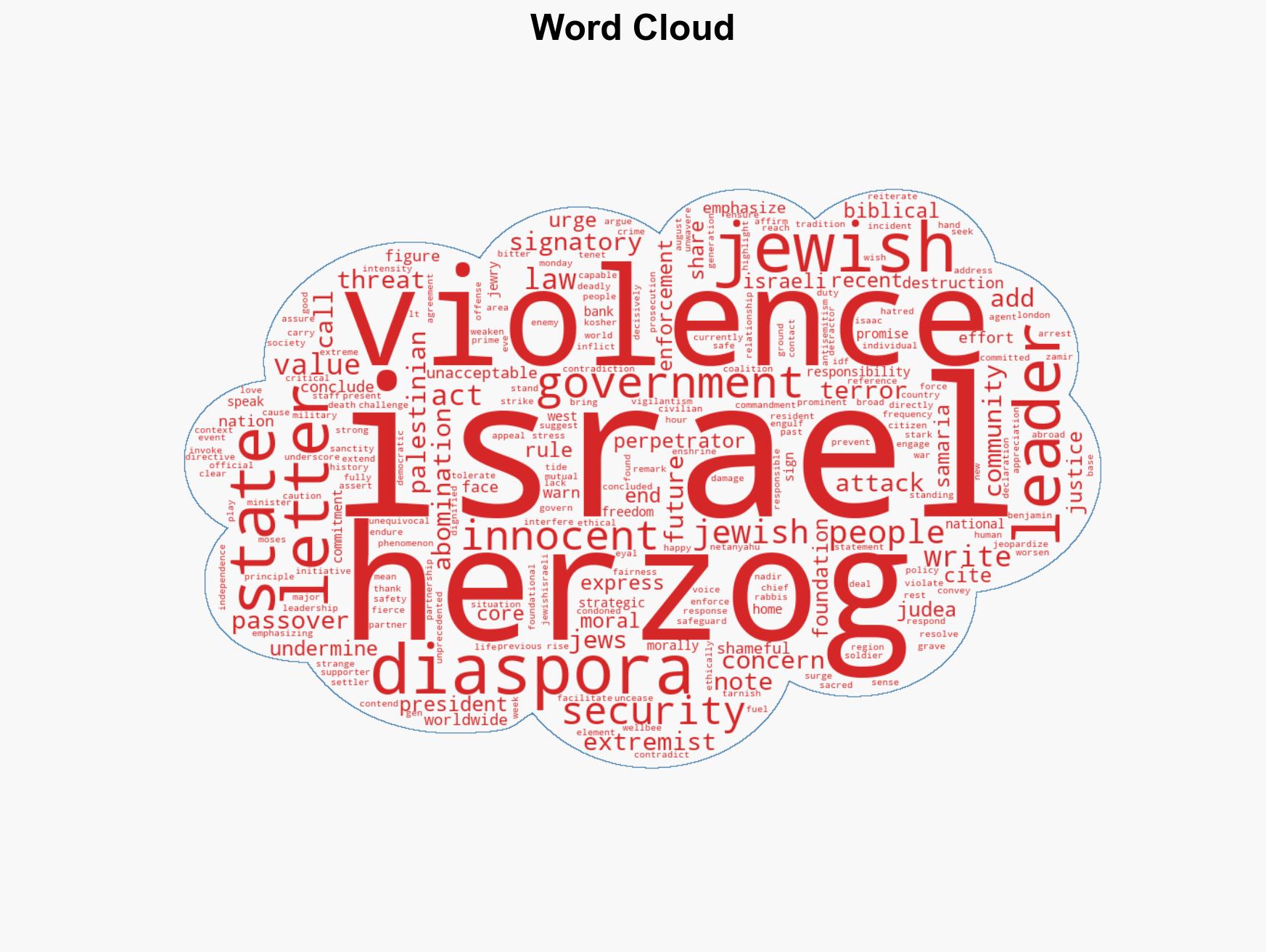
Herzog condemns extremist violence as a violation of Israel’s core values and ethical traditions
Published on: 2026-03-30
AI-powered OSINT brief from verified open sources. Automated NLP signal extraction with human verification. See our Methodology and Why WorldWideWatchers.
Intelligence Report: Herzog Extremist attacks in stark contradiction to Jewish values
1. BLUF (Bottom Line Up Front)
Israeli President Isaac Herzog has condemned recent extremist violence in Judea and Samaria, emphasizing its contradiction with Jewish values and the rule of law. This development could undermine Israel’s internal security and international image. The most likely hypothesis is that the violence is driven by fringe extremist groups, not representative of broader societal values. Overall confidence in this judgment is moderate.
2. Competing Hypotheses
- Hypothesis A: The violence is primarily driven by small, uncoordinated extremist groups acting independently. This is supported by Herzog’s emphasis on the acts being in stark contradiction to Jewish values and the rule of law, suggesting they are not state-sanctioned. However, there is uncertainty about the extent of these groups’ networks and support.
- Hypothesis B: The violence is part of a broader, organized effort with tacit support from certain political factions within Israel. This hypothesis is less supported due to Herzog’s strong public condemnation and the lack of evidence indicating state or widespread political support.
- Assessment: Hypothesis A is currently better supported, as there is no clear evidence of organized, state-supported violence. Key indicators that could shift this judgment include evidence of coordination among extremist groups or political endorsements of such actions.
3. Key Assumptions and Red Flags
- Assumptions: The violence is not state-sanctioned; extremist groups are relatively small and uncoordinated; Herzog’s statements reflect genuine concern and intent to act.
- Information Gaps: Detailed intelligence on the size, structure, and funding of the extremist groups involved; the response and measures taken by Israeli security forces.
- Bias & Deception Risks: Potential bias in public statements aimed at maintaining international support; risk of underestimating the organizational capacity of extremist groups.
4. Implications and Strategic Risks
This development could exacerbate tensions within Israel and between Israel and the international community, potentially affecting diplomatic relations and security dynamics.
- Political / Geopolitical: Increased scrutiny from international bodies and potential diplomatic fallout if violence continues unchecked.
- Security / Counter-Terrorism: Potential diversion of resources from counter-terrorism efforts against Palestinian threats to address internal extremist violence.
- Cyber / Information Space: Possible exploitation of the situation by adversaries through disinformation campaigns to weaken Israel’s international standing.
- Economic / Social: Risk of social unrest and economic instability if violence escalates or if international sanctions are considered.
5. Recommendations and Outlook
- Immediate Actions (0–30 days): Increase intelligence gathering on extremist groups; enhance public communication to clarify government stance and actions.
- Medium-Term Posture (1–12 months): Strengthen community engagement and deradicalization programs; foster international cooperation to counteract negative narratives.
- Scenario Outlook:
- Best Case: Effective law enforcement leads to a rapid decline in violence, restoring stability.
- Worst Case: Escalation of violence leads to international condemnation and potential sanctions.
- Most Likely: Continued isolated incidents with gradual reduction through targeted interventions.
6. Key Individuals and Entities
- Isaac Herzog – President of Israel
- Benjamin Netanyahu – Prime Minister of Israel
- Not clearly identifiable from open sources in this snippet.
7. Thematic Tags
national security threats, extremism, rule of law, Israel security, Jewish values, international relations, counter-terrorism, community engagement
Structured Analytic Techniques Applied
- Cognitive Bias Stress Test: Expose and correct potential biases in assessments through red-teaming and structured challenge.
- Bayesian Scenario Modeling: Use probabilistic forecasting for conflict trajectories or escalation likelihood.
- Network Influence Mapping: Map relationships between state and non-state actors for impact estimation.
Explore more:
National Security Threats Briefs ·
Daily Summary ·
Support us