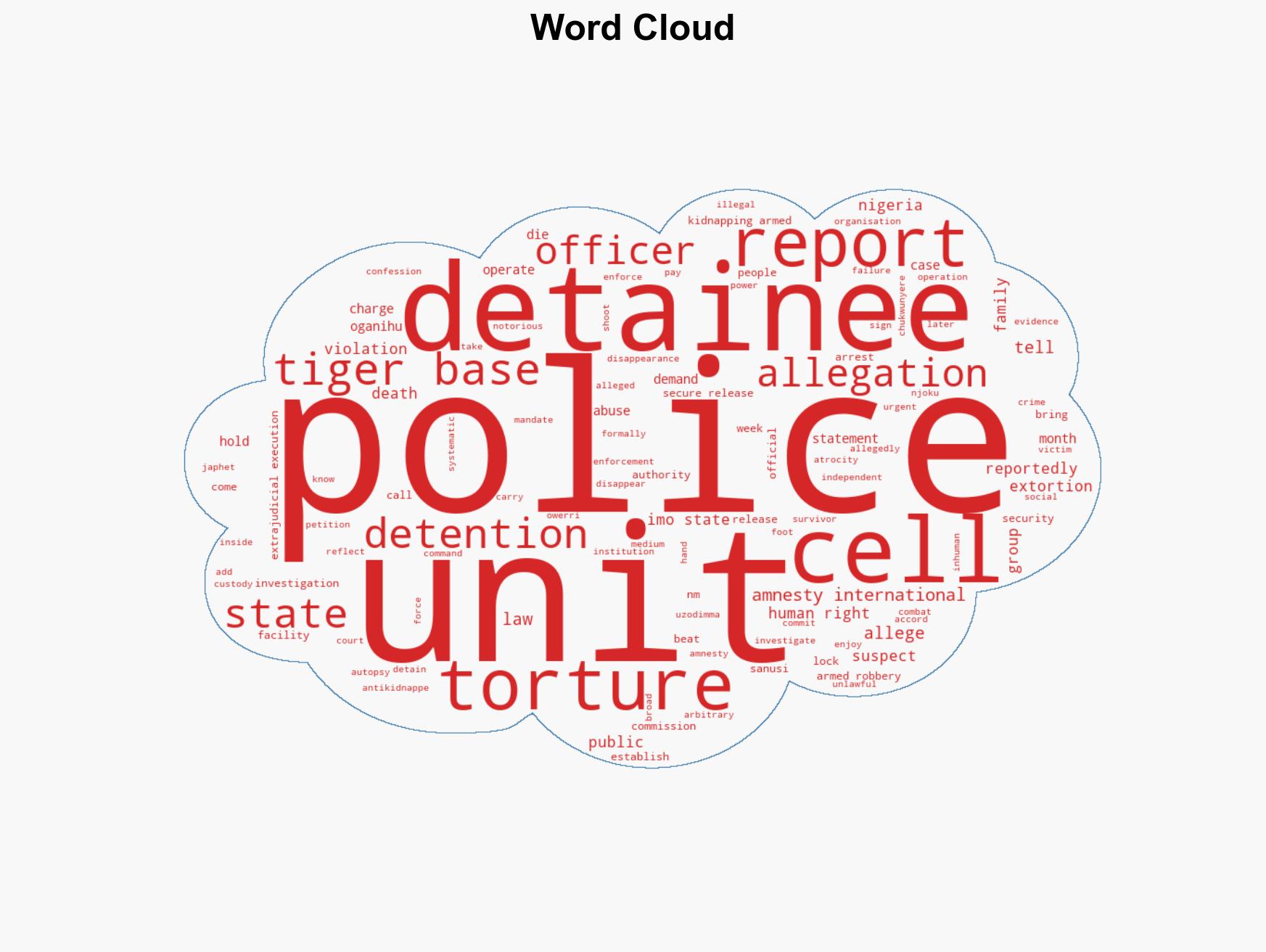
Amnesty International reports on torture and extrajudicial killings by Imo State’s anti-kidnapping unit
Published on: 2026-02-26
AI-powered OSINT brief from verified open sources. Automated NLP signal extraction with human verification. See our Methodology and Why WorldWideWatchers.
Intelligence Report: Amnesty alleges torture extrajudicial killings at Imo Tiger Base
1. BLUF (Bottom Line Up Front)
The Amnesty International report alleges severe human rights abuses by the Imo State Police Anti-Kidnapping Unit, known as “Tiger Base,” including torture, extrajudicial killings, and extortion. These allegations, if substantiated, could significantly undermine public trust in law enforcement and escalate tensions in the region. The most likely hypothesis is that systemic abuse is occurring at the Tiger Base, with moderate confidence due to the credibility of Amnesty International but limited corroborative evidence.
2. Competing Hypotheses
- Hypothesis A: The Imo State Police Anti-Kidnapping Unit is systematically engaging in human rights abuses, including torture and extrajudicial killings. This is supported by detailed testimonies and patterns of abuse reported by Amnesty International. However, there is a lack of independent verification from other sources.
- Hypothesis B: The allegations are exaggerated or manipulated, possibly as part of a campaign to discredit the police unit or due to misinformation. This hypothesis is less supported due to the absence of evidence contradicting Amnesty’s report and the organization’s established credibility.
- Assessment: Hypothesis A is currently better supported due to the detailed nature of the allegations and the credibility of Amnesty International. Key indicators that could shift this judgment include independent investigations corroborating or refuting the claims.
3. Key Assumptions and Red Flags
- Assumptions: The Amnesty International report is based on credible and unbiased sources; the Imo State Police have not conducted internal investigations into these allegations; the reported abuses are not isolated incidents.
- Information Gaps: Lack of independent verification from other human rights organizations or governmental bodies; absence of official responses or actions from Nigerian authorities.
- Bias & Deception Risks: Potential bias in the report due to reliance on testimonies from former detainees; possible manipulation of narratives by interested parties to influence public perception.
4. Implications and Strategic Risks
The allegations could exacerbate distrust in law enforcement and fuel civil unrest, potentially destabilizing the region. If unaddressed, these issues may lead to broader implications for governance and security.
- Political / Geopolitical: Increased scrutiny on Nigerian governance and human rights practices; potential international pressure or sanctions.
- Security / Counter-Terrorism: Diminished effectiveness of law enforcement due to loss of public cooperation; potential for increased criminal activity or insurgency.
- Cyber / Information Space: Potential for misinformation campaigns or cyber-attacks targeting Nigerian authorities or Amnesty International.
- Economic / Social: Erosion of social cohesion and economic stability due to decreased trust in public institutions.
5. Recommendations and Outlook
- Immediate Actions (0–30 days): Initiate independent investigations into the allegations; engage with international human rights organizations for verification and support.
- Medium-Term Posture (1–12 months): Develop resilience measures to restore public trust in law enforcement; enhance oversight mechanisms within police units.
- Scenario Outlook:
- Best: Allegations are addressed, leading to reforms and restored public confidence.
- Worst: Continued abuses lead to widespread unrest and international sanctions.
- Most-Likely: Partial reforms with ongoing scrutiny and pressure from international bodies.
6. Key Individuals and Entities
- Amnesty International Nigeria Director, Isa Sanusi
- Imo State Police Anti-Kidnapping Unit
- Amnesty International Social Media and Communications Officer, Michael Christian
- Not clearly identifiable from open sources in this snippet.
7. Thematic Tags
national security threats, human rights, police misconduct, Nigeria, Amnesty International, extrajudicial killings, torture, extortion
Structured Analytic Techniques Applied
- Cognitive Bias Stress Test: Expose and correct potential biases in assessments through red-teaming and structured challenge.
- Bayesian Scenario Modeling: Use probabilistic forecasting for conflict trajectories or escalation likelihood.
- Network Influence Mapping: Map relationships between state and non-state actors for impact estimation.
Explore more:
National Security Threats Briefs ·
Daily Summary ·
Support us