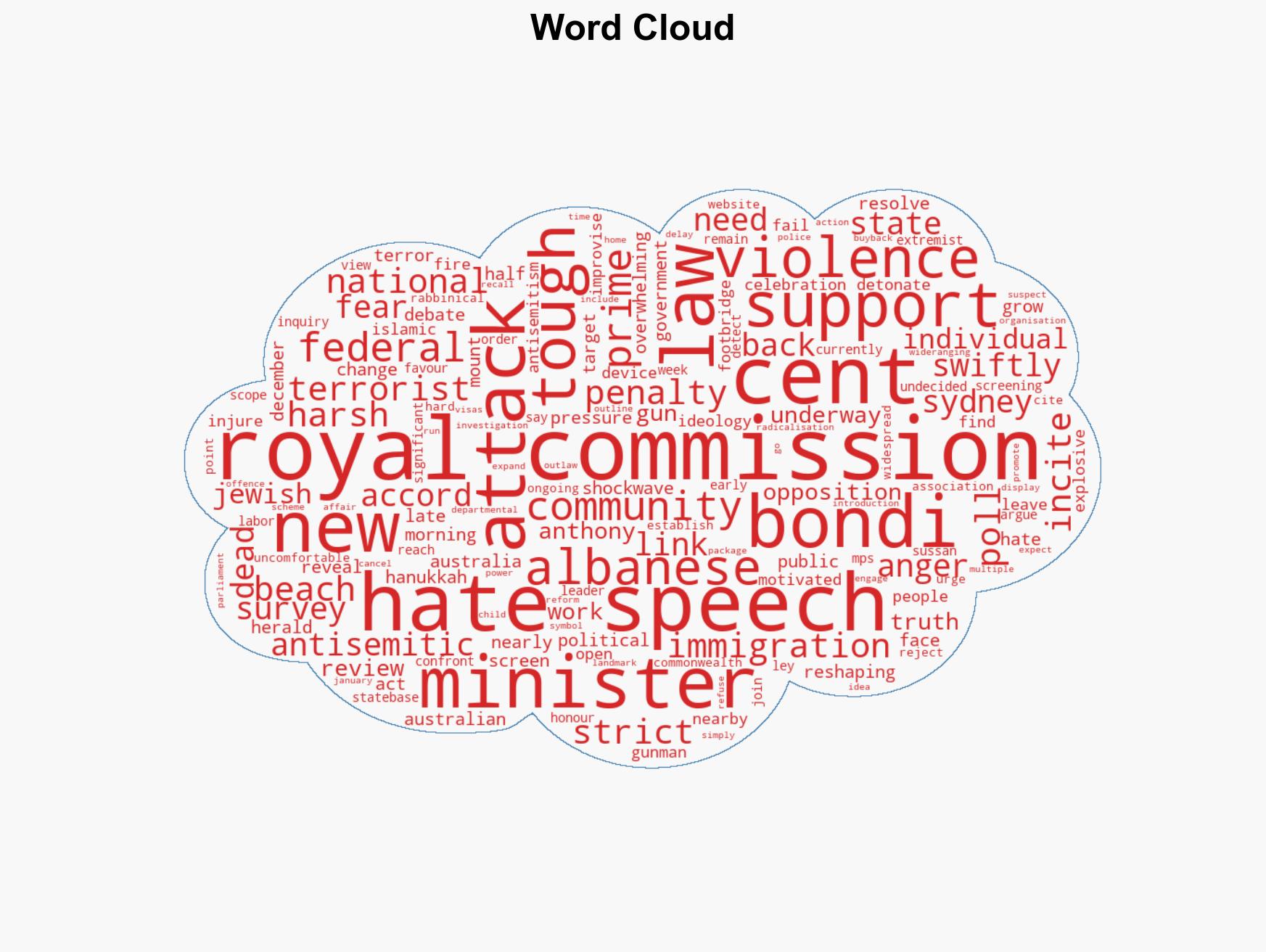
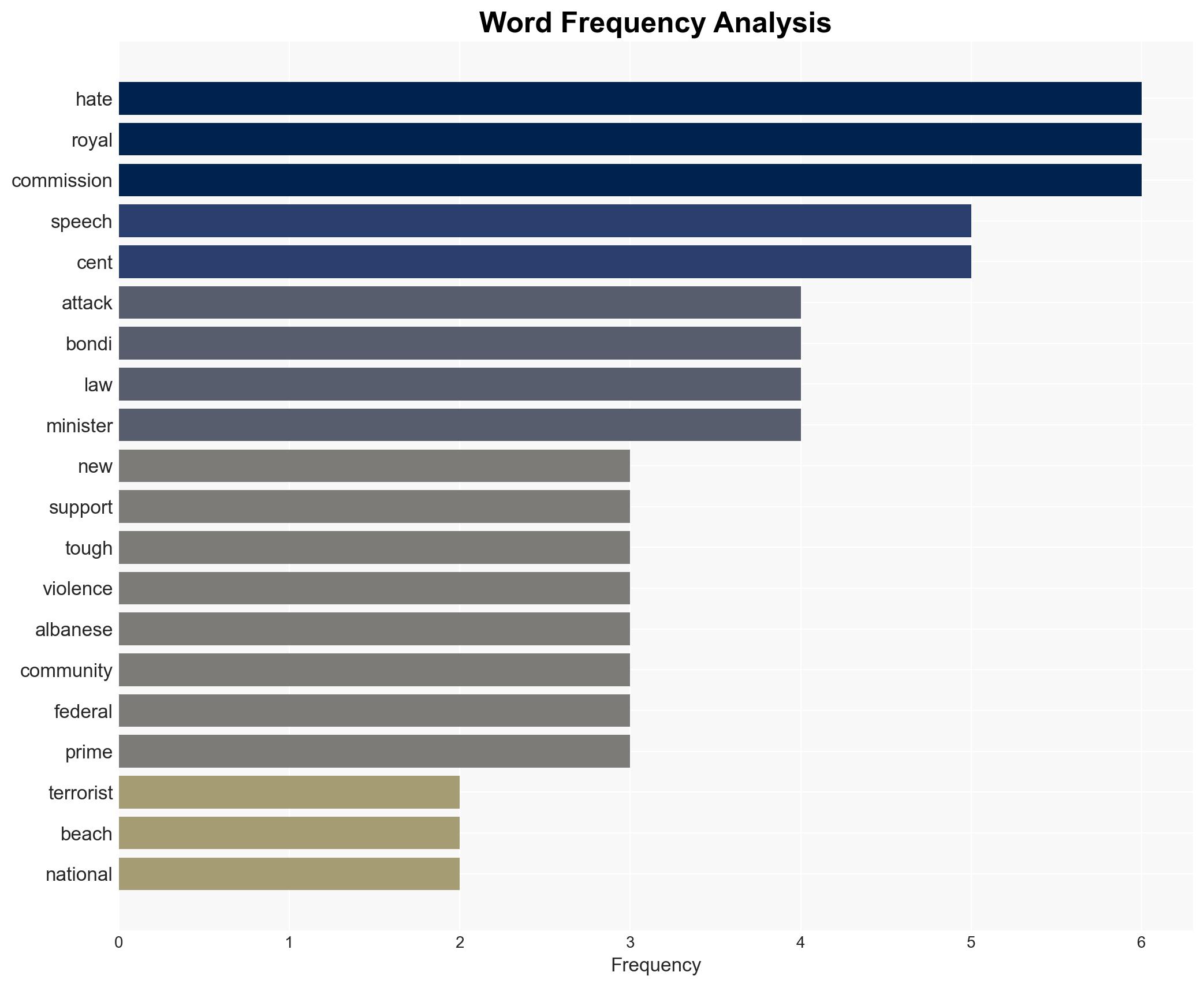
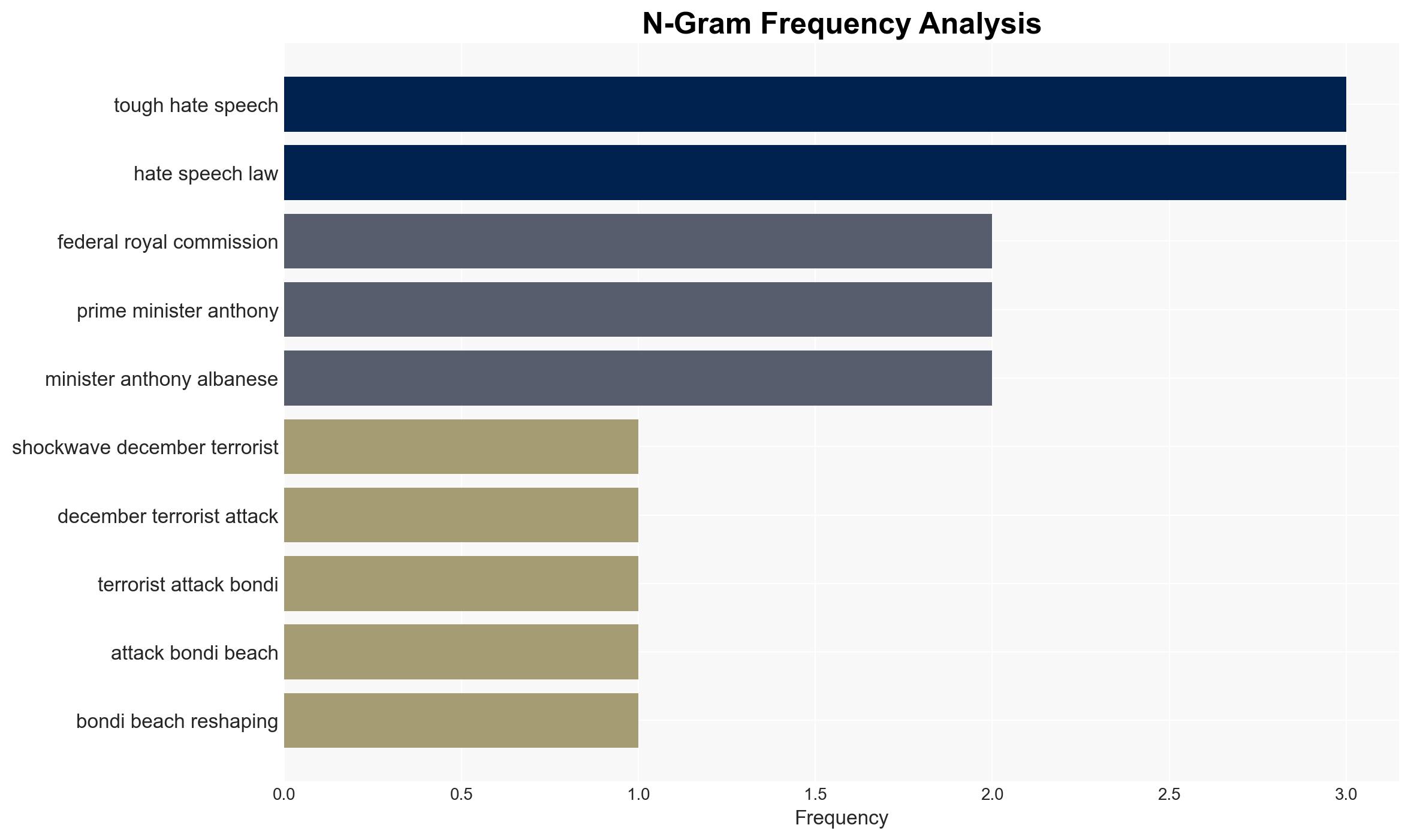
Australians favor tougher hate speech and immigration measures after Bondi Beach terror attack, poll shows
Published on: 2025-12-27
AI-powered OSINT brief from verified open sources. Automated NLP signal extraction with human verification. See our Methodology and Why WorldWideWatchers.
Intelligence Report: Majority of Australians support stricter hate speech and immigration laws following Bondi Beach terror attack poll finds
1. BLUF (Bottom Line Up Front)
The December 14 terrorist attack at Bondi Beach has catalyzed public support in Australia for stricter hate speech and immigration laws. The Albanese government faces pressure to act swiftly amid heightened community fear and anger. The most likely hypothesis is that legislative changes will be implemented to address these concerns, with moderate confidence in this assessment.
2. Competing Hypotheses
- Hypothesis A: The Australian government will enact stricter hate speech and immigration laws in response to public pressure and the Bondi Beach attack. Supporting evidence includes overwhelming public support for such measures and the government’s outlined reform package. Uncertainties include the potential for political opposition and the effectiveness of proposed measures.
- Hypothesis B: The government will maintain the status quo, relying on existing investigations and reviews rather than implementing new laws. Contradicting evidence includes the strong public demand for change and the government’s stated intention to introduce new legislation.
- Assessment: Hypothesis A is currently better supported due to the clear public mandate and the government’s proactive stance. Key indicators that could shift this judgment include significant political opposition or legal challenges to proposed reforms.
3. Key Assumptions and Red Flags
- Assumptions: Public opinion will continue to support legislative changes; the Albanese government has the political capital to pass new laws; proposed measures will effectively address security concerns.
- Information Gaps: Detailed plans for the proposed legislative changes; specific opposition strategies; potential international reactions.
- Bias & Deception Risks: Public opinion data may be influenced by recent events; potential for political actors to manipulate narratives for electoral gain.
4. Implications and Strategic Risks
The legislative response to the Bondi Beach attack could reshape Australia’s legal and security landscape, with potential ripple effects across multiple domains.
- Political / Geopolitical: Increased polarization and debate over civil liberties versus security; potential diplomatic tensions if measures are perceived as discriminatory.
- Security / Counter-Terrorism: Enhanced legal tools may improve counter-terrorism efforts, but could also drive extremist activities underground.
- Cyber / Information Space: Potential for increased cyber activism or propaganda by extremist groups in response to new laws.
- Economic / Social: Stricter immigration laws could impact labor markets and social cohesion, particularly in multicultural communities.
5. Recommendations and Outlook
- Immediate Actions (0–30 days): Monitor legislative developments and public opinion; engage with community leaders to mitigate fear and misinformation.
- Medium-Term Posture (1–12 months): Develop resilience measures to counter potential extremist backlash; strengthen partnerships with international allies for intelligence sharing.
- Scenario Outlook: Best: Successful implementation of laws with broad support. Worst: Legislative gridlock and increased societal division. Most-Likely: Passage of laws with some political contention and gradual adaptation by affected communities.
6. Key Individuals and Entities
- Prime Minister Anthony Albanese
- Federal Opposition Leader Sussan Ley
- Rabbinical Association
- Islamic State (ideological influence)
- Not clearly identifiable from open sources in this snippet.
7. Thematic Tags
national security threats, counter-terrorism, hate speech, immigration policy, public opinion, legislative reform, national security, extremist ideology
Structured Analytic Techniques Applied
- Cognitive Bias Stress Test: Expose and correct potential biases in assessments through red-teaming and structured challenge.
- Bayesian Scenario Modeling: Use probabilistic forecasting for conflict trajectories or escalation likelihood.
- Network Influence Mapping: Map relationships between state and non-state actors for impact estimation.
Explore more:
National Security Threats Briefs ·
Daily Summary ·
Support us