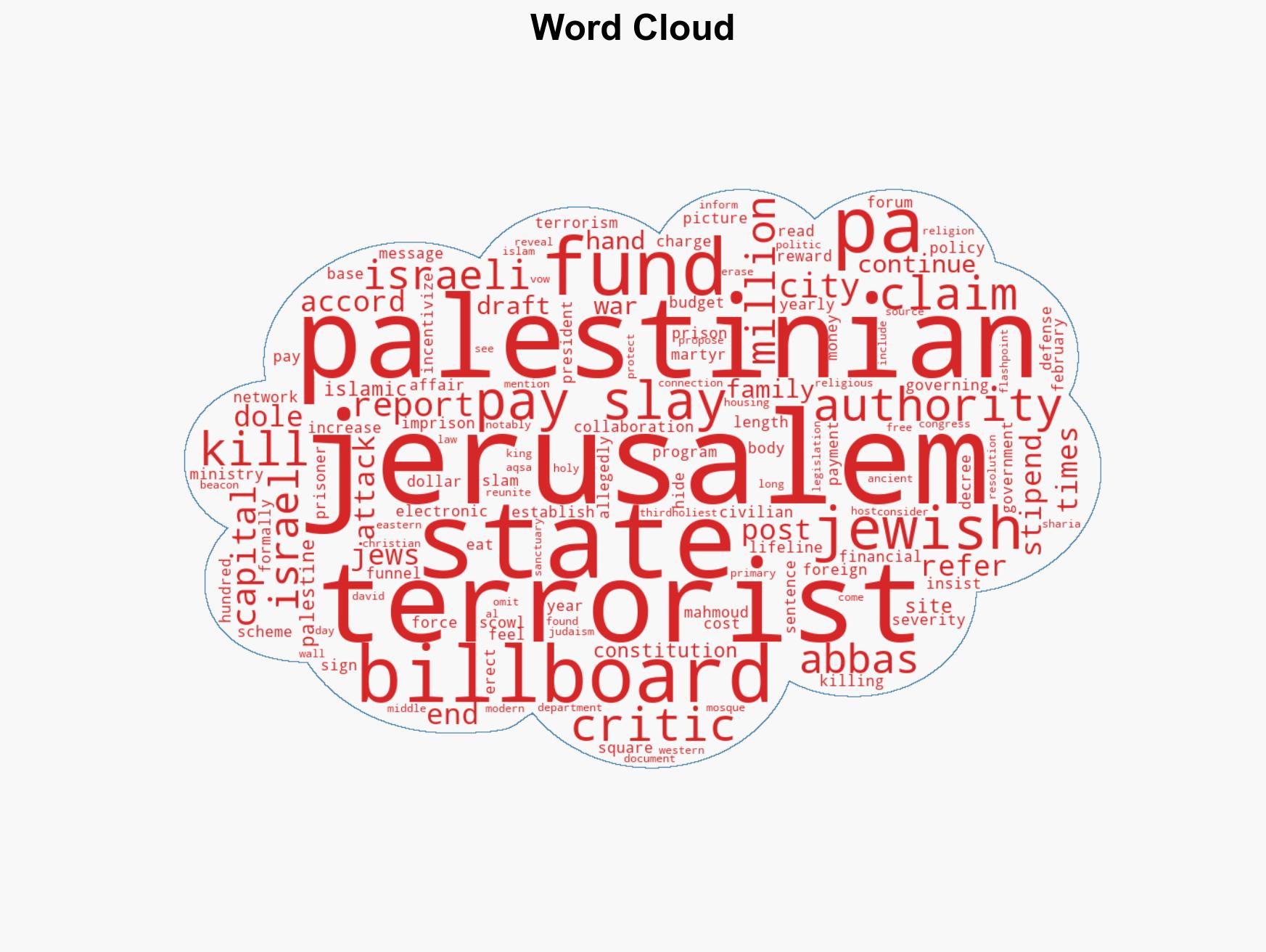
Billboard in Times Square demands cessation of Palestinian Authority’s financial rewards for terrorism
Published on: 2026-02-15
AI-powered OSINT brief from verified open sources. Automated NLP signal extraction with human verification. See our Methodology and Why WorldWideWatchers.
Intelligence Report: Times Square billboard calls for end to Palestinian pay for slay program
1. BLUF (Bottom Line Up Front)
The Times Square billboard campaign against the Palestinian Authority’s “pay for slay” program highlights ongoing tensions between Israel and Palestine, particularly regarding financial incentives for violence. The campaign, supported by Israel’s Foreign Affairs Ministry, underscores the contentious nature of the PA’s stipends to individuals involved in acts of terrorism. Despite official claims of program cessation, evidence suggests continued funding through covert channels. This situation exacerbates geopolitical tensions and complicates peace efforts. Overall confidence in this assessment is moderate.
2. Competing Hypotheses
- Hypothesis A: The Palestinian Authority has genuinely ended the “pay for slay” program, as per the decree signed by Mahmoud Abbas. Supporting evidence includes the official decree; however, contradicting reports suggest continued funding through hidden networks, creating significant uncertainty.
- Hypothesis B: The Palestinian Authority continues to fund the “pay for slay” program covertly, despite public claims of cessation. This hypothesis is supported by reports from the US State Department and other sources indicating ongoing financial support to terrorists and their families.
- Assessment: Hypothesis B is currently better supported due to multiple independent reports indicating continued funding. Key indicators that could shift this judgment include verifiable transparency measures by the PA or credible international audits confirming cessation.
3. Key Assumptions and Red Flags
- Assumptions: The PA’s public statements are not fully aligned with its covert actions; Israel’s Foreign Affairs Ministry’s involvement in the billboard campaign reflects official policy; financial incentives significantly influence terrorist activities.
- Information Gaps: Lack of direct evidence or audits confirming the cessation of payments; details on the alleged hidden networks used for funding.
- Bias & Deception Risks: Potential bias in reports from Israeli and US sources; risk of Palestinian Authority’s strategic deception to maintain international aid while continuing the program.
4. Implications and Strategic Risks
This development could exacerbate Israeli-Palestinian tensions, impacting regional stability and international diplomatic efforts. The ongoing financial support for terrorism poses a persistent security threat and complicates peace negotiations.
- Political / Geopolitical: Increased diplomatic friction between Israel and Palestine; potential for international pressure on the PA to demonstrate transparency.
- Security / Counter-Terrorism: Sustained financial incentives may lead to increased terrorist activities against Israeli targets, complicating counter-terrorism efforts.
- Cyber / Information Space: Potential for cyber campaigns or information operations to sway public opinion or discredit opposing narratives.
- Economic / Social: Economic strain on the PA’s budget; potential social unrest within Palestinian territories if funding is perceived as misallocated.
5. Recommendations and Outlook
- Immediate Actions (0–30 days): Increase monitoring of financial flows within the PA; engage with international partners to verify cessation claims; enhance intelligence sharing on terrorist funding networks.
- Medium-Term Posture (1–12 months): Develop resilience measures to counter potential terrorist activities; strengthen diplomatic channels to encourage PA transparency; support capacity-building initiatives for financial oversight.
- Scenario Outlook:
- Best: PA demonstrates verifiable cessation of payments, leading to improved diplomatic relations (trigger: international audit confirmation).
- Worst: Escalation in terrorist activities due to continued funding, resulting in heightened regional conflict (trigger: increase in attacks).
- Most-Likely: Continued covert funding with sporadic diplomatic tensions and security incidents (trigger: ongoing reports of payments).
6. Key Individuals and Entities
- Mahmoud Abbas – President of the Palestinian Authority
- Israel’s Foreign Affairs Ministry
- US State Department
- Palestinian Authority
7. Thematic Tags
national security threats, counter-terrorism, Israeli-Palestinian conflict, international diplomacy, financial networks, regional stability, geopolitical tensions, information operations
Structured Analytic Techniques Applied
- Cognitive Bias Stress Test: Expose and correct potential biases in assessments through red-teaming and structured challenge.
- Bayesian Scenario Modeling: Use probabilistic forecasting for conflict trajectories or escalation likelihood.
- Network Influence Mapping: Map influence relationships to assess actor impact.
Explore more:
National Security Threats Briefs ·
Daily Summary ·
Support us