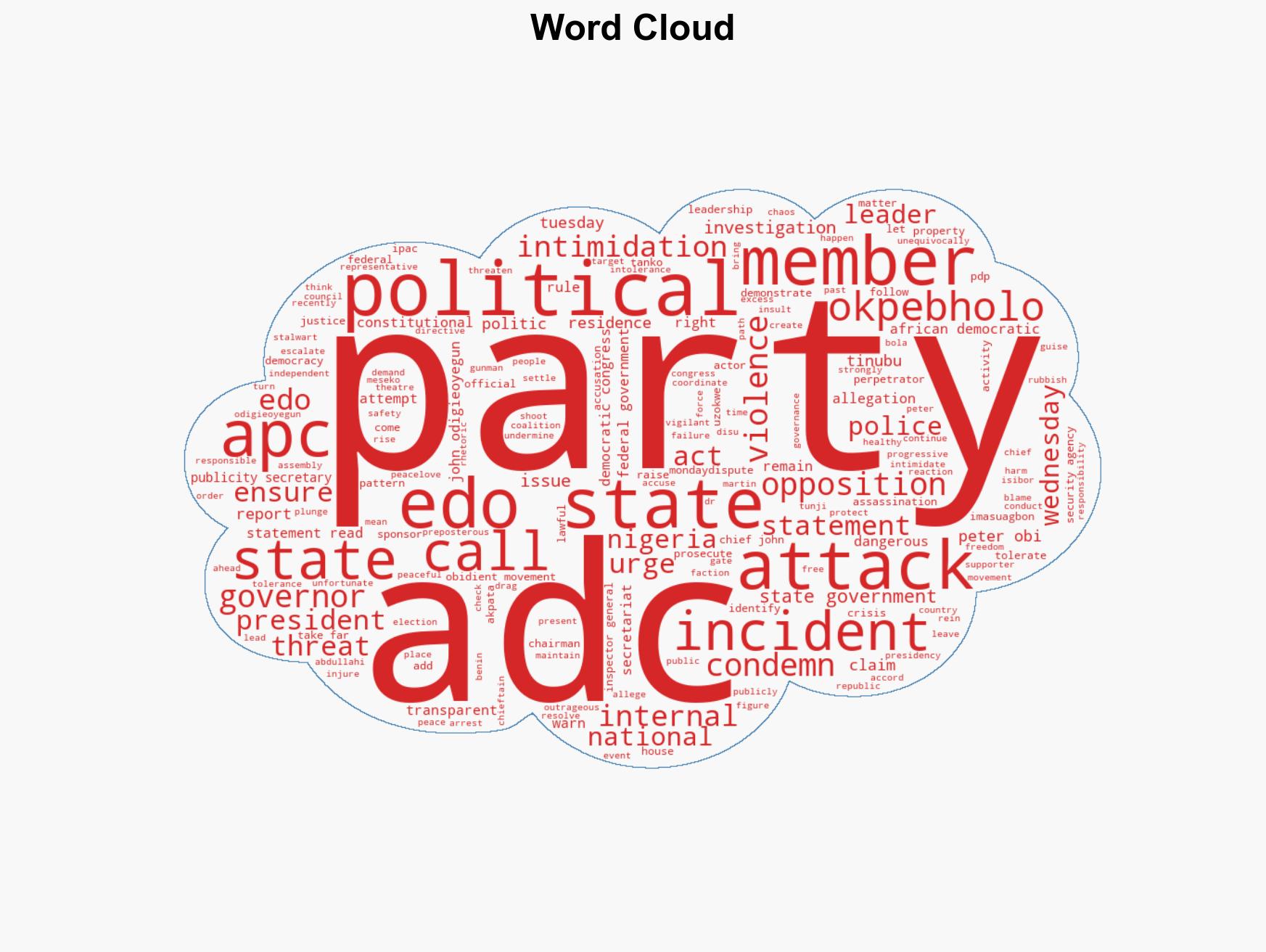
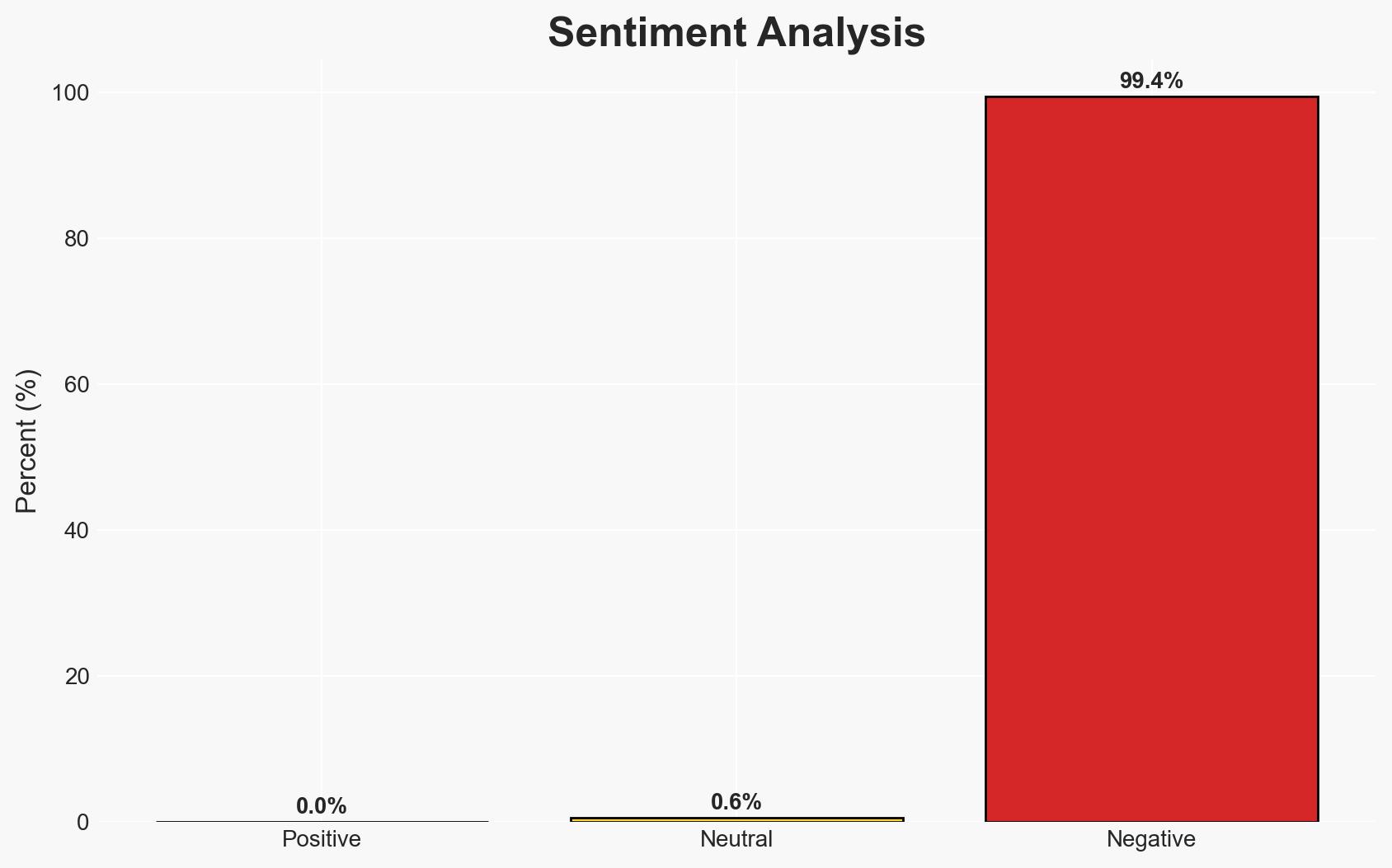
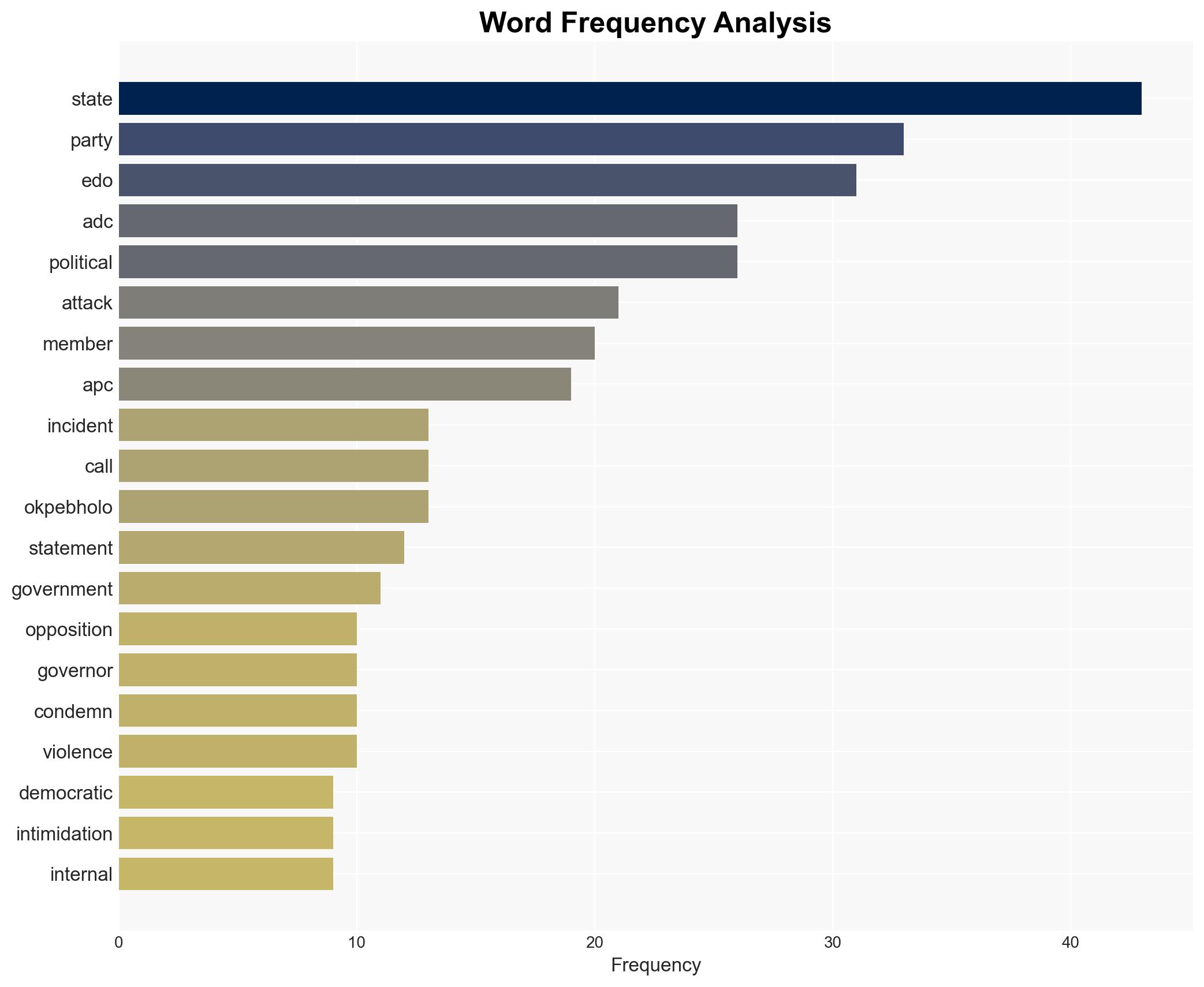
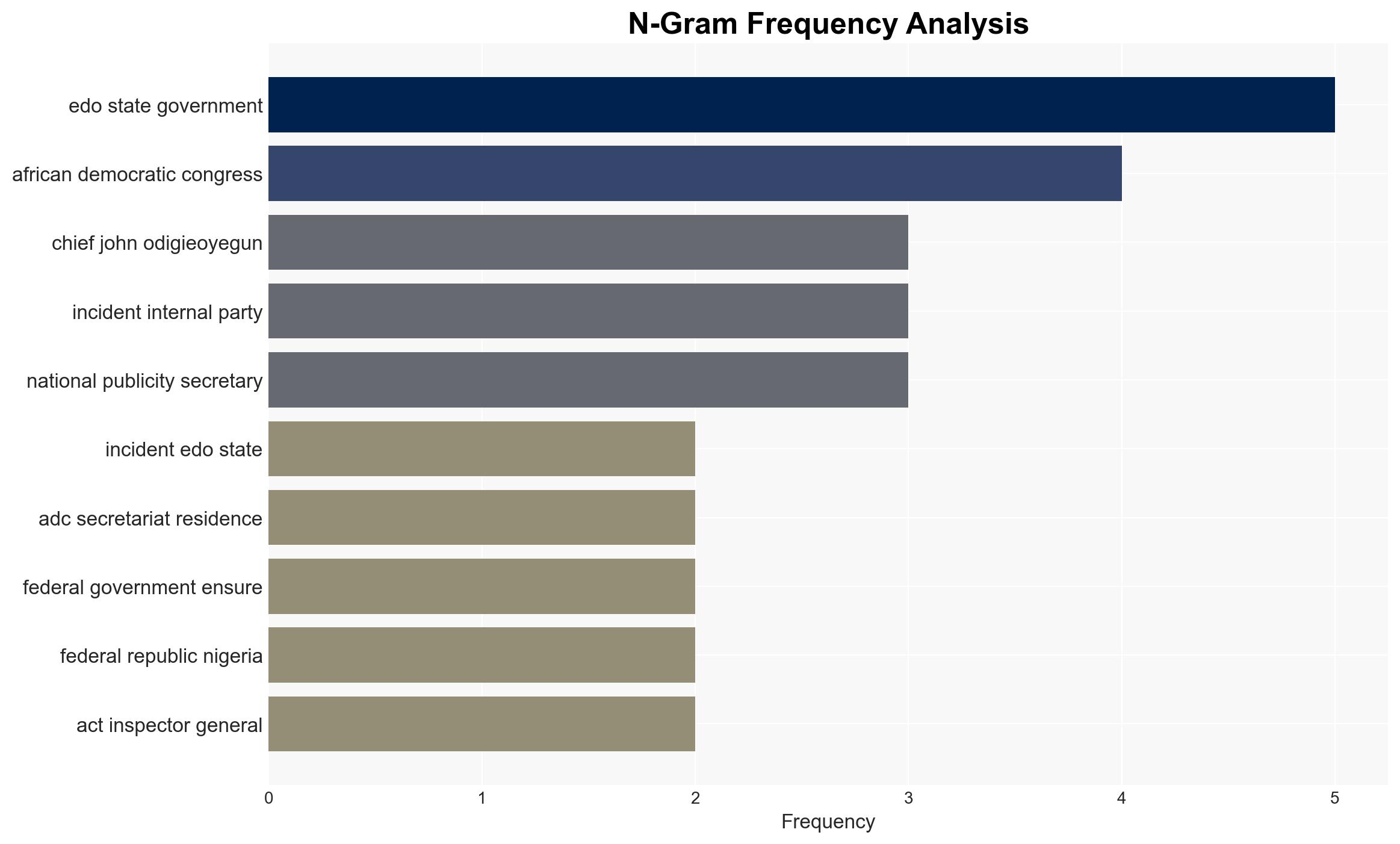
Edo State Shooting Incident Triggers Calls for Police Investigation Amid Political Blame Shift
Published on: 2026-02-26
AI-powered OSINT brief from verified open sources. Automated NLP signal extraction with human verification. See our Methodology and Why WorldWideWatchers.
Intelligence Report: Edo attack sparks blame game opposition demands IG probe
1. BLUF (Bottom Line Up Front)
The recent attack in Edo State, Nigeria, involving gunmen targeting the African Democratic Congress (ADC) and opposition figures, has escalated political tensions and accusations between political parties. The incident, perceived as politically motivated, demands an urgent and transparent investigation to prevent further violence. The most likely hypothesis is that the attack was orchestrated to intimidate opposition figures, with moderate confidence in this assessment due to limited direct evidence.
2. Competing Hypotheses
- Hypothesis A: The attack was a politically motivated attempt by the All Progressives Congress (APC) to intimidate and destabilize the ADC and its affiliates. This hypothesis is supported by the timing of the attack following a high-profile defection and the presence of opposition figures. However, there is no direct evidence linking the APC to the attack.
- Hypothesis B: The attack was conducted by independent actors seeking to exploit political tensions for personal or criminal gain. This explanation considers the possibility of opportunistic violence unrelated to direct political orders but lacks supporting evidence given the targeted nature of the attack.
- Assessment: Hypothesis A is currently better supported due to the specific targeting of opposition figures and the political context. Indicators such as further attacks or credible claims of responsibility could shift this judgment.
3. Key Assumptions and Red Flags
- Assumptions: The attack was intended to intimidate political opponents; the APC has the capability and motive to orchestrate such an attack; local law enforcement may be influenced by political pressures.
- Information Gaps: Lack of forensic evidence linking the attackers to specific political entities; absence of eyewitness accounts or surveillance footage; unclear motivations of the attackers.
- Bias & Deception Risks: Potential bias in reporting from politically affiliated sources; risk of misinformation or propaganda from involved parties; possibility of false flag operations to mislead investigators.
4. Implications and Strategic Risks
This development could exacerbate political instability in Edo State and potentially nationwide, influencing upcoming elections and governance. The incident may also embolden similar acts of violence if not addressed.
- Political / Geopolitical: Increased political polarization and potential for retaliatory actions by opposition groups.
- Security / Counter-Terrorism: Heightened risk of political violence and targeted attacks on opposition figures.
- Cyber / Information Space: Potential for misinformation campaigns and digital propaganda to shape public perception.
- Economic / Social: Possible negative impact on local economic activities and social cohesion due to increased insecurity.
5. Recommendations and Outlook
- Immediate Actions (0–30 days): Initiate a comprehensive investigation led by the Inspector-General of Police; increase security measures for opposition figures; monitor political rhetoric and social media for escalation indicators.
- Medium-Term Posture (1–12 months): Strengthen inter-party dialogue to reduce tensions; enhance law enforcement capabilities to prevent political violence; develop community resilience programs.
- Scenario Outlook:
- Best: Successful investigation and de-escalation of political tensions.
- Worst: Escalation into widespread political violence and instability.
- Most-Likely: Continued political tensions with sporadic incidents of violence, contingent on investigation outcomes.
6. Key Individuals and Entities
- Peter Uzokwe, House of Representatives member
- Olumide Akpata, former Nigerian Bar Association President
- John Odigie-Oyegun, former Edo governor
- Peter Obi, former Labour Party presidential candidate
- Yunusa Tanko, National Coordinator of the Obidient Movement Worldwide
- Not clearly identifiable from open sources in this snippet.
7. Thematic Tags
national security threats, political violence, Nigeria, opposition parties, security threats, investigation, inter-party tensions, misinformation
Structured Analytic Techniques Applied
- Cognitive Bias Stress Test: Expose and correct potential biases in assessments through red-teaming and structured challenge.
- Bayesian Scenario Modeling: Use probabilistic forecasting for conflict trajectories or escalation likelihood.
- Network Influence Mapping: Map relationships between state and non-state actors for impact estimation.
Explore more:
National Security Threats Briefs ·
Daily Summary ·
Support us