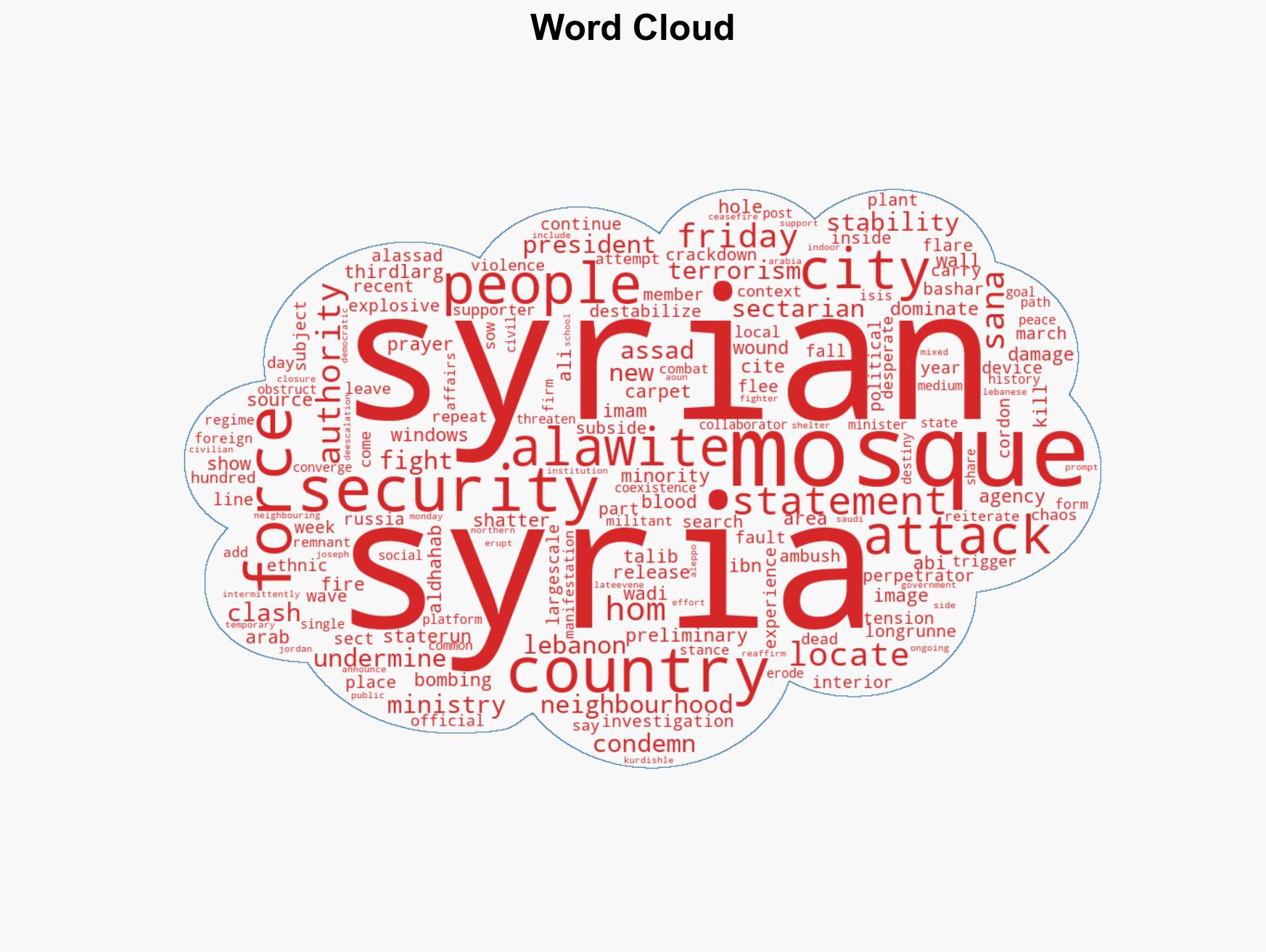
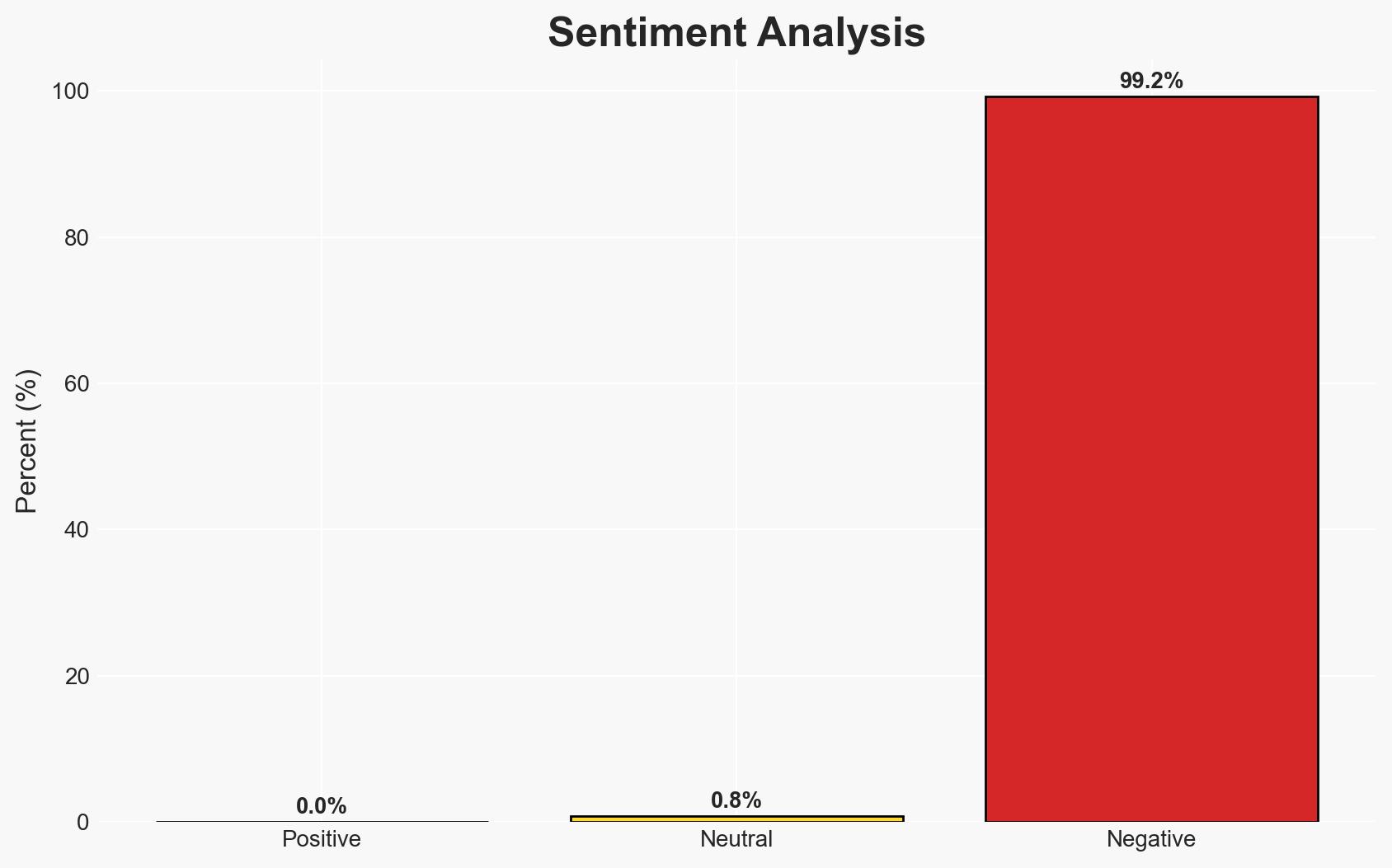
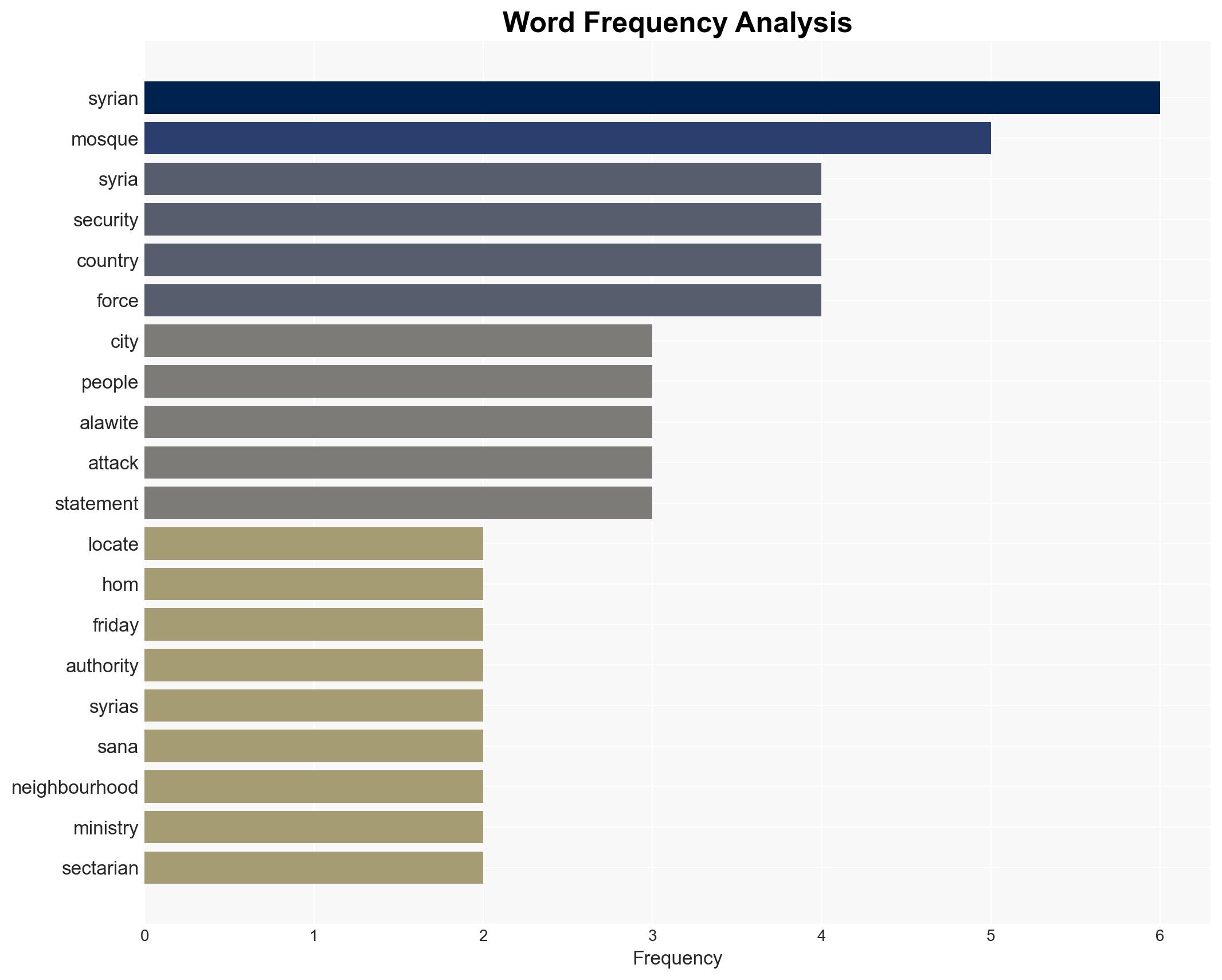
Eight killed and 18 injured in mosque bombing during Friday prayers in Homs, Syria.
Published on: 2025-12-26
AI-powered OSINT brief from verified open sources. Automated NLP signal extraction with human verification. See our Methodology and Why WorldWideWatchers.
Intelligence Report: 8 dead 18 wounded in Syria mosque bombing
1. BLUF (Bottom Line Up Front)
The bombing at the Imam Ali ibn Abi Talib Mosque in Homs, Syria, appears to be a targeted attack against the Alawite minority, exacerbating sectarian tensions. The most likely hypothesis is that remnants of the former regime or extremist groups are responsible, aiming to destabilize the region. This assessment is made with moderate confidence due to limited direct evidence and ongoing investigations.
2. Competing Hypotheses
- Hypothesis A: The attack was orchestrated by remnants of the former Assad regime or aligned groups to incite sectarian violence and undermine the current government. This is supported by the history of sectarian violence and the targeting of an Alawite-majority area. However, there is no direct evidence linking specific groups to the attack.
- Hypothesis B: The attack was carried out by ISIS or other extremist groups seeking to exploit sectarian divisions and destabilize Syria. This is plausible given ISIS’s history of targeting religious minorities, but lacks specific claims of responsibility or direct evidence.
- Assessment: Hypothesis A is currently better supported due to the context of recent sectarian violence and the strategic targeting of an Alawite area. Indicators that could shift this judgment include claims of responsibility or evidence of external involvement.
3. Key Assumptions and Red Flags
- Assumptions: The attack was sectarian in nature; the perpetrators aim to destabilize the region; the Alawite community remains a primary target for violence.
- Information Gaps: Lack of concrete evidence linking specific groups to the attack; absence of claims of responsibility; limited insight into the operational capabilities of potential perpetrators.
- Bias & Deception Risks: Potential bias in state-run media reporting; risk of misinformation from involved parties; possible manipulation of sectarian narratives to serve political agendas.
4. Implications and Strategic Risks
This development could further destabilize Syria by reigniting sectarian violence, complicating reconciliation efforts, and potentially drawing in external actors. The attack may also embolden extremist groups to exploit the situation.
- Political / Geopolitical: Risk of increased sectarian violence could strain relations with neighboring countries and complicate international diplomatic efforts.
- Security / Counter-Terrorism: Heightened threat environment for minority communities; potential for retaliatory attacks.
- Cyber / Information Space: Potential for increased propaganda and misinformation campaigns exploiting sectarian divides.
- Economic / Social: Further destabilization could hinder economic recovery and exacerbate humanitarian challenges.
5. Recommendations and Outlook
- Immediate Actions (0–30 days): Enhance intelligence-sharing with regional partners; increase security around vulnerable communities; monitor for claims of responsibility.
- Medium-Term Posture (1–12 months): Strengthen community resilience programs; engage in diplomatic efforts to reduce sectarian tensions; bolster counter-terrorism capabilities.
- Scenario Outlook:
- Best: Successful de-escalation and prevention of further attacks.
- Worst: Escalation into widespread sectarian conflict.
- Most-Likely: Continued sporadic violence with intermittent de-escalation efforts.
6. Key Individuals and Entities
- Not clearly identifiable from open sources in this snippet.
7. Thematic Tags
national security threats, sectarian violence, Syria conflict, terrorism, Alawite community, regional stability, extremist groups, intelligence assessment
Structured Analytic Techniques Applied
- Cognitive Bias Stress Test: Expose and correct potential biases in assessments through red-teaming and structured challenge.
- Bayesian Scenario Modeling: Use probabilistic forecasting for conflict trajectories or escalation likelihood.
- Network Influence Mapping: Map relationships between state and non-state actors for impact estimation.
Explore more:
National Security Threats Briefs ·
Daily Summary ·
Support us