Escalation in Middle East: US and Israel Initiate Major Offensive Against Iran Amid Rising Tensions
Published on: 2026-03-06
AI-powered OSINT brief from verified open sources. Automated NLP signal extraction with human verification. See our Methodology and Why WorldWideWatchers.
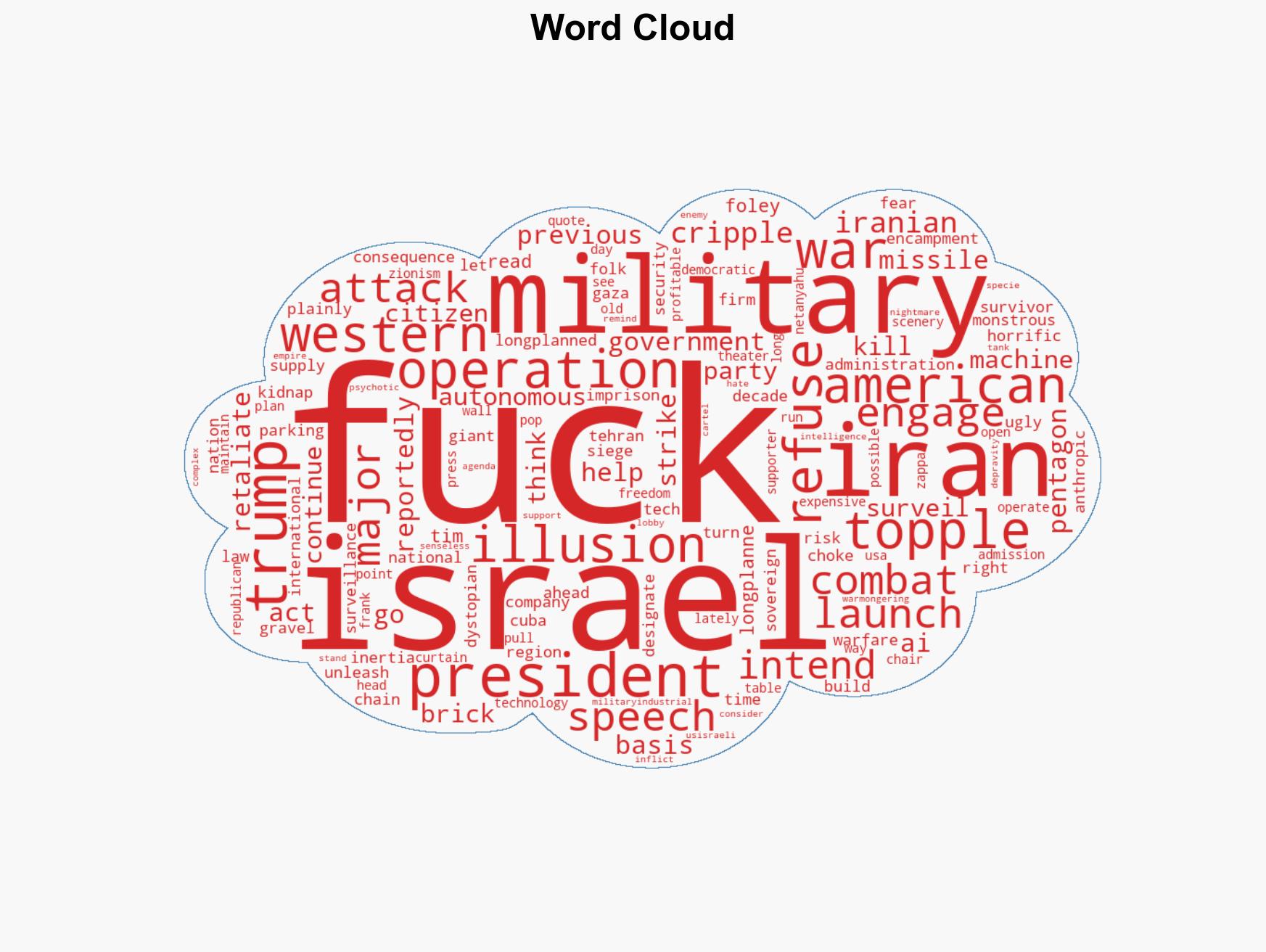
Intelligence Report: Fuck Everyone Who Made This War Possible
1. BLUF (Bottom Line Up Front)
The US and Israel have initiated military operations against Iran, aiming to destabilize its government. Iran’s retaliatory actions include missile strikes on US and Israeli targets. This escalation poses significant risks to regional stability and global security. Overall confidence in this assessment is moderate, given the limited information and potential biases in the source.
2. Competing Hypotheses
- Hypothesis A: The US and Israel’s military actions are a strategic move to neutralize perceived threats from Iran and reshape regional power dynamics. Supporting evidence includes the reported initiation of combat operations and historical tensions. Contradicting evidence includes potential exaggeration or misreporting of events.
- Hypothesis B: The reported military actions are exaggerated or misrepresented, possibly serving as propaganda or misinformation. Supporting evidence includes the hyperbolic and emotionally charged language in the source. Contradicting evidence includes the consistency of reported events with known geopolitical tensions.
- Assessment: Hypothesis A is currently better supported due to the alignment with longstanding geopolitical objectives and reported actions. However, confirmation from additional sources is necessary to solidify this judgment.
3. Key Assumptions and Red Flags
- Assumptions: The source accurately reflects real-world events; Iran’s military capabilities are sufficient to retaliate effectively; US-Israeli objectives include regime change in Iran.
- Information Gaps: Verification of the scale and scope of military operations; independent confirmation of Iranian retaliatory actions; details on international diplomatic responses.
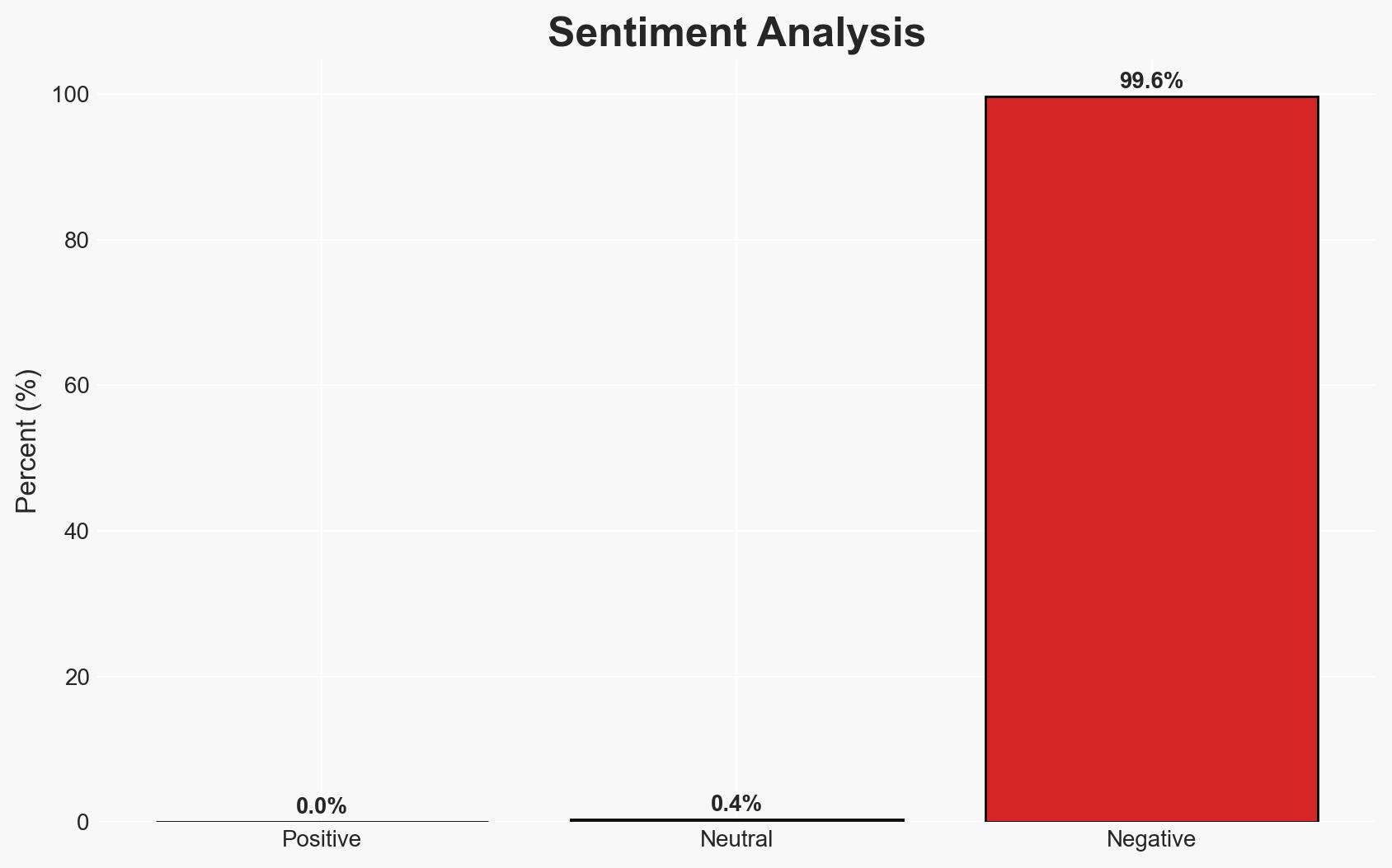
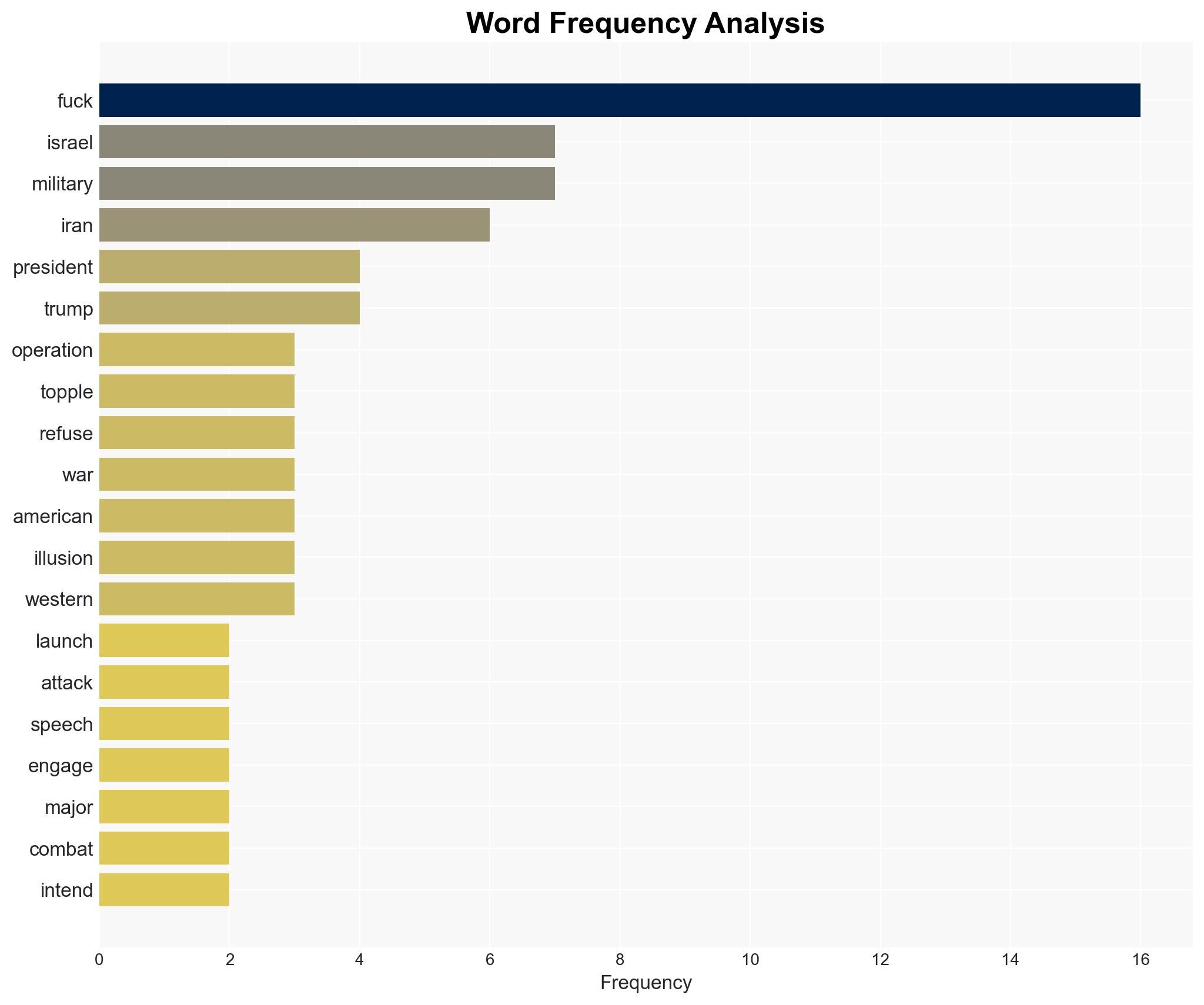
- Bias & Deception Risks: The source exhibits strong emotional bias and potential misinformation; risk of cognitive bias in interpreting emotionally charged language.
4. Implications and Strategic Risks
This development could lead to prolonged regional conflict, affecting global security and economic stability. The situation may evolve into broader geopolitical confrontations involving other state and non-state actors.
- Political / Geopolitical: Potential for escalation into a wider regional conflict; strain on US and Israeli relations with other Middle Eastern countries.
- Security / Counter-Terrorism: Increased risk of terrorist activities and asymmetric warfare targeting US and Israeli interests globally.
- Cyber / Information Space: Likely increase in cyber operations targeting critical infrastructure and information warfare campaigns.
- Economic / Social: Disruption of global oil markets; potential for refugee crises and humanitarian issues in affected regions.
5. Recommendations and Outlook
- Immediate Actions (0–30 days): Enhance intelligence collection and verification efforts; engage in diplomatic dialogue to de-escalate tensions; monitor cyber threats to critical infrastructure.
- Medium-Term Posture (1–12 months): Strengthen alliances and partnerships in the region; develop contingency plans for potential economic disruptions; invest in counter-terrorism capabilities.
- Scenario Outlook:
- Best: Rapid de-escalation and diplomatic resolution, triggered by international mediation.
- Worst: Full-scale regional war with significant global economic and security impacts, triggered by further military escalations.
- Most-Likely: Protracted conflict with periodic escalations and international diplomatic efforts to manage tensions.
6. Key Individuals and Entities
- Donald Trump, President of the United States
- Benjamin Netanyahu, Prime Minister of Israel
- Not clearly identifiable from open sources in this snippet.
7. Thematic Tags
national security threats, military escalation, Iran conflict, US-Israel relations, regional stability, geopolitical tensions, information warfare, economic impact
Structured Analytic Techniques Applied
- Cognitive Bias Stress Test: Expose and correct potential biases in assessments through red-teaming and structured challenge.
- Bayesian Scenario Modeling: Use probabilistic forecasting for conflict trajectories or escalation likelihood.
- Network Influence Mapping: Map relationships between state and non-state actors for impact estimation.
Explore more:
National Security Threats Briefs ·
Daily Summary ·
Support us