EU Faces Energy Security Challenges Amid Growing Dependence on U.S. Gas and Greenland Diplomatic Tensions
Published on: 2026-01-30
AI-powered OSINT brief from verified open sources. Automated NLP signal extraction with human verification. See our Methodology and Why WorldWideWatchers.
Intelligence Report: A new dependency EU confronts energy vulnerability amid Greenland rift
1. BLUF (Bottom Line Up Front)
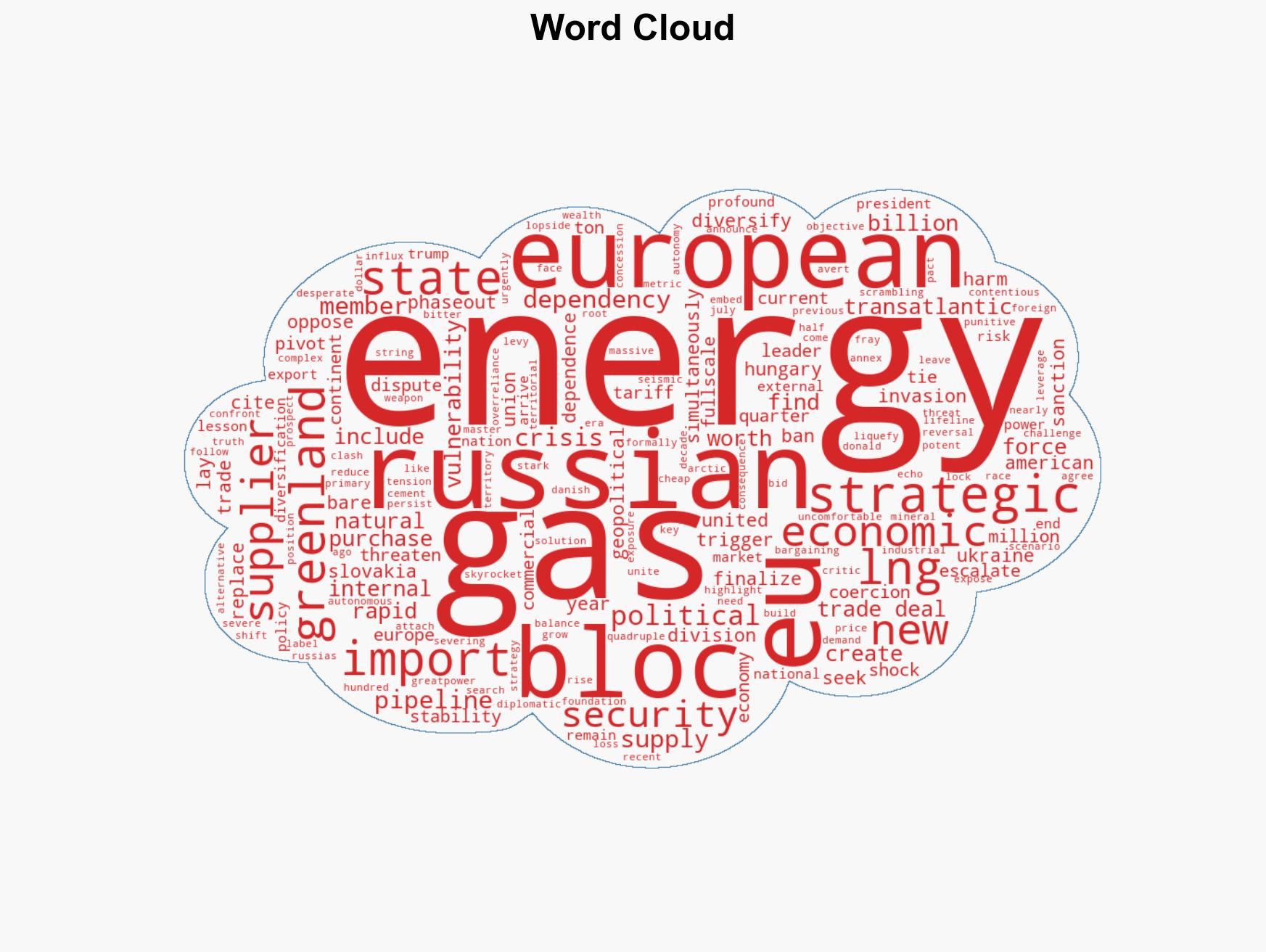
The European Union is facing a strategic energy dependency on the United States, exacerbated by tensions over Greenland. This dependency mirrors past vulnerabilities with Russian gas and poses significant geopolitical risks. The most likely hypothesis is that the EU will seek to diversify energy sources to mitigate this dependency. Overall confidence in this assessment is moderate.
2. Competing Hypotheses
- Hypothesis A: The EU will successfully diversify its energy sources away from the U.S., reducing strategic dependency. Supporting evidence includes the EU’s historical efforts to diversify energy supplies and ongoing sanctions against Russian LNG. Contradicting evidence includes the current lack of viable alternative suppliers and internal EU divisions.
- Hypothesis B: The EU will remain dependent on U.S. energy due to lack of alternatives and economic pressures. Supporting evidence includes the binding nature of the transatlantic trade deal and the absence of immediate alternative suppliers. Contradicting evidence includes potential new energy partnerships and technological advancements in renewable energy.
- Assessment: Hypothesis B is currently better supported due to the binding trade agreements and immediate lack of alternatives. Indicators that could shift this judgment include new energy partnerships or breakthroughs in renewable energy technology.
3. Key Assumptions and Red Flags
- Assumptions: The EU has the political will to diversify energy sources; U.S. energy prices remain competitive; internal EU divisions will not impede collective action.
- Information Gaps: Details on potential new energy suppliers; internal EU deliberations on energy strategy; U.S. intentions regarding Greenland.
- Bias & Deception Risks: Potential over-reliance on U.S. sources for information; EU member states may underreport internal dissent; U.S. statements may be strategically misleading.
4. Implications and Strategic Risks
This development could lead to increased geopolitical tensions and economic instability within the EU. The EU’s energy strategy may evolve to prioritize diversification and energy independence.
- Political / Geopolitical: Potential for increased EU-U.S. tensions; risk of EU fragmentation over energy policy.
- Security / Counter-Terrorism: Increased focus on securing energy infrastructure; potential for energy-related cyber threats.
- Cyber / Information Space: Risk of cyber-attacks targeting energy infrastructure; potential for misinformation campaigns.
- Economic / Social: Potential economic strain from high energy costs; social unrest due to energy insecurity.
5. Recommendations and Outlook
- Immediate Actions (0–30 days): Monitor U.S.-EU diplomatic interactions; assess potential new energy partnerships; evaluate internal EU energy policy debates.
- Medium-Term Posture (1–12 months): Develop resilience measures for energy supply; explore renewable energy investments; strengthen EU energy policy cohesion.
- Scenario Outlook:
- Best: EU successfully diversifies energy sources, reducing dependency.
- Worst: EU remains heavily dependent on U.S. energy, leading to geopolitical concessions.
- Most-Likely: EU makes gradual progress in diversification but remains partially dependent on U.S. energy.
6. Key Individuals and Entities
- European Union (EU)
- United States (U.S.)
- Greenland
- Donald Trump (U.S. President)
- Hungary and Slovakia (EU Member States)
- Not clearly identifiable from open sources in this snippet.
7. Thematic Tags
national security threats, energy security, EU-U.S. relations, geopolitical tensions, trade agreements, energy diversification, sanctions, economic dependency
Structured Analytic Techniques Applied
- Cognitive Bias Stress Test: Expose and correct potential biases in assessments through red-teaming and structured challenge.
- Bayesian Scenario Modeling: Forecast futures under uncertainty via probabilistic logic.
- Network Influence Mapping: Map relationships between state and non-state actors for impact estimation.
Explore more:
National Security Threats Briefs ·
Daily Summary ·
Support us