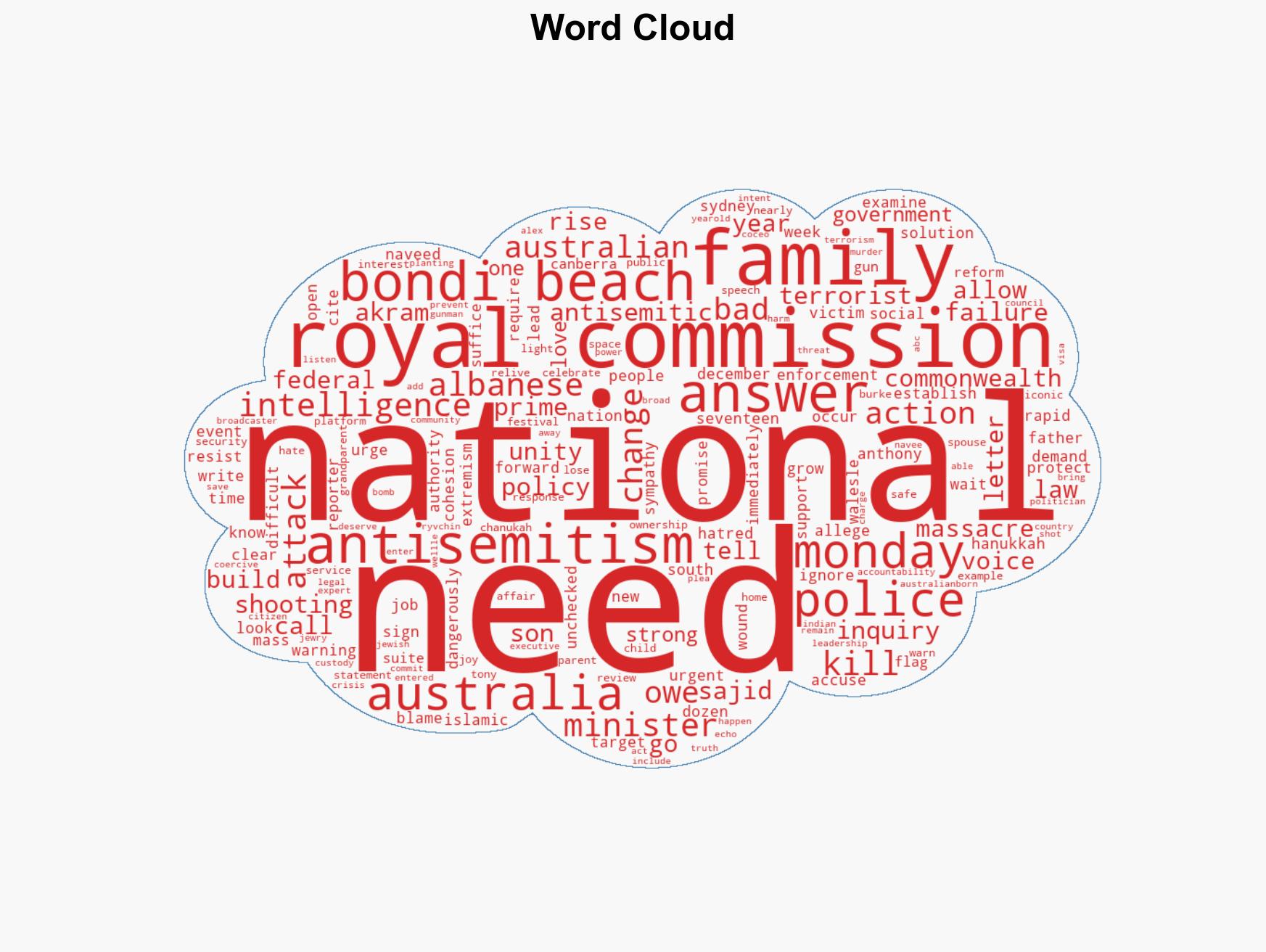
Families of Bondi Beach shooting victims call for national inquiry into rising antisemitism and policing fail…
Published on: 2025-12-29
AI-powered OSINT brief from verified open sources. Automated NLP signal extraction with human verification. See our Methodology and Why WorldWideWatchers.
Intelligence Report: Bondi victims families demand national probe into antisemitism
1. BLUF (Bottom Line Up Front)
The families of victims from the Bondi Beach mass shooting are demanding a national inquiry into antisemitism and perceived failures in policing and intelligence. The Australian government is currently resisting these calls, opting for state-level investigations and immediate reforms. This situation highlights a critical tension between community demands for accountability and government priorities for rapid policy action. Overall confidence in this assessment is moderate.
2. Competing Hypotheses
- Hypothesis A: The Bondi Beach attack was a result of systemic failures in intelligence and policing, necessitating a national inquiry to address rising antisemitism. Supporting evidence includes the families’ claims of ignored warning signs and unchecked extremism. Contradicting evidence is the government’s stance that state-level inquiries are sufficient.
- Hypothesis B: The attack was an isolated incident, and existing state-level mechanisms are adequate to address any systemic issues. This is supported by the Prime Minister’s preference for immediate reforms over a national inquiry. However, the persistent calls for a national probe suggest unresolved systemic concerns.
- Assessment: Hypothesis A is currently better supported due to the widespread calls for a national inquiry from affected families and community leaders, indicating perceived systemic issues. Key indicators that could shift this judgment include the outcomes of state-level inquiries and any new evidence of systemic failures.
3. Key Assumptions and Red Flags
- Assumptions: The rise in antisemitism is a national issue; existing state-level mechanisms may not fully address systemic failures; community demands reflect broader societal concerns.
- Information Gaps: Detailed findings from state-level inquiries; comprehensive data on antisemitic incidents and intelligence failures.
- Bias & Deception Risks: Potential bias in government statements prioritizing rapid action; risk of community narratives being amplified without full evidence.
4. Implications and Strategic Risks
This development could exacerbate tensions between the government and affected communities, influencing national cohesion and policy direction. The handling of this issue may impact public trust in government and law enforcement.
- Political / Geopolitical: Potential for increased political pressure on the government, affecting domestic policy and international reputation regarding human rights.
- Security / Counter-Terrorism: Possible reassessment of counter-terrorism strategies and intelligence-sharing protocols.
- Cyber / Information Space: Risk of misinformation or extremist narratives spreading online, necessitating enhanced monitoring.
- Economic / Social: Potential impacts on social cohesion and community relations, with economic implications if public safety concerns affect tourism or local businesses.
5. Recommendations and Outlook
- Immediate Actions (0–30 days): Enhance monitoring of antisemitic activities and rhetoric; engage with community leaders to address concerns and build trust.
- Medium-Term Posture (1–12 months): Develop resilience measures in intelligence and policing; consider partnerships with community organizations for better threat assessment.
- Scenario Outlook:
- Best: Successful state-level inquiry leads to effective reforms and improved community relations.
- Worst: National inquiry reveals deep systemic failures, leading to significant political fallout.
- Most-Likely: Incremental reforms at state and federal levels address some concerns but leave others unresolved.
6. Key Individuals and Entities
- Prime Minister Anthony Albanese
- Home Affairs Minister Tony Burke
- Alex Ryvchin, co-CEO of the Executive Council of Australian Jewry
- Not clearly identifiable from open sources in this snippet.
7. Thematic Tags
national security threats, antisemitism, national security, intelligence failures, community relations, counter-terrorism, public policy, social cohesion
Structured Analytic Techniques Applied
- Cognitive Bias Stress Test: Expose and correct potential biases in assessments through red-teaming and structured challenge.
- Bayesian Scenario Modeling: Use probabilistic forecasting for conflict trajectories or escalation likelihood.
- Network Influence Mapping: Map relationships between state and non-state actors for impact estimation.
Explore more:
National Security Threats Briefs ·
Daily Summary ·
Support us