FBI Used Assessment Authority to Collect Data on Journalists and Religious Groups, Report Reveals
Published on: 2026-02-12
AI-powered OSINT brief from verified open sources. Automated NLP signal extraction with human verification. See our Methodology and Why WorldWideWatchers.
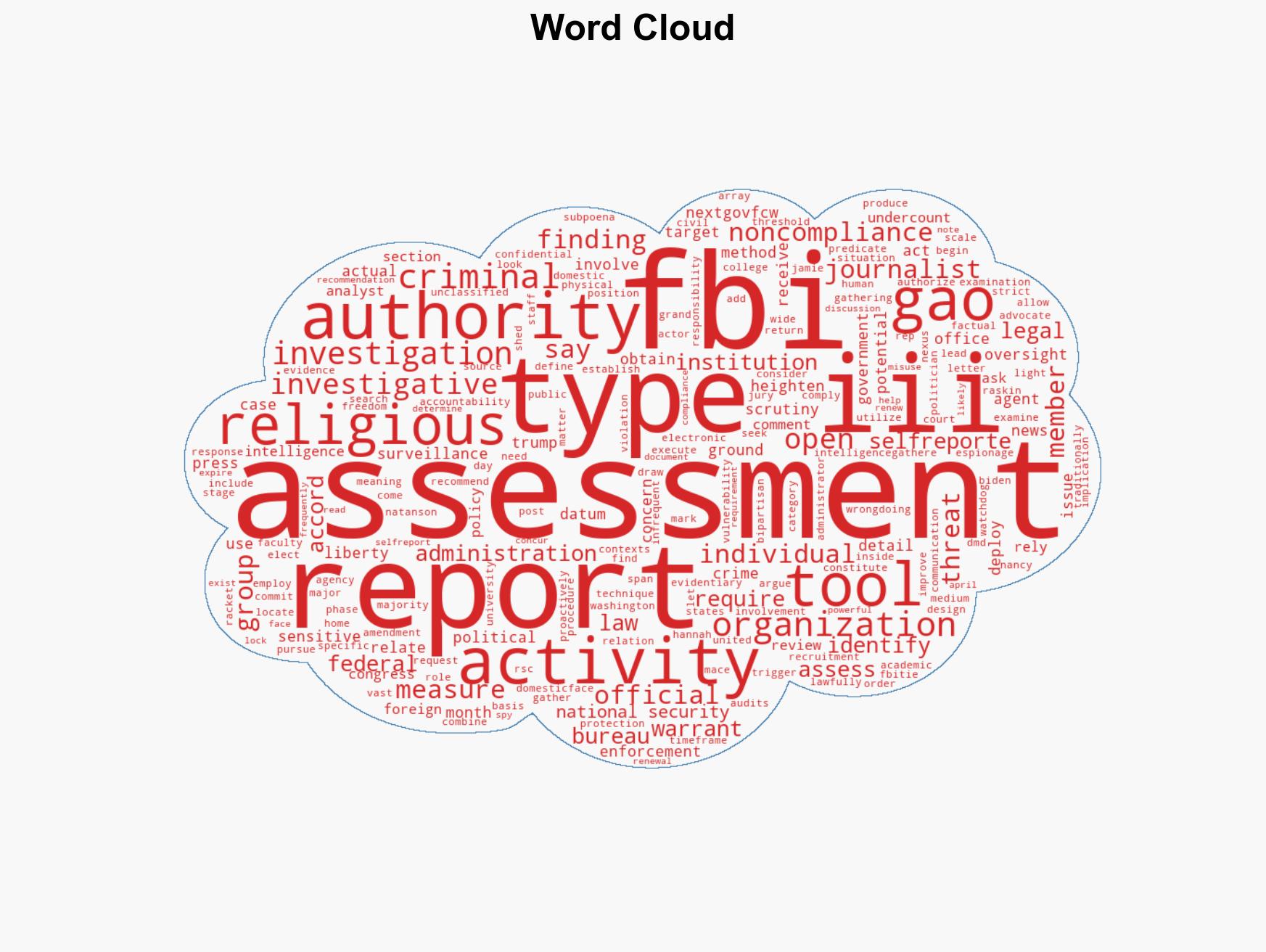
Intelligence Report: FBI gathered intelligence on reporters religious orgs using assessment authority watchdog report says
1. BLUF (Bottom Line Up Front)
The FBI’s use of assessment authority to gather intelligence on journalists, religious organizations, and politicians raises significant civil liberties concerns. The practice, which does not require a criminal predicate, could face increased scrutiny and legal challenges. This development affects domestic law enforcement and civil rights groups, with moderate confidence in the assessment due to limited information on specific cases and outcomes.
2. Competing Hypotheses
- Hypothesis A: The FBI’s use of assessment authority is primarily aimed at preemptively identifying national security threats and criminal activities. This is supported by the broad scope of the authority and its application to potential threats. However, the lack of specific criminal predicates raises concerns about overreach and civil liberties violations.
- Hypothesis B: The FBI’s actions may be driven by an institutional bias towards expanding surveillance capabilities, potentially at the expense of civil liberties. The inclusion of journalists and religious organizations suggests a broader surveillance agenda, although this lacks direct evidence of intent beyond security concerns.
- Assessment: Hypothesis A is currently better supported due to the stated purpose of the assessment authority in identifying threats. However, increased scrutiny and legal challenges could shift this judgment if evidence of misuse or bias emerges.
3. Key Assumptions and Red Flags
- Assumptions: The FBI’s actions are driven by legitimate security concerns; the assessment authority is applied uniformly across cases; civil liberties are adequately considered in decision-making processes.
- Information Gaps: Specific details on the outcomes of these assessments; internal FBI guidelines on the use of assessment authority; oversight mechanisms in place.
- Bias & Deception Risks: Potential cognitive bias towards prioritizing security over civil liberties; source bias from government reports; lack of transparency as a possible indicator of manipulation.
4. Implications and Strategic Risks
This development could lead to increased legal and public scrutiny of the FBI’s intelligence-gathering practices, potentially affecting its operational capabilities and public trust.
- Political / Geopolitical: Potential for legislative action to restrict or redefine assessment authority; increased tensions between law enforcement and civil rights groups.
- Security / Counter-Terrorism: Possible operational impacts if assessment authority is curtailed; challenges in balancing security needs with civil liberties.
- Cyber / Information Space: Heightened concerns over surveillance and privacy could influence public discourse on digital rights and data protection.
- Economic / Social: Erosion of trust in government institutions could affect social cohesion and stability; potential economic impacts from legal challenges and reforms.
5. Recommendations and Outlook
- Immediate Actions (0–30 days): Conduct a review of current assessment cases for compliance with civil liberties; increase transparency with public and oversight bodies.
- Medium-Term Posture (1–12 months): Develop clearer guidelines and oversight mechanisms; engage with civil rights groups to address concerns and build trust.
- Scenario Outlook:
- Best: Reforms lead to improved balance between security and civil liberties, enhancing public trust.
- Worst: Continued misuse leads to significant legal restrictions and loss of operational capabilities.
- Most-Likely: Incremental reforms with ongoing scrutiny and debate over the scope of assessment authority.
6. Key Individuals and Entities
- Not clearly identifiable from open sources in this snippet.
7. Thematic Tags
national security threats, civil liberties, FBI, intelligence gathering, surveillance, national security, legal oversight, media relations
Structured Analytic Techniques Applied
- Cognitive Bias Stress Test: Expose and correct potential biases in assessments through red-teaming and structured challenge.
- Bayesian Scenario Modeling: Use probabilistic forecasting for conflict trajectories or escalation likelihood.
- Network Influence Mapping: Map relationships between state and non-state actors for impact estimation.
Explore more:
National Security Threats Briefs ·
Daily Summary ·
Support us