Hindu Extremist Groups Target Christians Amid Rising Religious Violence in India
Published on: 2026-01-14
AI-powered OSINT brief from verified open sources. Automated NLP signal extraction with human verification. See our Methodology and Why WorldWideWatchers.
Intelligence Report: As hate spirals in India Hindu extremists turn to Christian targets
1. BLUF (Bottom Line Up Front)
There is a notable increase in religiously motivated hate speech and violence in India, particularly targeting the Christian minority, alongside Muslims. This escalation is largely driven by Hindu majoritarian groups and elements within the ruling BJP. The situation poses a growing risk to social cohesion and religious freedom in India. Overall confidence in this assessment is moderate, given the reliance on reported incidents and potential biases in source material.
2. Competing Hypotheses
- Hypothesis A: The rise in anti-Christian violence and rhetoric is primarily driven by grassroots Hindu extremist groups, with tacit support from political entities. This is supported by the increase in hate speech events and the involvement of BJP-affiliated individuals. Key uncertainties include the extent of direct government endorsement.
- Hypothesis B: The incidents are isolated and not indicative of a broader systemic issue, possibly exaggerated by media and advocacy groups. This is contradicted by the widespread nature of the events and the statistical increase in hate speech. However, the lack of explicit government condemnation could suggest a more complex political dynamic.
- Assessment: Hypothesis A is currently better supported due to the documented increase in organized hate speech and violence, and the involvement of political figures. Indicators that could shift this judgment include explicit government actions to curb such violence or evidence of misreporting.
3. Key Assumptions and Red Flags
- Assumptions: The data from India Hate Lab is accurate and comprehensive; Hindu majoritarian groups have significant influence over local political dynamics; the BJP’s lack of condemnation implies tacit approval.
- Information Gaps: Detailed government response strategies; internal communications within BJP and RSS regarding these events; independent verification of incident reports.
- Bias & Deception Risks: Potential bias in reporting from advocacy groups; risk of underreporting or mischaracterization of events by local authorities; possible manipulation of social media narratives.
4. Implications and Strategic Risks
This development could exacerbate religious tensions in India, potentially leading to further violence and destabilization. It may also impact India’s international reputation regarding religious freedom.
- Political / Geopolitical: Potential for increased domestic and international criticism of India’s human rights record; risk of alienating minority communities.
- Security / Counter-Terrorism: Increased likelihood of retaliatory violence or radicalization among targeted communities; potential for communal unrest.
- Cyber / Information Space: Use of social media to propagate hate speech and organize events; possible cyber campaigns by extremist groups.
- Economic / Social: Deterioration in social cohesion; potential negative impact on tourism and foreign investment due to perceived instability.
5. Recommendations and Outlook
- Immediate Actions (0–30 days): Increase monitoring of hate speech and extremist activities; engage with local leaders to promote dialogue and de-escalation; enhance security measures for vulnerable communities.
- Medium-Term Posture (1–12 months): Develop resilience programs for affected communities; strengthen partnerships with civil society organizations to counter hate narratives; invest in community policing initiatives.
- Scenario Outlook:
- Best: Government takes decisive action to curb hate speech, leading to reduced tensions.
- Worst: Escalation into widespread communal violence, damaging social fabric and international relations.
- Most-Likely: Continued sporadic incidents with moderate government intervention, maintaining current tensions.
6. Key Individuals and Entities
- Hindu majoritarian groups
- Bharatiya Janata Party (BJP)
- Rashtriya Swayamsevak Sangh (RSS)
- Center for the Study of Organized Hate (CSOH)
- Not clearly identifiable from open sources in this snippet
7. Thematic Tags
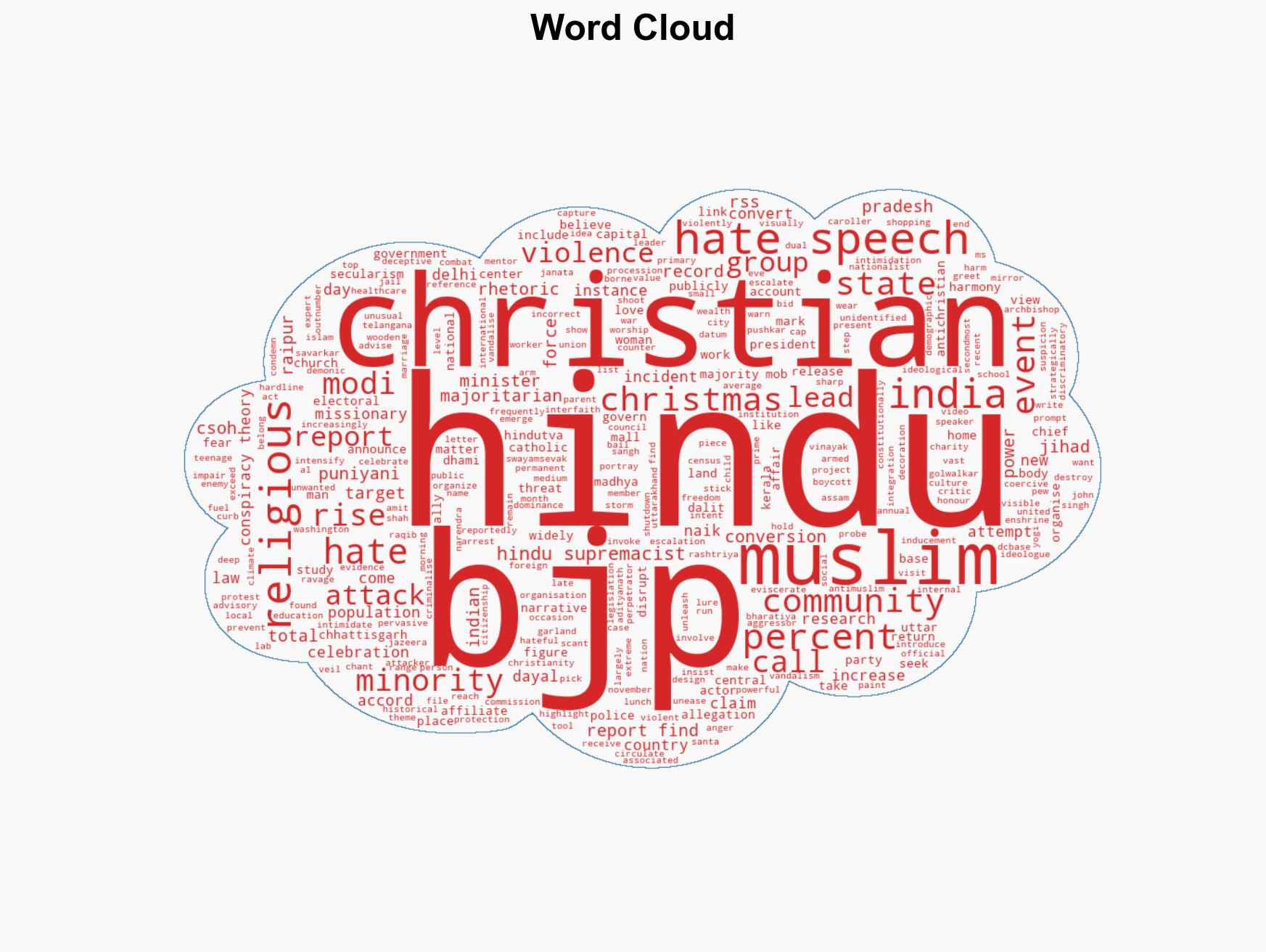
national security threats, religious violence, Hindu nationalism, hate speech, BJP, India, social cohesion, minority rights
Structured Analytic Techniques Applied
- Cognitive Bias Stress Test: Expose and correct potential biases in assessments through red-teaming and structured challenge.
- Bayesian Scenario Modeling: Use probabilistic forecasting for conflict trajectories or escalation likelihood.
- Network Influence Mapping: Map relationships between state and non-state actors for impact estimation.
Explore more:
National Security Threats Briefs ·
Daily Summary ·
Support us