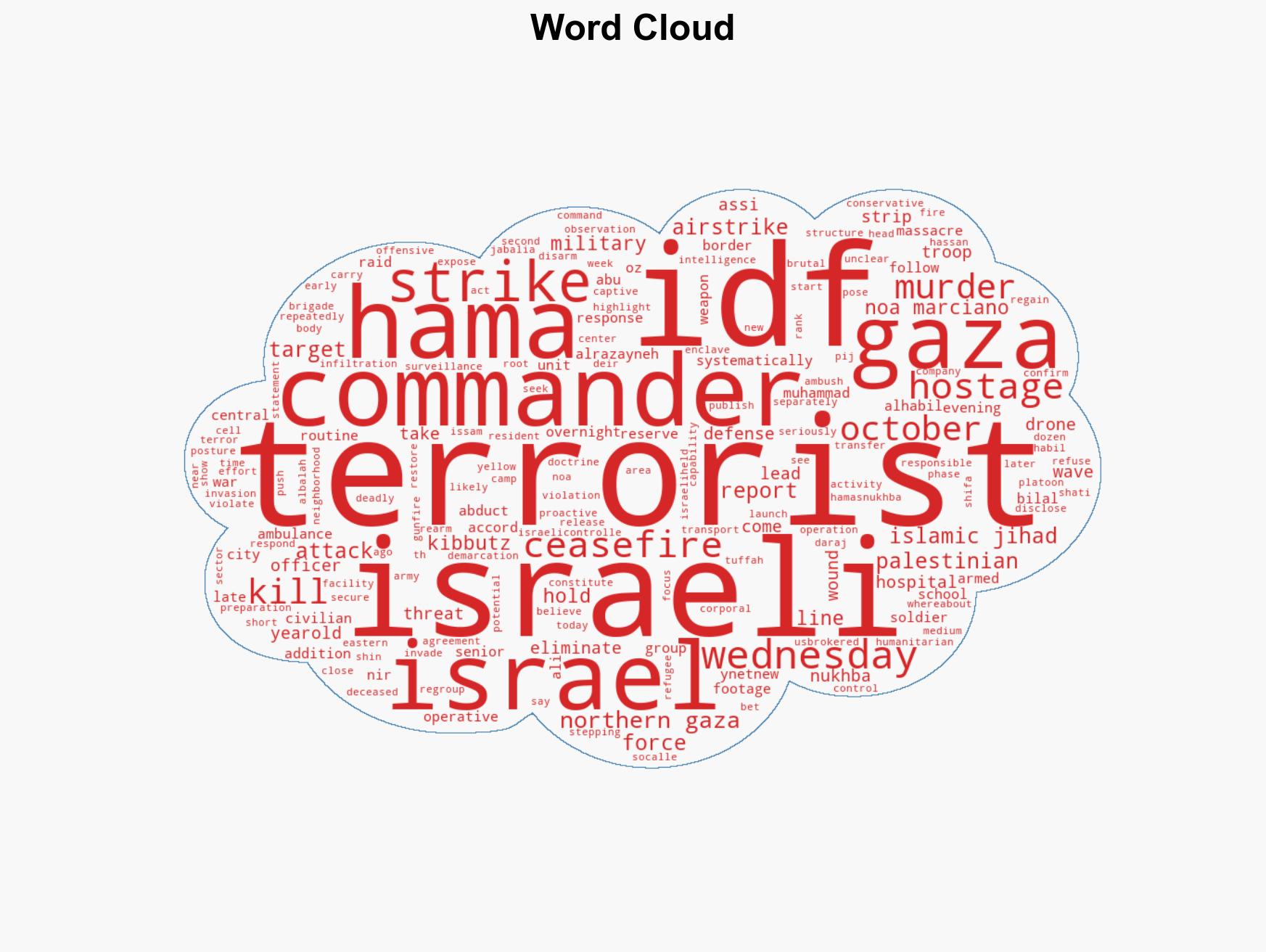
IDF Strikes Eliminate Senior Islamic Jihad Commander and Target Hamas Nukhba Leader Responsible for October 7…
Published on: 2026-02-04
AI-powered OSINT brief from verified open sources. Automated NLP signal extraction with human verification. See our Methodology and Why WorldWideWatchers.
Intelligence Report: IDF Eliminates Islamic Jihads North Gaza Commander Targets Hamas-Nukhba Commander
1. BLUF (Bottom Line Up Front)
The Israel Defense Forces (IDF) have conducted targeted strikes eliminating key commanders of Palestinian Islamic Jihad and Hamas in Gaza. This action is likely to disrupt the operational capabilities of these groups in the short term. However, it may also escalate tensions and provoke retaliatory attacks. Overall confidence in this assessment is moderate due to potential information gaps and the dynamic nature of the conflict.
2. Competing Hypotheses
- Hypothesis A: The IDF strikes will significantly degrade the operational capabilities of Islamic Jihad and Hamas, leading to a temporary reduction in attacks against Israel. This is supported by the elimination of key commanders, which could disrupt command and control structures. However, uncertainty remains regarding the groups’ ability to quickly replace leadership and adapt.
- Hypothesis B: The strikes will provoke increased retaliatory attacks from Islamic Jihad and Hamas, potentially escalating the conflict. This is supported by historical patterns of retaliation following targeted killings. Contradicting evidence includes potential deterrent effects of the strikes and internal pressure within Gaza to avoid further escalation.
- Assessment: Hypothesis A is currently better supported given the immediate disruption to leadership structures. However, indicators such as increased militant communications or public statements could shift this judgment towards Hypothesis B.
3. Key Assumptions and Red Flags
- Assumptions: The elimination of commanders will have a significant impact on operational capabilities; Hamas and Islamic Jihad will prioritize retaliation; IDF intelligence on target locations is accurate.
- Information Gaps: Details on the current state of command structures within Hamas and Islamic Jihad; potential for external support to these groups; internal political dynamics within Gaza.
- Bias & Deception Risks: Potential bias in relying on IDF and Israeli media reports; risk of deception by militant groups regarding leadership casualties.
4. Implications and Strategic Risks
The targeted strikes may temporarily weaken militant capabilities but could also lead to an escalation in violence. The situation remains fluid, with potential for broader regional implications.
- Political / Geopolitical: Potential for increased regional tensions, particularly if external actors become involved or if the conflict spills over into neighboring areas.
- Security / Counter-Terrorism: Short-term reduction in militant attacks, but heightened risk of retaliatory actions and potential for new recruitment drives by militant groups.
- Cyber / Information Space: Possible increase in cyber operations or propaganda efforts by both sides to influence public perception and morale.
- Economic / Social: Continued instability may exacerbate humanitarian conditions in Gaza, impacting social cohesion and economic recovery efforts.
5. Recommendations and Outlook
- Immediate Actions (0–30 days): Enhance monitoring of militant communications and movements; prepare for potential retaliatory attacks; engage in diplomatic efforts to prevent escalation.
- Medium-Term Posture (1–12 months): Strengthen intelligence-sharing with regional partners; invest in resilience measures for border communities; support humanitarian aid to mitigate civilian impact.
- Scenario Outlook:
- Best Case: Strikes lead to prolonged reduction in militant activity, enabling diplomatic engagement (trigger: sustained ceasefire).
- Worst Case: Escalation into broader conflict involving regional actors (trigger: significant retaliatory attack).
- Most-Likely: Periodic flare-ups of violence with intermittent ceasefires (trigger: ongoing tit-for-tat attacks).
6. Key Individuals and Entities
- Ali Al-Razayneh – Islamic Jihad Northern Gaza Commander
- Bilal Abu Assi – Hamas Nukhba Commander
- Muhammad Issam Hassan al-Habil – Hamas Cell Commander
- Noa Marciano – Israeli Hostage
- Israel Defense Forces (IDF)
7. Thematic Tags
Counter-Terrorism, military operations, Middle East conflict, Hamas, Islamic Jihad, IDF, regional security
Structured Analytic Techniques Applied
- ACH 2.0: Reconstruct likely threat actor intentions via hypothesis testing and structured refutation.
- Indicators Development: Track radicalization signals and propaganda patterns to anticipate operational planning.
- Narrative Pattern Analysis: Analyze spread/adaptation of ideological narratives for recruitment/incitement signals.
Explore more:
Counter-Terrorism Briefs ·
Daily Summary ·
Support us