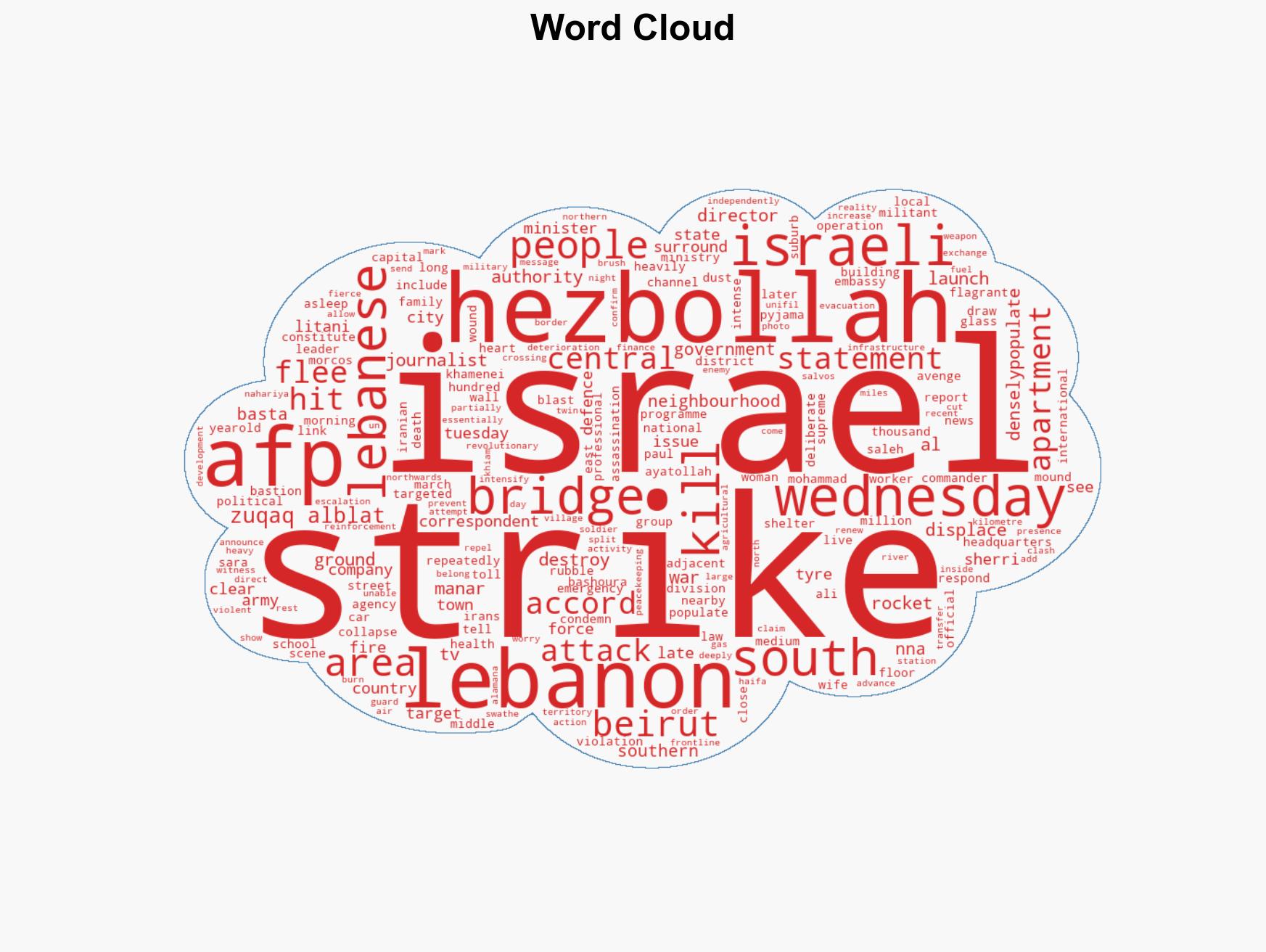
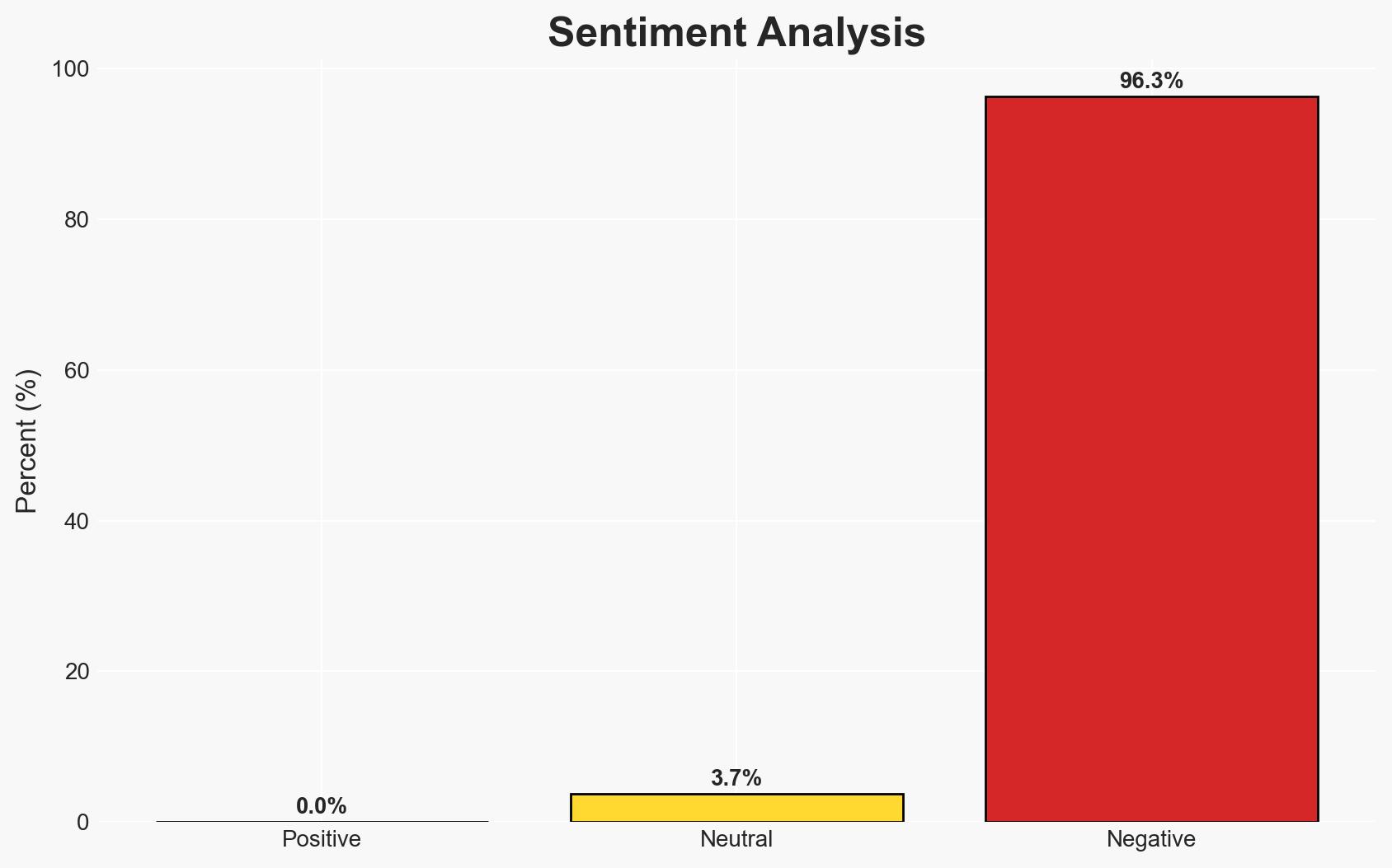
Israel Intensifies Airstrikes on Beirut, Targeting Bridges and Resulting in Multiple Casualties
Published on: 2026-03-19
AI-powered OSINT brief from verified open sources. Automated NLP signal extraction with human verification. See our Methodology and Why WorldWideWatchers.
Intelligence Report: Israel conducts wave of strikes on Beirut knocks out southern bridges
1. BLUF (Bottom Line Up Front)
Israel’s recent airstrikes on Beirut and southern Lebanon are a significant escalation in the ongoing conflict with Hezbollah, resulting in substantial casualties and infrastructure damage. The strikes appear to be a direct response to Hezbollah’s rocket attacks following the assassination of Iran’s Supreme Leader. This development is likely to exacerbate regional tensions and could lead to further military engagements. Overall confidence in this assessment is moderate due to incomplete information on strategic intentions and potential third-party interventions.
2. Competing Hypotheses
- Hypothesis A: Israel’s strikes aim to degrade Hezbollah’s military capabilities and infrastructure in response to recent provocations. Supporting evidence includes targeted attacks on Hezbollah strongholds and infrastructure. However, the lack of clarity on Israel’s long-term strategic goals introduces uncertainty.
- Hypothesis B: The strikes are primarily a retaliatory measure intended to deter further Hezbollah aggression and signal strength to regional adversaries. This is supported by the timing and intensity of the strikes following Hezbollah’s attacks. Contradictory evidence includes the potential for these actions to provoke further escalation rather than deter it.
- Assessment: Hypothesis B is currently better supported due to the immediate retaliatory nature of the strikes and the historical context of similar responses. Indicators such as continued Hezbollah attacks or Israeli statements on strategic objectives could shift this judgment.
3. Key Assumptions and Red Flags
- Assumptions: Israel’s primary objective is deterrence; Hezbollah will continue to retaliate; regional actors will not intervene directly.
- Information Gaps: Details on Israel’s long-term strategic objectives and potential diplomatic engagements are missing.
- Bias & Deception Risks: Source bias from local media and potential misinformation from involved parties could skew perceptions of the conflict’s scale and impact.
4. Implications and Strategic Risks
The escalation in military actions between Israel and Hezbollah could lead to broader regional instability, drawing in other state and non-state actors. This conflict may also impact global energy markets and international diplomatic efforts in the Middle East.
- Political / Geopolitical: Potential for increased involvement from Iran and other regional powers, leading to wider geopolitical tensions.
- Security / Counter-Terrorism: Heightened risk of terrorist activities and cross-border attacks, impacting regional security dynamics.
- Cyber / Information Space: Possible increase in cyber operations and propaganda campaigns by both state and non-state actors.
- Economic / Social: Displacement and infrastructure damage could exacerbate Lebanon’s economic crisis and social unrest.
5. Recommendations and Outlook
- Immediate Actions (0–30 days): Enhance intelligence monitoring of military movements and diplomatic communications; engage in back-channel diplomacy to de-escalate tensions.
- Medium-Term Posture (1–12 months): Strengthen regional alliances and develop contingency plans for potential escalation; support humanitarian efforts in Lebanon.
- Scenario Outlook: Best: De-escalation through diplomatic channels. Worst: Full-scale regional conflict involving multiple state actors. Most-Likely: Continued tit-for-tat exchanges with periodic escalations.
6. Key Individuals and Entities
- Hezbollah
- Israeli Defense Forces (IDF)
- Iranian Revolutionary Guards
- Lebanese Government
- Mohammad Sherri (Hezbollah’s Al Manar TV director)
7. Thematic Tags
Counter-Terrorism, military escalation, Hezbollah, Israel-Lebanon conflict, regional stability, infrastructure damage, geopolitical tensions
Structured Analytic Techniques Applied
- ACH 2.0: Reconstruct likely threat actor intentions via hypothesis testing and structured refutation.
- Indicators Development: Track radicalization signals and propaganda patterns to anticipate operational planning.
- Narrative Pattern Analysis: Analyze spread/adaptation of ideological narratives for recruitment/incitement signals.
Explore more:
Counter-Terrorism Briefs ·
Daily Summary ·
Support us