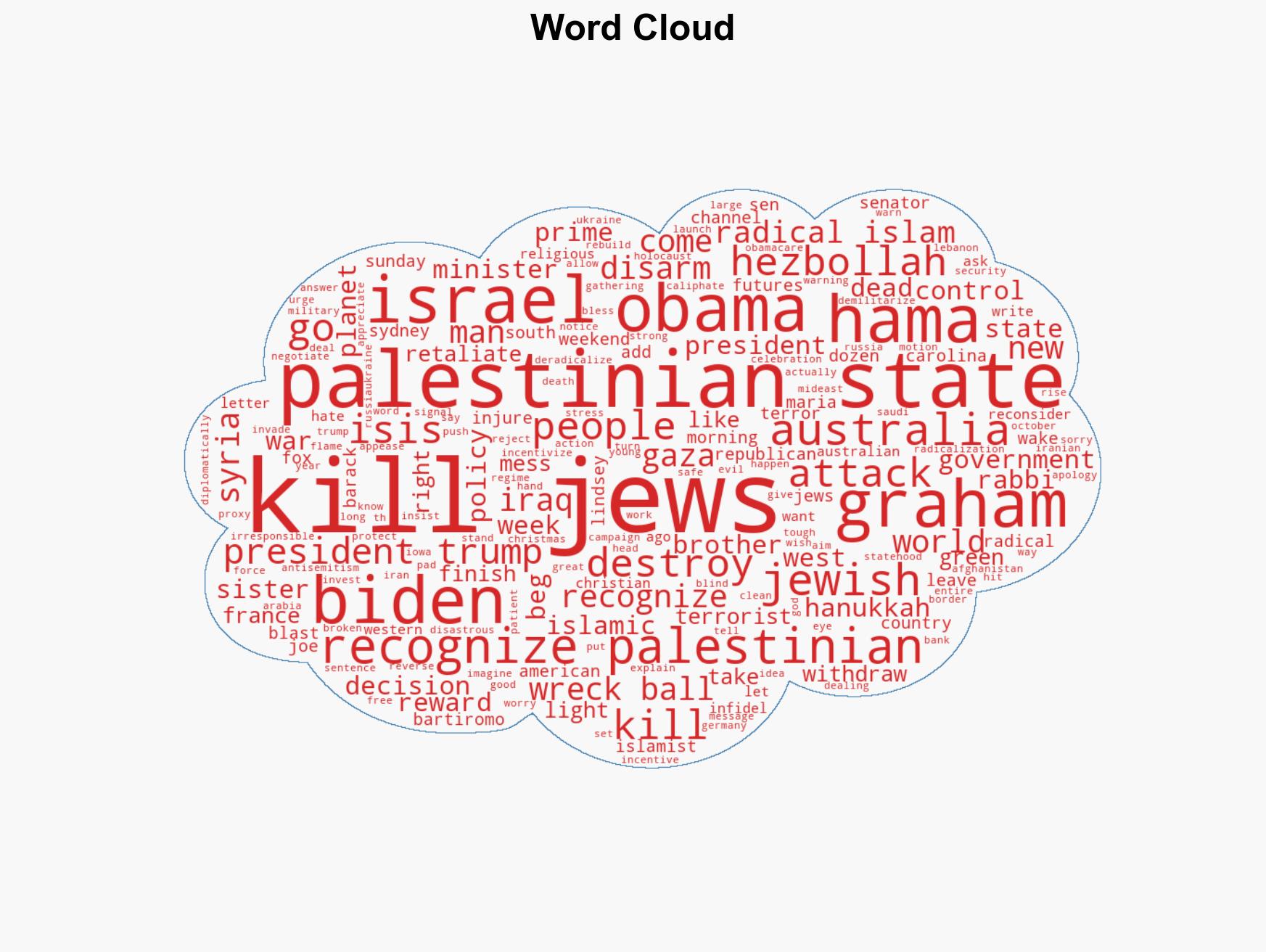
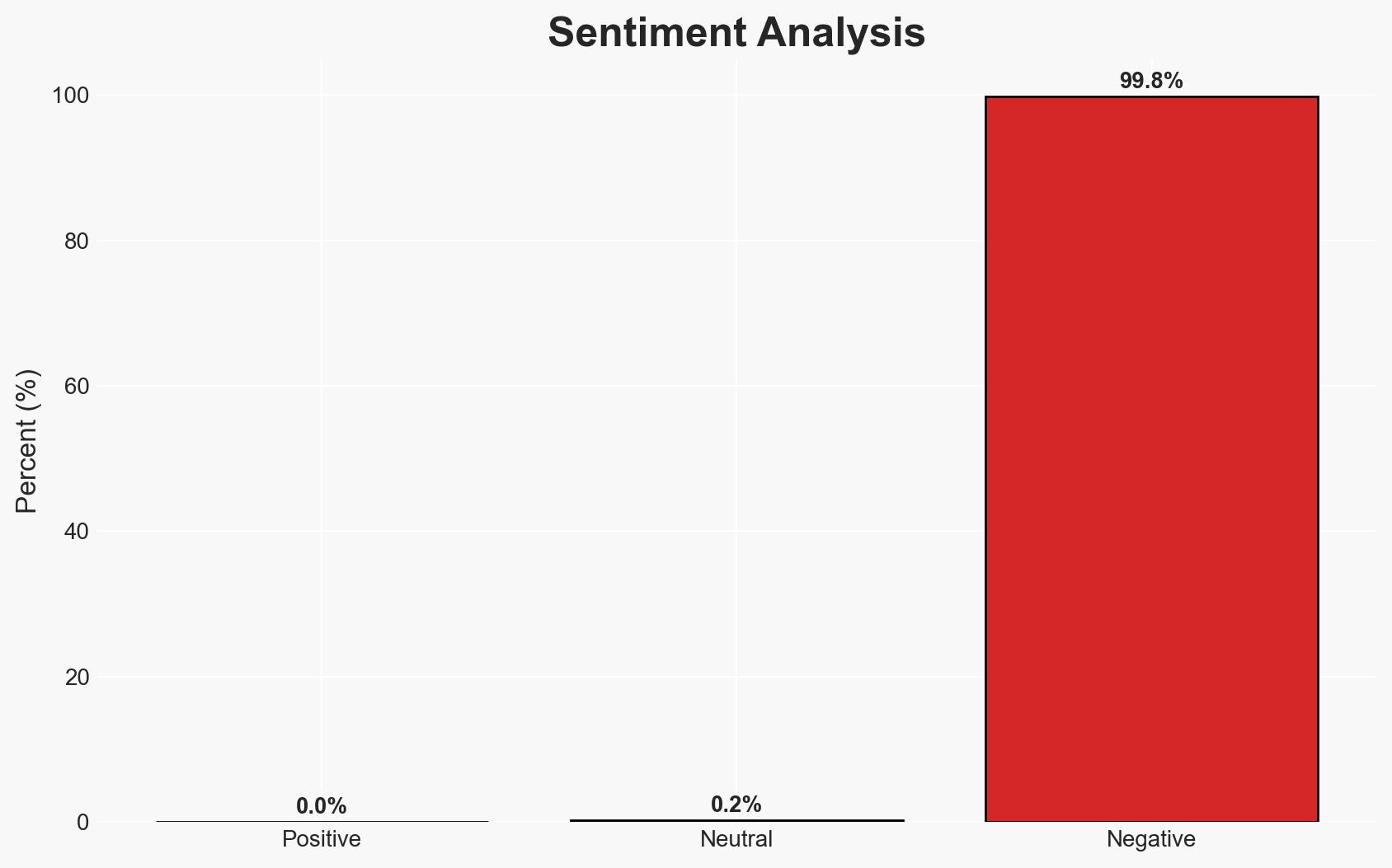
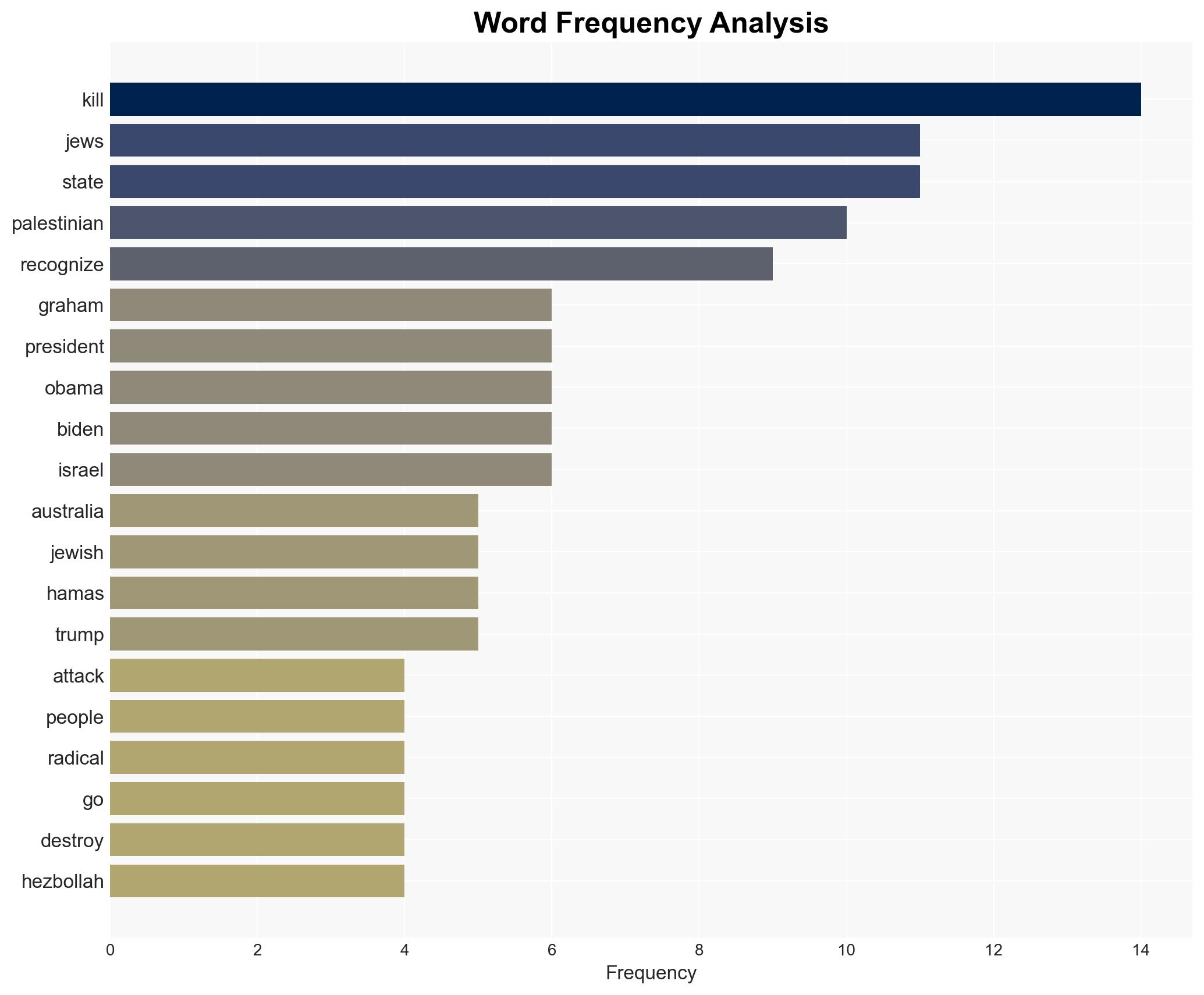
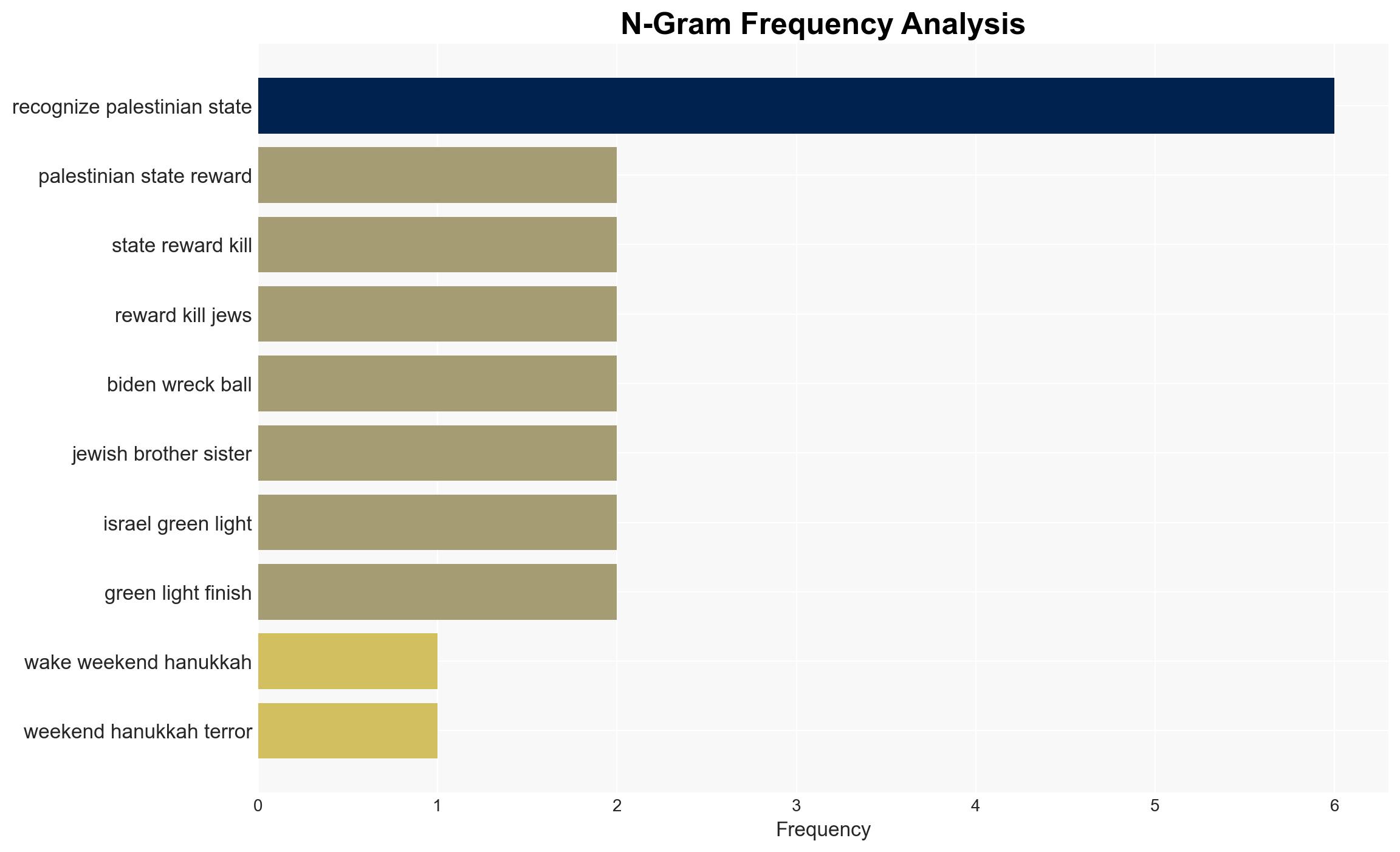
Lindsey Graham condemns recognition of Palestinian state as a reward for violence against Jews following Sydn…
Published on: 2025-12-14
AI-powered OSINT brief from verified open sources. Automated NLP signal extraction with human verification. See our Methodology and Why WorldWideWatchers.
Intelligence Report: This is a religious war Sen Lindsey Graham hammers countries recognizing Palestinian state as rewarding killing Jews
1. BLUF (Bottom Line Up Front)
Senator Lindsey Graham’s statements highlight a perceived link between the recognition of a Palestinian state and increased anti-Semitic violence, suggesting that such recognition incentivizes attacks on Jewish communities. The analysis indicates a moderate confidence that Graham’s rhetoric may influence U.S. and allied policy discussions, potentially impacting diplomatic relations and security postures in the Middle East and Western countries.
2. Competing Hypotheses
- Hypothesis A: Recognition of a Palestinian state directly incentivizes anti-Semitic violence. This is supported by Graham’s assertion that such recognition rewards violence against Jews. However, the hypothesis lacks direct causal evidence linking state recognition to specific acts of violence.
- Hypothesis B: Recognition of a Palestinian state is a diplomatic move aimed at resolving long-standing conflicts and does not directly incentivize violence. This is supported by the broader international context where state recognition is often a step towards peace negotiations. Contradicting evidence includes ongoing violence and instability in regions recognizing Palestinian statehood.
- Assessment: Hypothesis B is currently better supported, as state recognition is typically part of broader peace efforts. However, Graham’s statements could influence public perception and policy, potentially shifting this judgment if violence escalates in recognized states.
3. Key Assumptions and Red Flags
- Assumptions: Recognition of a Palestinian state is assumed to be a significant factor in regional violence; Graham’s statements reflect broader U.S. policy sentiments; anti-Semitic violence is primarily driven by state recognition.
- Information Gaps: Lack of direct evidence linking state recognition to specific acts of violence; insufficient data on the impact of Graham’s statements on policy changes.
- Bias & Deception Risks: Potential bias in Graham’s statements due to political affiliations; risk of overestimating the impact of state recognition on violence without comprehensive data.
4. Implications and Strategic Risks
The development could exacerbate tensions between pro-Palestinian and pro-Israeli factions, influencing international diplomatic strategies and domestic security policies.
- Political / Geopolitical: Potential strain on U.S. relations with countries recognizing Palestinian statehood; increased polarization in international forums.
- Security / Counter-Terrorism: Heightened security risks for Jewish communities globally; potential for increased counter-terrorism operations.
- Cyber / Information Space: Possible increase in cyber-attacks or information operations targeting Jewish organizations or countries recognizing Palestinian statehood.
- Economic / Social: Potential economic repercussions from strained diplomatic relations; social unrest in multicultural societies.
5. Recommendations and Outlook
- Immediate Actions (0–30 days): Monitor rhetoric and policy changes in countries recognizing Palestinian statehood; enhance security measures for Jewish communities.
- Medium-Term Posture (1–12 months): Strengthen diplomatic engagements to mitigate tensions; develop resilience measures for potential cyber threats.
- Scenario Outlook:
- Best: Diplomatic efforts lead to de-escalation and renewed peace negotiations.
- Worst: Increased violence and diplomatic isolation of countries recognizing Palestinian statehood.
- Most-Likely: Continued tension with sporadic violence and diplomatic challenges.
6. Key Individuals and Entities
- Senator Lindsey Graham
- Former President Barack Obama
- President Joe Biden
- Hamas
- Hezbollah
- Iranian Regime
- Not clearly identifiable from open sources in this snippet.
7. Thematic Tags
Counter-Terrorism, Middle East policy, anti-Semitism, diplomatic relations, state recognition, radical Islam, international security
Structured Analytic Techniques Applied
- ACH 2.0: Reconstruct likely threat actor intentions via hypothesis testing and structured refutation.
- Indicators Development: Track radicalization signals and propaganda patterns to anticipate operational planning.
- Narrative Pattern Analysis: Analyze spread/adaptation of ideological narratives for recruitment/incitement signals.
Explore more:
Counter-Terrorism Briefs ·
Daily Summary ·
Support us