Mysterious Persian Radio Signal Captivates Analysts Amidst Escalating Tensions in the Region
Published on: 2026-04-01
AI-powered OSINT brief from verified open sources. Automated NLP signal extraction with human verification. See our Methodology and Why WorldWideWatchers.
Intelligence Report: Random numbers Persian code A mysterious signal transfixes radio sleuths
1. BLUF (Bottom Line Up Front)
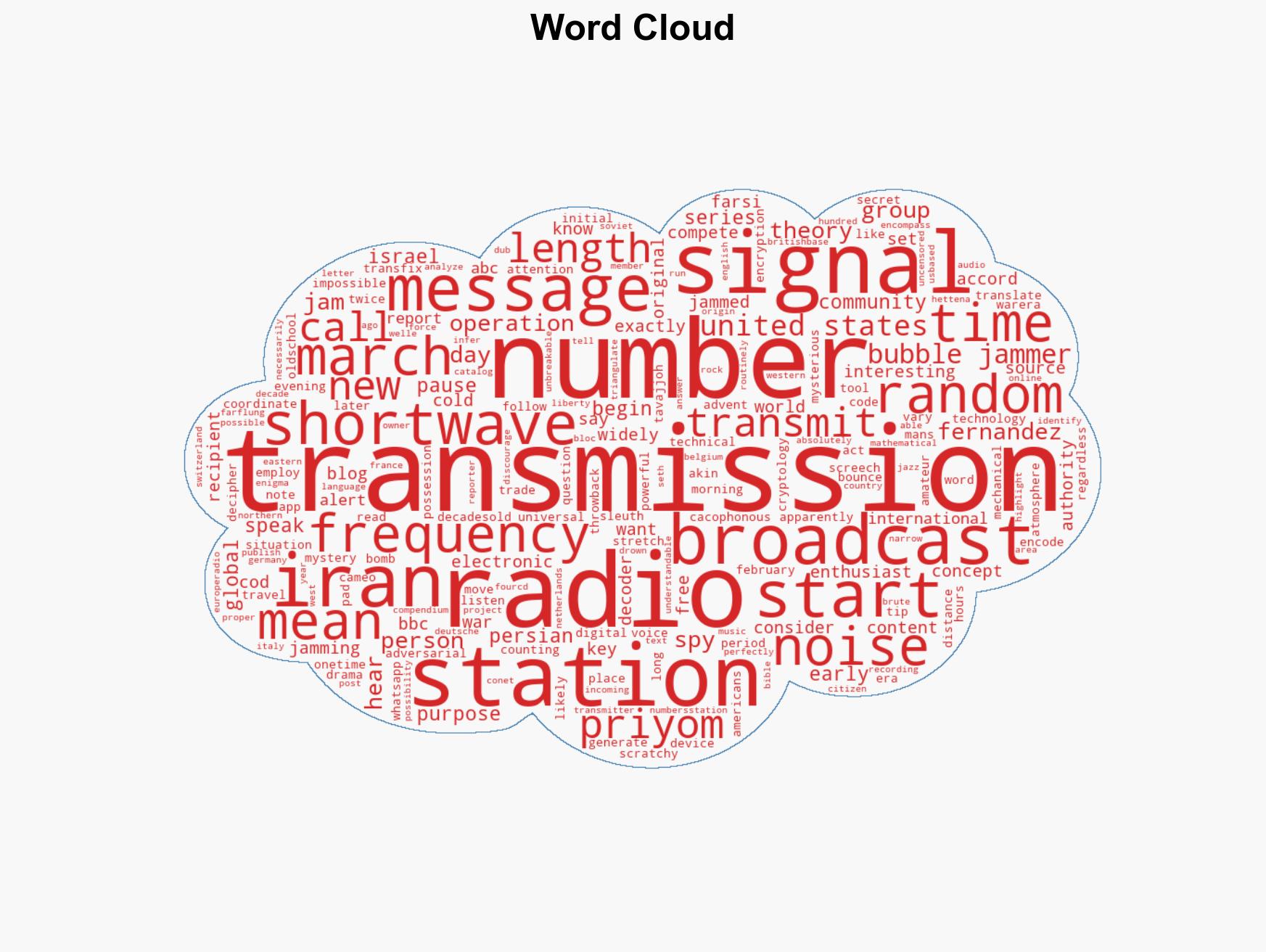
The mysterious radio transmission broadcasting random numbers in Persian coincides with military actions involving the United States, Israel, and Iran. The signal’s jamming suggests adversarial interference, likely indicating a covert intelligence operation. The most supported hypothesis is that this is an operation against Iran. Overall confidence in this assessment is moderate due to significant information gaps.
2. Competing Hypotheses
- Hypothesis A: The transmission is an Iranian operation, potentially communicating with operatives or allies. Supporting evidence includes the use of Persian and the timing post-bombing. Contradicting evidence includes the jamming, which suggests external interference. Key uncertainties include the origin and intended recipient of the signal.
- Hypothesis B: The transmission is a U.S. or allied operation aimed at destabilizing or gathering intelligence on Iran. Supporting evidence includes the technical capability of the U.S. to jam signals and the strategic timing. Contradicting evidence includes the use of Persian, which might suggest an Iranian origin.
- Assessment: Hypothesis B is currently better supported due to the jamming, which implies a counteraction against an Iranian transmission. Key indicators that could shift this judgment include identifying the source of the jamming or deciphering the message’s content.
3. Key Assumptions and Red Flags
- Assumptions: The transmission is intended for intelligence purposes; the jamming is deliberate and not coincidental; the timing is strategically linked to geopolitical events.
- Information Gaps: The exact origin of the transmission and jamming; the content and purpose of the message; the identity of the intended recipient.
- Bias & Deception Risks: Potential confirmation bias towards assuming state-level actors; risk of misattribution due to lack of concrete evidence; possible deception by involved parties to mislead analysis.
4. Implications and Strategic Risks
This development could exacerbate tensions between Iran and Western nations, particularly the U.S. and Israel, potentially leading to further covert operations or open conflict escalation.
- Political / Geopolitical: Increased diplomatic strain and potential for retaliatory actions by Iran.
- Security / Counter-Terrorism: Heightened alert for intelligence and military operations in the region.
- Cyber / Information Space: Potential for increased cyber operations targeting communication networks.
- Economic / Social: Possible impact on regional stability, affecting economic conditions and social cohesion.
5. Recommendations and Outlook
- Immediate Actions (0–30 days): Enhance monitoring of shortwave frequencies; engage in diplomatic channels to de-escalate tensions; increase intelligence-sharing with allies.
- Medium-Term Posture (1–12 months): Develop resilience measures for communication infrastructure; strengthen partnerships with regional allies; invest in counter-jamming technologies.
- Scenario Outlook:
- Best: Diplomatic resolution reduces tensions, leading to cessation of covert operations.
- Worst: Escalation into open conflict with significant regional destabilization.
- Most-Likely: Continued covert operations with periodic diplomatic engagements to manage tensions.
6. Key Individuals and Entities
- Not clearly identifiable from open sources in this snippet.
7. Thematic Tags
regional conflicts, covert operations, radio communications, Iran, U.S. intelligence, geopolitical tensions, signal jamming, numbers station
Structured Analytic Techniques Applied
- Causal Layered Analysis (CLA): Analyze events across surface happenings, systems, worldviews, and myths.
- Cross-Impact Simulation: Model ripple effects across neighboring states, conflicts, or economic dependencies.
- Scenario Generation: Explore divergent futures under varying assumptions to identify plausible paths.
- Adversarial Threat Simulation: Model hostile behavior to identify vulnerabilities.
Explore more:
Regional Conflicts Briefs ·
Daily Summary ·
Support us