Six US Army Reservists Killed in Iranian Drone Strike on Kuwait Command Center
Published on: 2026-03-03
AI-powered OSINT brief from verified open sources. Automated NLP signal extraction with human verification. See our Methodology and Why WorldWideWatchers.
Intelligence Report: Six US soldiers killed in Iranian strike on Kuwait base
1. BLUF (Bottom Line Up Front)
The confirmed deaths of six US soldiers in an Iranian unmanned aircraft system strike on a command center in Kuwait represent a significant escalation in hostilities between the US and Iran. This incident could lead to increased military tensions and necessitates a reassessment of US force protection measures in the region. Overall confidence in this assessment is moderate, given the current lack of detailed intelligence on Iranian intentions and capabilities.
2. Competing Hypotheses
- Hypothesis A: The strike was a deliberate Iranian military action aimed at escalating tensions and testing US defenses. Supporting evidence includes the precision and timing of the attack. However, the absence of a formal claim of responsibility by Iran introduces uncertainty.
- Hypothesis B: The strike was a rogue action by an Iranian faction not sanctioned by the central government, possibly intended to provoke a US response. This is less supported due to the lack of evidence indicating internal dissent within Iranian military ranks.
- Assessment: Hypothesis A is currently better supported due to the strategic nature of the target and the sophistication of the attack. Key indicators that could shift this judgment include official Iranian communications or intelligence intercepts suggesting unauthorized actions.
3. Key Assumptions and Red Flags
- Assumptions: Iran has the capability and intent to conduct such operations; the US military’s initial casualty reports are accurate; regional tensions are primarily driven by state actors.
- Information Gaps: Details on the decision-making process within Iran regarding the strike; comprehensive intelligence on Iranian UAV capabilities and deployment strategies.
- Bias & Deception Risks: Potential bias in US military reporting; Iranian state media may engage in disinformation to obscure responsibility or intent.
4. Implications and Strategic Risks
This development could lead to a cycle of retaliation between the US and Iran, impacting regional stability and global security dynamics.
- Political / Geopolitical: Increased US-Iran tensions could strain relations with regional allies and complicate diplomatic negotiations.
- Security / Counter-Terrorism: Heightened threat levels for US and allied forces in the region; potential for asymmetric warfare tactics by Iran.
- Cyber / Information Space: Possible increase in cyber operations targeting US assets; information warfare to shape narratives.
- Economic / Social: Potential disruptions in oil markets; increased anti-US sentiment could affect regional social cohesion.
5. Recommendations and Outlook
- Immediate Actions (0–30 days): Enhance force protection measures; increase intelligence collection on Iranian military activities; engage in diplomatic channels to de-escalate tensions.
- Medium-Term Posture (1–12 months): Strengthen regional alliances; develop contingency plans for further escalation; invest in advanced defense systems against UAV threats.
- Scenario Outlook:
- Best: Diplomatic resolution reduces tensions, with no further military engagements.
- Worst: Escalation into broader military conflict, involving regional and global powers.
- Most-Likely: Continued low-level hostilities with periodic diplomatic engagements.
6. Key Individuals and Entities
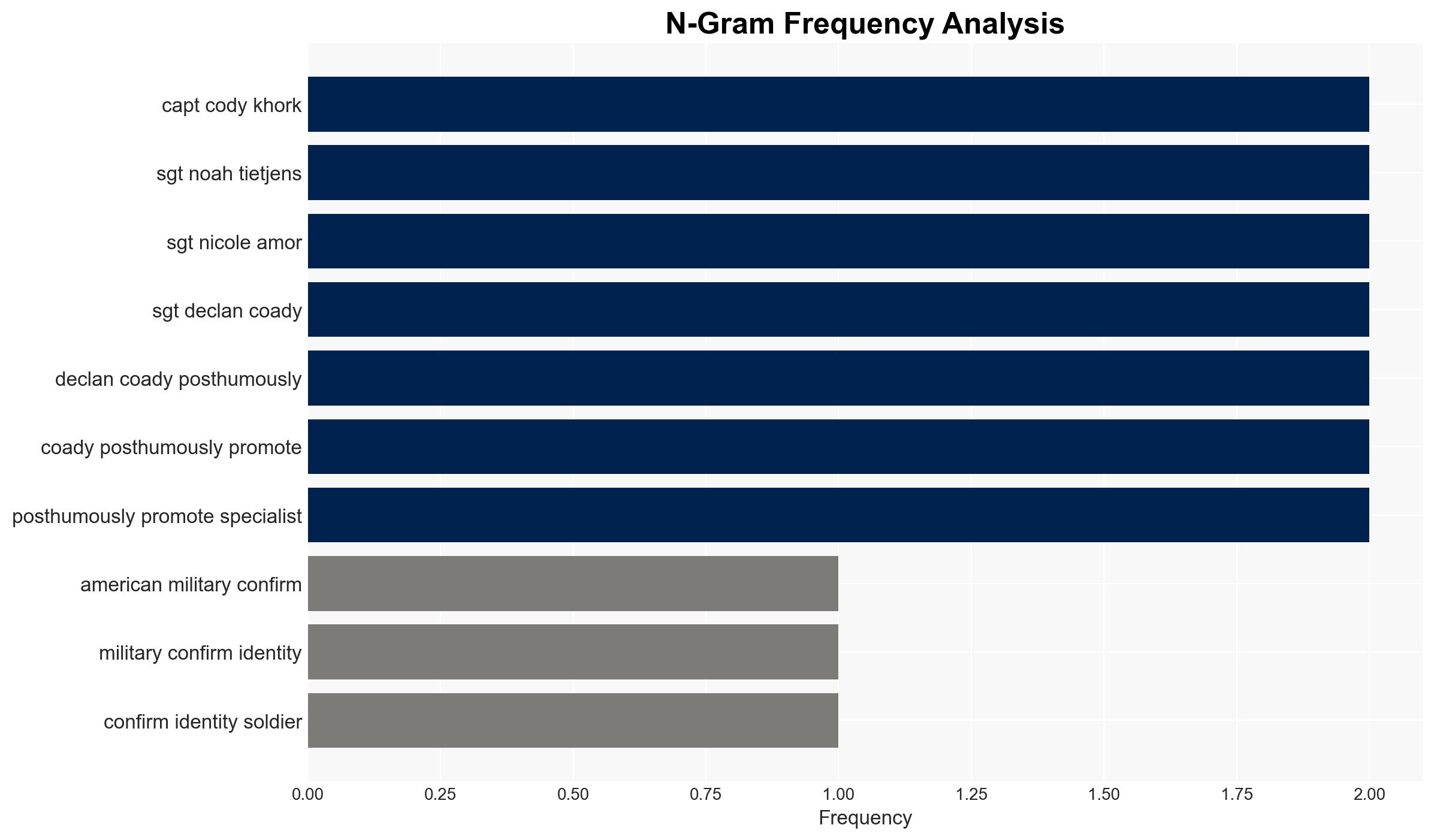
- Capt Cody Khork, Sgt Noah Tietjens, Sgt Nicole Amor, Sgt Declan Coady
- US Central Command
- Iranian military forces
7. Thematic Tags
regional conflicts, military escalation, US-Iran relations, UAV strike, regional security, force protection, geopolitical tensions
Structured Analytic Techniques Applied
- Causal Layered Analysis (CLA): Analyze events across surface happenings, systems, worldviews, and myths.
- Cross-Impact Simulation: Model ripple effects across neighboring states, conflicts, or economic dependencies.
- Scenario Generation: Explore divergent futures under varying assumptions to identify plausible paths.
Explore more:
Regional Conflicts Briefs ·
Daily Summary ·
Support us