Syrian Forces Enforce Curfew in Kurdish Areas of Aleppo Amid Ongoing Clashes with SDF
Published on: 2026-01-07
AI-powered OSINT brief from verified open sources. Automated NLP signal extraction with human verification. See our Methodology and Why WorldWideWatchers.
Intelligence Report: Syrian army closes Aleppos Kurdish areas as clashes persist
1. BLUF (Bottom Line Up Front)
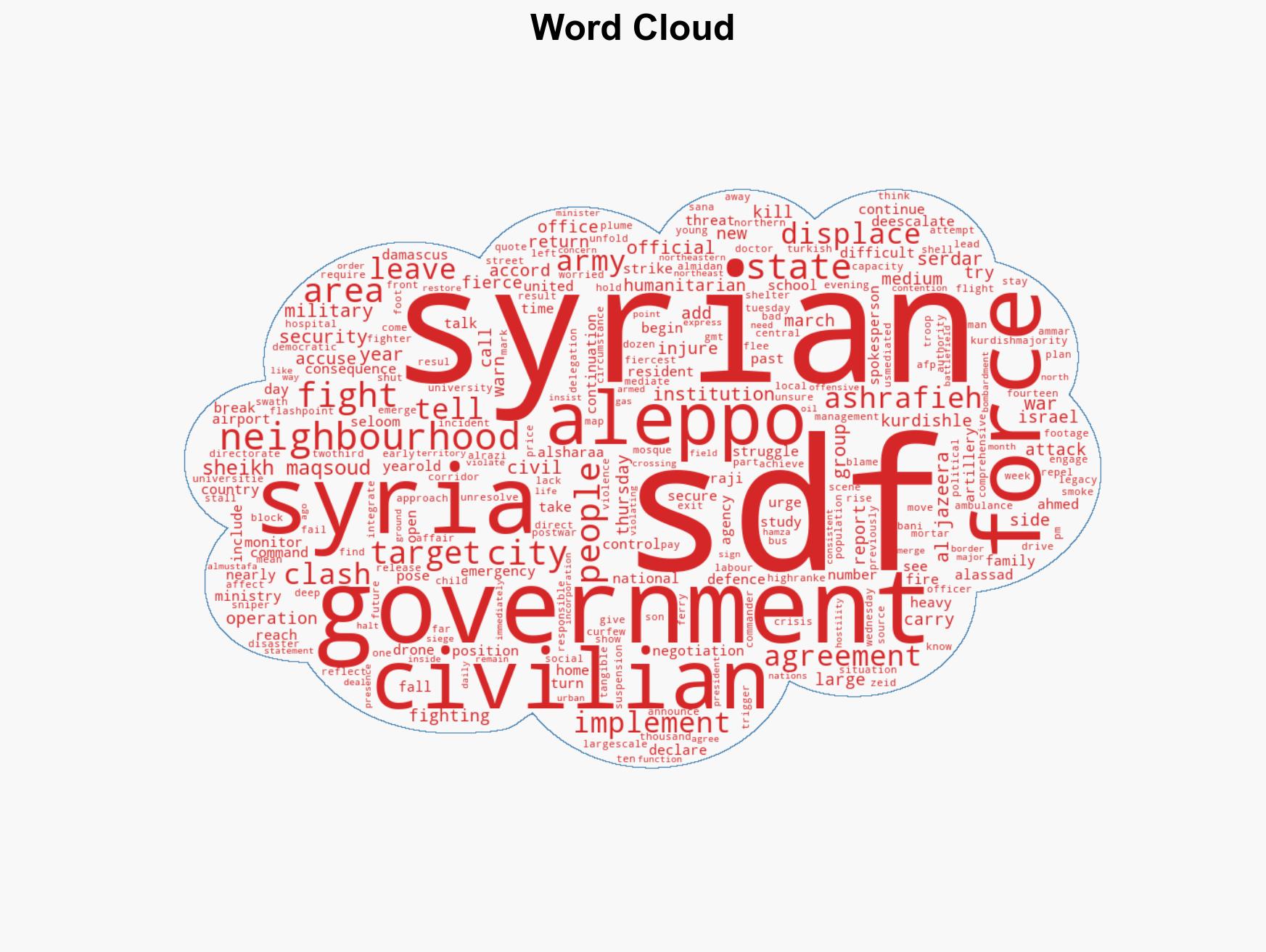
Fierce clashes between Syrian government forces and the Kurdish-led Syrian Democratic Forces (SDF) in Aleppo have resulted in significant civilian displacement and casualties. The situation is escalating, with potential for a humanitarian crisis. The most likely hypothesis is that the Syrian government aims to reassert control over Kurdish-majority areas, with moderate confidence in this assessment.
2. Competing Hypotheses
- Hypothesis A: The Syrian government is conducting operations to reassert control over Kurdish-majority areas in Aleppo. This is supported by the targeted operations and curfews imposed by the Syrian Army. However, the extent of international involvement or support remains unclear.
- Hypothesis B: The clashes are primarily defensive actions by the SDF in response to perceived aggressive maneuvers by the Syrian government. This is supported by reports of SDF repelling attacks and downing drones, but lacks evidence of a broader strategic initiative by the SDF.
- Assessment: Hypothesis A is currently better supported due to the proactive measures taken by the Syrian government, including curfews and targeted operations. Indicators such as increased military presence or international diplomatic responses could shift this judgment.
3. Key Assumptions and Red Flags
- Assumptions: The Syrian government intends to maintain long-term control over Kurdish-majority areas; SDF’s capabilities are limited to defensive operations; civilian displacement will continue without significant international intervention.
- Information Gaps: Details on international reactions or involvement, specific casualty figures, and the strategic objectives of both sides are lacking.
- Bias & Deception Risks: Potential bias in state media reporting; risk of misinformation from both Syrian government and SDF sources; possibility of staged incidents to manipulate perceptions.
4. Implications and Strategic Risks
The ongoing conflict in Aleppo could exacerbate regional instability and lead to broader geopolitical tensions. The humanitarian situation may deteriorate rapidly, affecting regional security dynamics and international relations.
- Political / Geopolitical: Potential for increased tensions between Syria and Kurdish allies, and possible international diplomatic fallout.
- Security / Counter-Terrorism: Heightened risk of insurgency or terrorist activities exploiting the chaos.
- Cyber / Information Space: Potential for cyber operations targeting communication infrastructure or misinformation campaigns.
- Economic / Social: Displacement could strain local resources, leading to economic instability and social unrest.
5. Recommendations and Outlook
- Immediate Actions (0–30 days): Increase monitoring of the situation; engage with regional partners to assess humanitarian needs; prepare for potential refugee flows.
- Medium-Term Posture (1–12 months): Develop resilience measures for displaced populations; strengthen diplomatic channels to mediate conflict; enhance intelligence sharing with allies.
- Scenario Outlook: Best: De-escalation through diplomatic intervention; Worst: Full-scale humanitarian crisis and regional conflict; Most-Likely: Prolonged skirmishes with intermittent ceasefires.
6. Key Individuals and Entities
- Not clearly identifiable from open sources in this snippet.
7. Thematic Tags
regional conflicts, conflict, displacement, humanitarian crisis, Syrian government, Kurdish forces, Aleppo, regional stability
Structured Analytic Techniques Applied
- Causal Layered Analysis (CLA): Analyze events across surface happenings, systems, worldviews, and myths.
- Cross-Impact Simulation: Model ripple effects across neighboring states, conflicts, or economic dependencies.
- Scenario Generation: Explore divergent futures under varying assumptions to identify plausible paths.
- Narrative Pattern Analysis: Deconstruct and track propaganda or influence narratives.
Explore more:
Regional Conflicts Briefs ·
Daily Summary ·
Support us