Trump Details US Military Operation Leading to Capture of Venezuelan President Nicolás Maduro
Published on: 2026-01-03
AI-powered OSINT brief from verified open sources. Automated NLP signal extraction with human verification. See our Methodology and Why WorldWideWatchers.
Intelligence Report: The most important things Trump said about the operation that captured Venezuela’s Nicolás Maduro
1. BLUF (Bottom Line Up Front)
The U.S. military operation resulting in the capture of Venezuelan President Nicolás Maduro represents a significant escalation in U.S. intervention in Venezuela. This action is likely to have profound implications for regional stability and U.S.-Venezuela relations. The operation’s success, as described by President Trump, suggests a high level of U.S. military capability and intelligence coordination. Overall confidence in this assessment is moderate, given the lack of detailed information on the operation’s long-term political and strategic impacts.
2. Competing Hypotheses
- Hypothesis A: The U.S. operation was a strategic move to remove a hostile regime and stabilize Venezuela, supported by the successful capture of Maduro and the absence of U.S. casualties. However, the long-term plan for governance and transition remains unclear, raising questions about sustainability.
- Hypothesis B: The operation was primarily a demonstration of U.S. military power intended to deter other adversaries, with the capture of Maduro as a secondary objective. This is supported by the emphasis on military might and comparisons to past operations, but it contradicts the stated goal of stabilizing Venezuela.
- Assessment: Hypothesis A is currently better supported due to the operation’s focus on regime change and the explicit mention of a transition plan, albeit vague. Indicators that could shift this judgment include emerging details on the U.S. strategy for governance in Venezuela and international reactions.
3. Key Assumptions and Red Flags
- Assumptions: The U.S. has a viable plan for Venezuela’s governance post-capture; Maduro’s capture will lead to reduced resistance from Venezuelan forces; U.S. actions will not provoke significant international backlash.
- Information Gaps: Details on the transition plan for Venezuela, the role of international actors, and the response of Venezuelan military and civilian populations.
- Bias & Deception Risks: Potential overconfidence in U.S. military capabilities; source bias from U.S. officials emphasizing success; possible deception in reported Venezuelan military response.
4. Implications and Strategic Risks
This development could lead to increased U.S. involvement in Venezuela, affecting regional stability and international relations. The operation’s success may embolden similar actions elsewhere, but risks backlash from allies and adversaries.
- Political / Geopolitical: Potential for increased tensions with countries opposing U.S. intervention; possible shifts in regional alliances.
- Security / Counter-Terrorism: Changes in threat dynamics within Venezuela; potential for insurgency or guerrilla tactics by Maduro loyalists.
- Cyber / Information Space: Increased cyber operations targeting U.S. interests by state or non-state actors; information warfare to influence public opinion.
- Economic / Social: Economic instability in Venezuela; potential humanitarian crisis; impact on global oil markets.
5. Recommendations and Outlook
- Immediate Actions (0–30 days): Monitor regional and international reactions; establish clear communication channels with Venezuelan interim leadership; prepare for potential cyber retaliation.
- Medium-Term Posture (1–12 months): Develop resilience measures for potential economic impacts; engage with regional partners to stabilize Venezuela; enhance intelligence capabilities to monitor emerging threats.
- Scenario Outlook:
- Best: Successful transition to a stable, U.S.-friendly government in Venezuela.
- Worst: Escalation into a prolonged conflict with significant regional destabilization.
- Most-Likely: A challenging transition period with intermittent instability and international diplomatic tensions.
6. Key Individuals and Entities
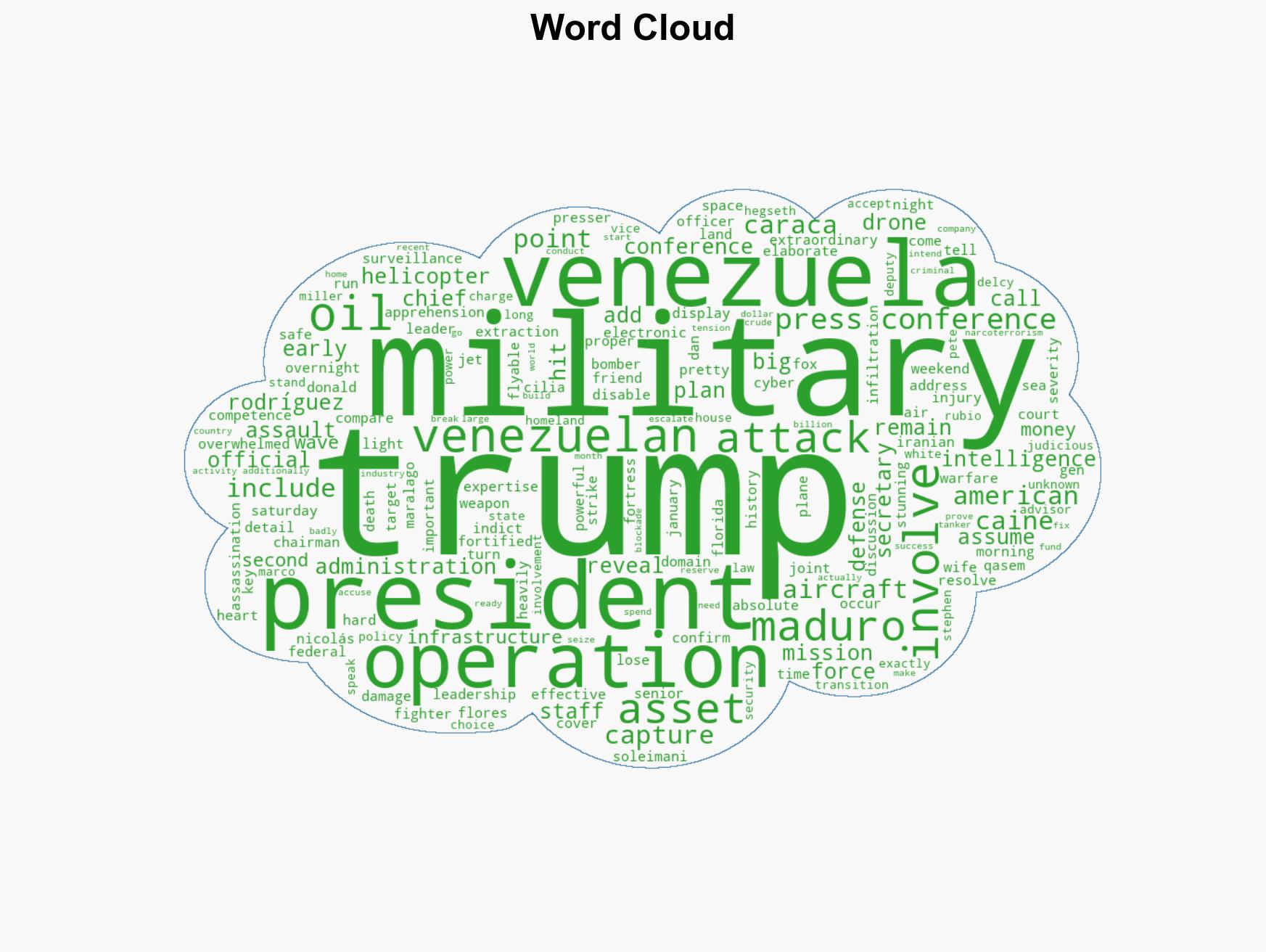
- Donald Trump, Nicolás Maduro, Cilia Flores, Gen. Dan Caine, Stephen Miller, Pete Hegseth, Marco Rubio
7. Thematic Tags
national security threats, military intervention, regime change, U.S.-Venezuela relations, regional stability, intelligence operations, geopolitical strategy, cyber threats
Structured Analytic Techniques Applied
- Cognitive Bias Stress Test: Expose and correct potential biases in assessments through red-teaming and structured challenge.
- Bayesian Scenario Modeling: Use probabilistic forecasting for conflict trajectories or escalation likelihood.
- Network Influence Mapping: Map relationships between state and non-state actors for impact estimation.
Explore more:
National Security Threats Briefs ·
Daily Summary ·
Support us