Trump Urged to Act Against Iran’s Theocratic Regime for the Liberation of Women and Girls
Published on: 2026-03-28
AI-powered OSINT brief from verified open sources. Automated NLP signal extraction with human verification. See our Methodology and Why WorldWideWatchers.
Intelligence Report: End the regime for the sake of Iranian women President Trump
1. BLUF (Bottom Line Up Front)
The Iranian regime’s systemic use of violence and repression against women and dissenters is a critical human rights issue. The most likely hypothesis is that external pressure, particularly from the U.S., could destabilize the regime, but this carries significant geopolitical risks. This assessment is made with moderate confidence due to information gaps and potential bias in reporting.
2. Competing Hypotheses
- Hypothesis A: The Iranian regime will be destabilized by continued U.S. pressure, leading to potential regime change. This is supported by the regime’s violent repression tactics and internal dissent. However, the lack of clear evidence on the regime’s internal cohesion and external support introduces uncertainty.
- Hypothesis B: The Iranian regime will withstand external pressures and maintain power through continued repression. This is supported by the regime’s historical resilience and control over security forces. Contradicting evidence includes increasing internal dissent and international condemnation.
- Assessment: Hypothesis A is currently better supported due to the increasing internal dissent and international pressure. Key indicators that could shift this judgment include changes in the regime’s internal cohesion or shifts in international diplomatic stances.
3. Key Assumptions and Red Flags
- Assumptions: The Iranian regime’s use of violence is unsustainable; U.S. pressure will continue; international community will support regime change efforts.
- Information Gaps: Detailed insights into the regime’s internal cohesion and the full extent of international support for regime change are lacking.
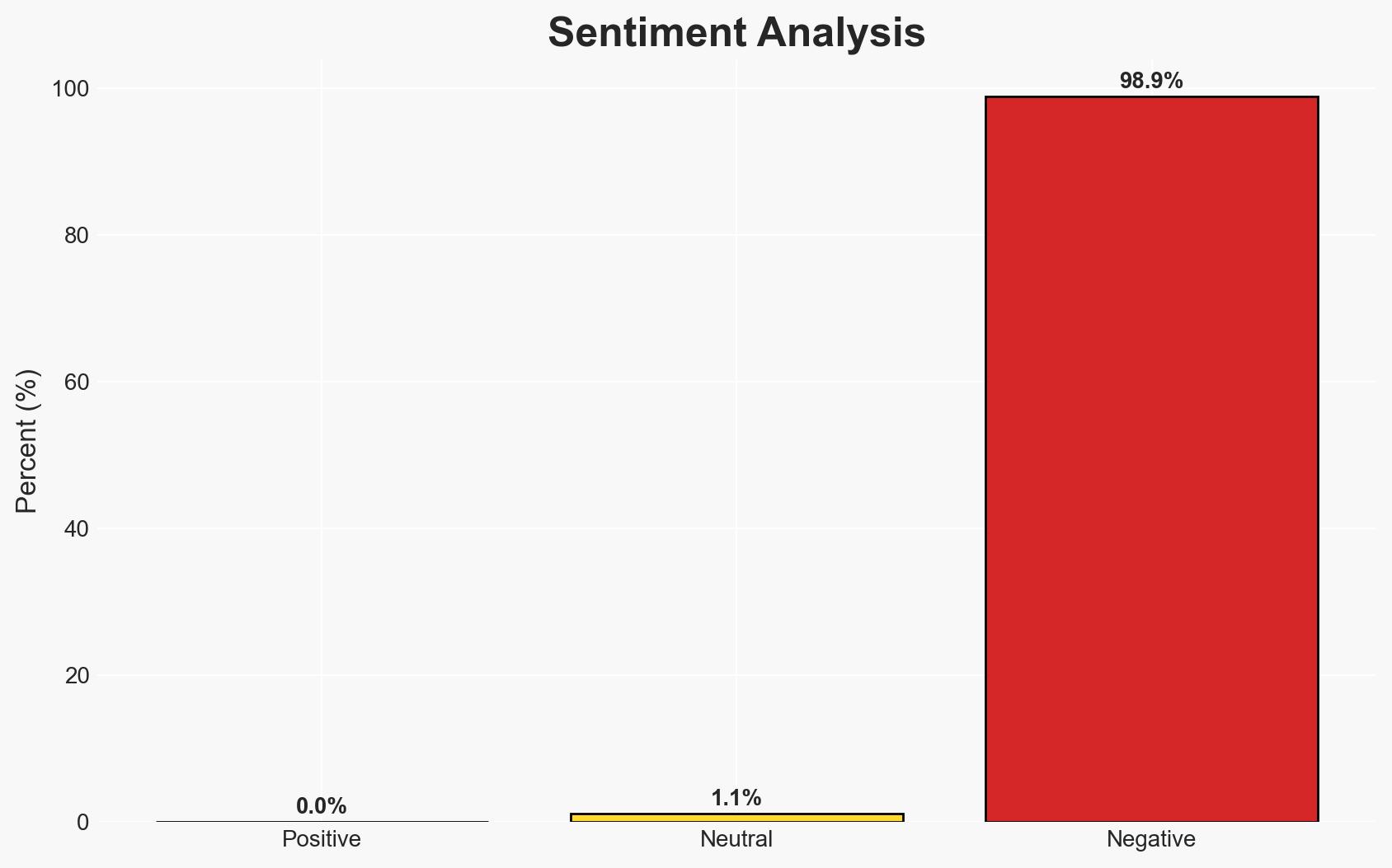
- Bias & Deception Risks: Potential bias in sources advocating for regime change; risk of manipulation in casualty figures and protest reports.
4. Implications and Strategic Risks
The situation in Iran could evolve into a broader regional conflict if external pressures lead to regime destabilization. This could impact global oil markets and regional alliances.
- Political / Geopolitical: Potential for increased tensions between Iran and Western countries, particularly the U.S.
- Security / Counter-Terrorism: Possible increase in terrorist activities by Iranian proxies or the IRGC in retaliation.
- Cyber / Information Space: Increased cyber operations by Iran targeting U.S. and allied infrastructure.
- Economic / Social: Potential for economic instability in the region, impacting global oil prices and social unrest within Iran.
5. Recommendations and Outlook
- Immediate Actions (0–30 days): Enhance intelligence gathering on Iranian internal dynamics; prepare for potential cyber retaliation.
- Medium-Term Posture (1–12 months): Strengthen alliances with regional partners; develop contingency plans for regional instability.
- Scenario Outlook:
- Best: Peaceful regime change with minimal violence, leading to democratic reforms.
- Worst: Escalation into regional conflict, significant loss of life, and economic disruption.
- Most-Likely: Continued internal unrest with periodic violent crackdowns by the regime.
6. Key Individuals and Entities
- President Donald Trump
- Supreme Leader Ayatollah Ali Khamenei
- Islamic Revolutionary Guard Corps (IRGC)
- Basij
- Ayatollah Ruhollah Khomeini (historical reference)
7. Thematic Tags
national security threats, Iranian regime, human rights, U.S. foreign policy, regime change, internal dissent, geopolitical risk, cyber threats
Structured Analytic Techniques Applied
- Cognitive Bias Stress Test: Expose and correct potential biases in assessments through red-teaming and structured challenge.
- Bayesian Scenario Modeling: Use probabilistic forecasting for conflict trajectories or escalation likelihood.
- Network Influence Mapping: Map relationships between state and non-state actors for impact estimation.
Explore more:
National Security Threats Briefs ·
Daily Summary ·
Support us